Microscopic Minimal Invasive Resection of Spinal Tumor with Tubular Retractor System: Case Studies of 70 Patients with Literature Review
- PMID: 40852071
- PMCID: PMC12370329
- DOI: 10.1055/s-0045-1806866
Microscopic Minimal Invasive Resection of Spinal Tumor with Tubular Retractor System: Case Studies of 70 Patients with Literature Review
Abstract
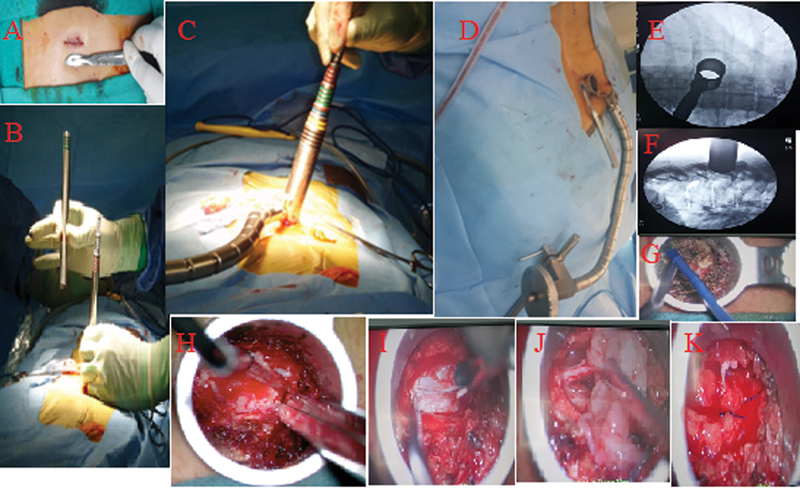
Objective: Minimal invasive spine surgery with tubular retractor system avoids contralateral laminectomy, minimizes manipulation of midline supportive structures, and reduces surgical morbidity. The objective of this study was to evaluate the safety and efficacy of microscopic minimal invasive tubular retractor system for intradural spinal tumor resection.
Materials and methods: A retrospective study was performed in 70 patients who were admitted between January 2017 and January 2024 with intradural spinal tumors and underwent excision with microscopic minimal invasive tubular retractor system. Patient's data including age, sex, clinical symptoms, and magnetic resonance imaging were collected. The extent of resection, surgical complications, estimated blood loss, estimated surgical time, and neurological outcomes were recorded. The neurological assessment was done by the modified McCormick grading scale pre- and postoperatively.
Results: Out of 70 patients, there were 38 (54.28%) males and 32 (45.71%) females, with a mean age of 45.16 (range: 8-79) years. The histology of these cases was meningioma (34.28%), schwannoma (51.42%), astrocytoma (2.85%), ependymoma (2.85%), and neurofibroma (8.57%). The average volume of tumors was 1.98 cm 3 , and gross total resection was achieved in 64 (91.53%) cases and subtotal resection was achieved in 6 (8.57%) cases. One patient had neurological deterioration, which was improved on follow-up after 6 months, and cerebrospinal fluid (CSF) leakage was noted in one case, which recovered after keeping lumbar drain for 5 days. No permanent neurological deficits were observed compared with their preoperative status, with improvement noted in visual analog scale and modified McCormick grade in all cases in the long-term follow-up evaluation (6-24 months).
Conclusion: Microscopic minimal invasive resection of intradural spinal tumor by the tubular retractor system is safe and effective with excellent neurological improvement as well as better resection rate, short hospital stay, and less surgical complication.
Keywords: excision; intradural spinal tumor; minimal invasive; outcome; tubular retractor.
Asian Congress of Neurological Surgeons. This is an open access article published by Thieme under the terms of the Creative Commons Attribution-NonDerivative-NonCommercial License, permitting copying and reproduction so long as the original work is given appropriate credit. Contents may not be used for commercial purposes, or adapted, remixed, transformed or built upon. ( https://creativecommons.org/licenses/by-nc-nd/4.0/ ).
Conflict of interest statement
Conflict of Interest None declared.
Figures

References
-
- Bresnahan L, Ogden A T, Natarajan R N, Fessler R G. A biomechanical evaluation of graded posterior element removal for treatment of lumbar stenosis: comparison of a minimally invasive approach with two standard laminectomy techniques. Spine. 2009;34(01):17–23. - PubMed
-
- Newton H B, Newton C L, Gatens C, Hebert R, Pack R. Spinal cord tumors: review of etiology, diagnosis, and multidisciplinary approach to treatment. Cancer Pract. 1995;3(04):207–218. - PubMed
-
- Traul D E, Shaffrey M E, Schiff D. Part I: spinal-cord neoplasms-intradural neoplasms. Lancet Oncol. 2007;8(01):35–45. - PubMed
LinkOut - more resources
Full Text Sources