. 2025 Aug 25;15(1):126.
doi: 10.1186/s13568-025-01940-3.

Treponema pallidum inhibits CD4+ T-cell proliferation through METAP2: insights from Mendelian randomization analysis

Affiliations

Treponema pallidum inhibits CD4+ T-cell proliferation through METAP2: insights from Mendelian randomization analysis

Zhaoping Liu et al. AMB Express. .

Abstract

Neurosyphilis (NS) is a chronic central nervous system infection caused by Treponema pallidum. Owing to its diverse clinical manifestations and the limited sensitivity of current diagnostic methods, NS is difficult to diagnose. Understanding the molecular mechanisms of NS and identifying reliable biomarkers are essential for improving diagnostic and therapeutic strategies. This study employed Mendelian randomization (MR) analysis to explore the causal relationships among protein ratio quantitative trait loci (rQTLs), cerebrospinal fluid (CSF) metabolites, and syphilis risk at various stages. The results revealed that several rQTLs, including CD46/TNFRSF14 and TBC1D23/TBC1D5, were closely associated with syphilis risk, whereas others, such as BANK1/HEXIM1 and GOPC/HEXIM1, exhibited protective effects. Mediation analysis further identified key CSF metabolites, such as N-acetyltaurine and bilirubin, as important mediators linking rQTLs and syphilis progression. Through integrated analysis of cis-proteins from rQTLs and transcriptomic data from CD4 + T-cells of NS patients, METAP2 was identified as a key biomarker in NS, with the potential mechanisms elucidated. Importantly, T. pallidum may inhibit CD4 + T-cell proliferation by modulating METAP2, thereby accelerating disease progression. These findings offer new insights into the pathogenesis of NS and highlight METAP2 as a potential biomarker, laying a foundation for improving diagnostic and therapeutic strategies.

Keywords: Treponema pallidum; CD4 + T-cells; Cerebrospinal fluid metabolites; METAP2; Mendelian randomization.


Conflict of interest statement

Declarations. Ethics approval and consent to participate: Not applicable. Consent for publication: Not applicable. Competing interests: The authors declare no competing interests.

Figures
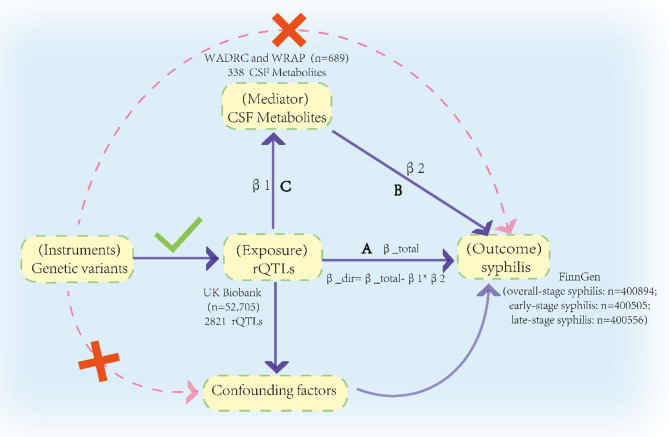
Fig. 1
Fig. 1
Assumptions and design of the mediation MR analyses. A The causal effects of rQTLs (exposure) on syphilis (outcome), with β_total indicating the total effect of rQTLs on syphilis. B The causal effect of CSF metabolites (mediators) on syphilis (outcome), with β2 representing the effect of CSF metabolites on syphilis. C Mediation analysis where CSF metabolites mediate the pathway from rQTLs (exposure) to syphilis (outcome). Here, β1 represents the effect of rQTLs (exposure) on CSF metabolites (mediators). The indirect effect (β_dir = β_total - β1*β2) reflects the impact of exposure on syphilis mediated by the corresponding metabolite
Fig. 2
Fig. 2
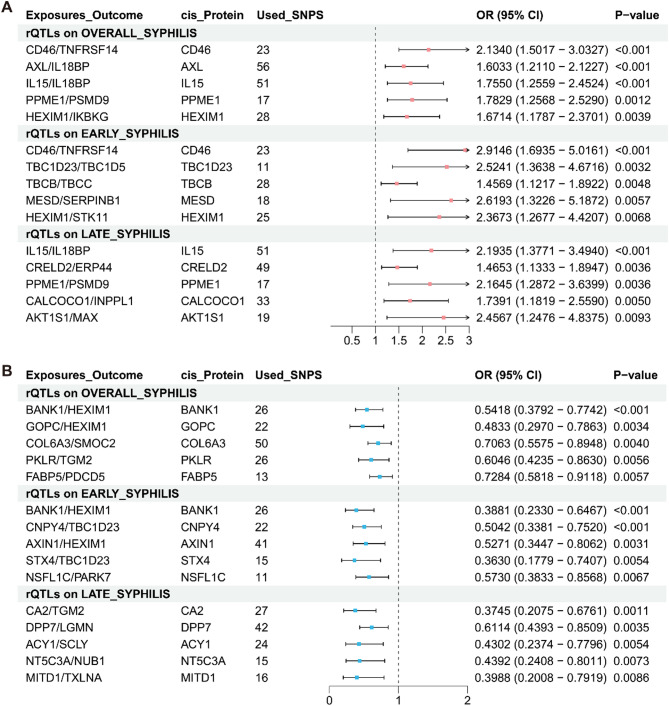
MR analysis reveals rQTLs linked to syphilis risk across different stages. A rQTLs positively associated with syphilis risk [odds ratio (OR) > 1]. B rQTLs negatively associated with syphilis risk (OR < 1). Red and green dots represent positive and negative syphilis risk, respectively, from the IVW analysis. Each panel displays the top five significant rQTLs with the lowest p values across overall-stage syphilis, early-stage syphilis, and late-stage syphilis. The OR and 95% confidence interval (CI) were used to quantify the association between each rQTLs and syphilis risk
Fig. 3
Fig. 3
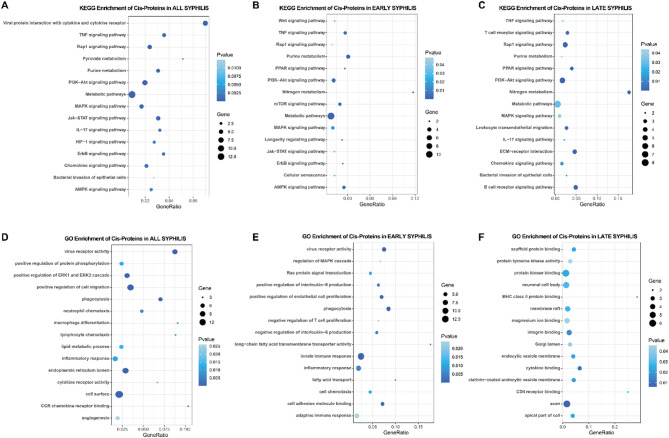
Functional pathways and biological roles of rQTL-associated cis-proteins in syphilis. A KEGG pathway analysis and D GO enrichment analysis of cis-proteins from rQTLs associated with overall-stage syphilis risk. B KEGG pathway analysis and E GO enrichment analysis of cis-proteins from rQTLs associated with early-stage syphilis risk. C KEGG pathway analysis and F GO enrichment analysis of cis-proteins from rQTLs associated with late-stage syphilis risk. The horizontal axis represents the proportion of candidate gene sets relative to background genes. The size of the dots indicates the number of cis-proteins involved in each pathway, and the color of the dots corresponds to different p value ranges
Fig. 4
Fig. 4
MR analysis identifies key CSF metabolites associated with syphilis risk. A CSF metabolites positively associated with syphilis risk (OR > 1). B CSF metabolites are negatively associated with syphilis risk (OR < 1). Red and green dots represent positive and negative syphilis risk, respectively, from the IVW analysis. Each panel displays the top five significant rQTLs with the lowest p values across overall-stage syphilis, early-stage syphilis, and late-stage syphilis. The OR and 95% CI were used to quantify the association between each rQTLs and syphilis risk
Fig. 5
Fig. 5
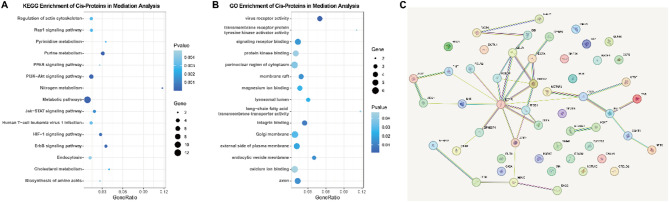
KEGG and GO enrichment analyses of cis-proteins from rQTLs in mediation analysis. A KEGG pathway analysis and B GO enrichment analysis of cis-proteins from rQTLs in mediation analysis. (C) PPI analysis of cis-proteins from rQTLs via mediation analysis. The horizontal axis represents the proportion of candidate gene sets to background genes, the size of the dots indicates the number of cis-proteins involved in each pathway, and the color of the dots corresponds to different p value ranges.
Fig. 6
Fig. 6
METAP2 as a potential key molecule in regulating CD4 + T-cells in NS. A Venn diagram showing the overlap between cis-proteins from rQTLs identified via mediation analysis and RNA-seq data from CD4 + T-cells of NS patients (GSE103599). B The relationships between DelncRNAs and DEmiRNAs identified in GSE103599 and GSE156421 were determined via the starBase v3.0 database. The interactions between DEmiRNAs and METAP2 were predicted via TargetScan, miRcode, and MiRanda. On the basis of the predicted interactions among lncRNAs, miRNAs, and mRNAs, a ceRNA regulatory network was constructed and visualized via Cytoscape 3.10.2. C qRT‒PCR analysis was used to detect changes in the mRNA expression levels of LINC00501, LINC00334, METAP2, and PDCD5 in Jurkat T-cells treated with LTP, DTP, or PBS for 24 h. D Western blotting was performed to assess changes in the protein expression levels of METAP2 and PDCD5 in Jurkat T-cells treated with LTP, DTP, or PBS for 24 h. *p < 0.05; **p < 0.01; ***p < 0.001; ns, not significant
Fig. 7
Fig. 7
T. pallidum inhibits CD4 + T-cell proliferation through METAP2. A-D qRT-PCR and Western blotting were used to measure METAP2 mRNA and protein expression levels in Jurkat T-cells 48 h after METAP2 knockdown or overexpression to assess the transfection efficacy. E, F Flow cytometry was used to assess Ki67 levels to evaluate the impact of METAP2 gene knockdown or overexpression on Jurkat T-cell proliferation. G Flow cytometry was used to determine Ki67 levels to assess the effects of METAP2 overexpression and T. pallidum treatment on Jurkat T-cell proliferation. **p < 0.01; ***p < 0.001; ns, not significant

References

    1. Ai C, Kong L (2018) CGPS: a machine learning-based approach integrating multiple gene set analysis tools for better prioritization of biologically relevant pathways. J Genet genom = Yi Chuan Xue Bao 45:489–504. 10.1016/j.jgg.2018.08.002 - PubMed
    1. Bartleson JM, Viehmann Milam AA, Donermeyer DL, Horvath S, Xia Y, Egawa T, Allen PM (2020) Strength of tonic T cell receptor signaling instructs T follicular helper cell-fate decisions. Nat Immunol 21:1384–1396. 10.1038/s41590-020-0781-7 - PMC - PubMed
    1. Birney E (2022) Mendelian randomization. Cold Spring Harbor Perspect Med 12. 10.1101/cshperspect.a041302 - PMC - PubMed
    1. Datta R, Choudhury P, Bhattacharya M, Soto Leon F, Zhou Y, Datta B (2001) Protection of translation initiation factor eIF2 phosphorylation correlates with eIF2-associated glycoprotein p67 levels and requires the lysine-rich domain I of p67. Biochimie 83:919–931. 10.1016/s0300-9084(01)01344-x - PubMed
    1. FinnGen (2024) Documentation of R10 release. https://finngen.gitbook.io/documentation/v/r10/

LinkOut - more resources