


The impacts of indoor residual spraying with bendiocarb and pirimiphos-methyl on allelic frequencies of kdr and ace-1 mutations in central Senegal
- PMID: 40855152
- PMCID: PMC12378222
- DOI: 10.1038/s41598-025-12052-0
The impacts of indoor residual spraying with bendiocarb and pirimiphos-methyl on allelic frequencies of kdr and ace-1 mutations in central Senegal
Abstract
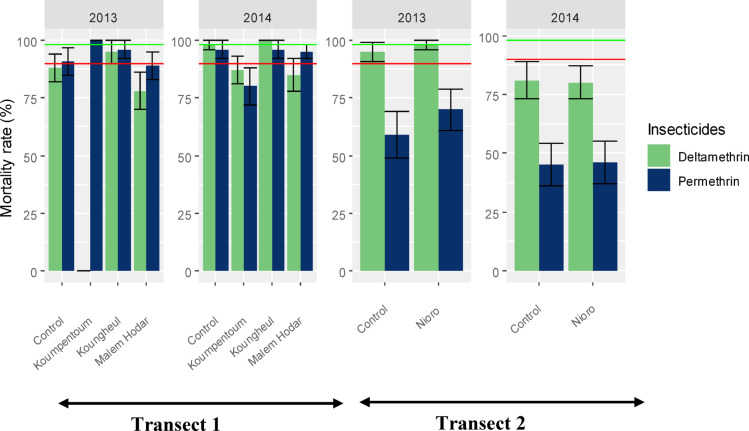
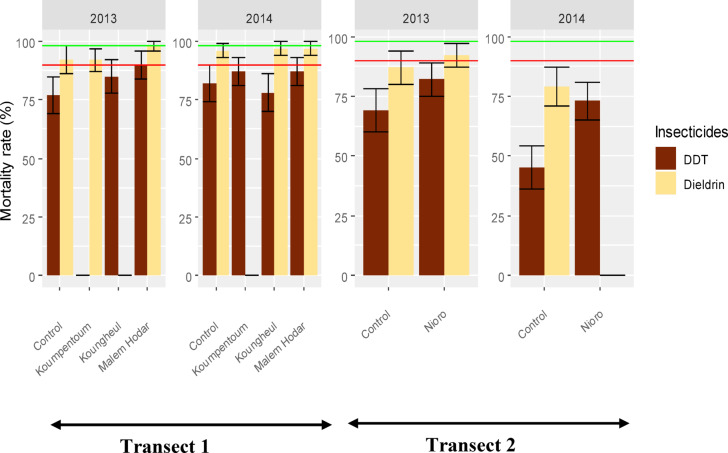
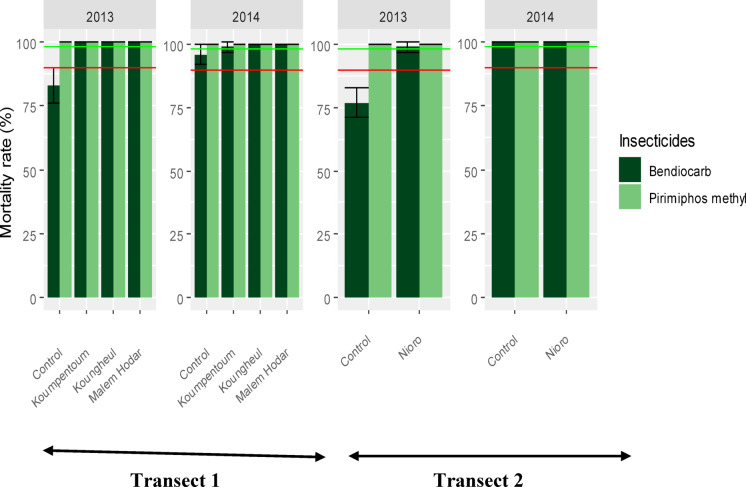
The use of long-lasting insecticidal nets (LLINs) and indoor residual spraying (IRS) has been the primary vector control strategy in Sénégal since 2007, significantly reducing the malaria burden. However, the emergence insecticide resistance in malaria vectors threatens the effectiveness of these interventions. This study aimed to assess susceptibility, spatiotemporal variations, and the impact of IRS with bendiocarb and pirimiphos-methyl on allele frequencies and resistant genotypes of kdr and ace-1 in An. gambae s.l. in IRS and control zones in central Sénégal between 2013 and 2014. Larvae of An. gambiae s.l. were collected from four IRS and two control districts in central Sénégal. Emerging adult females were exposed to insecticide-impregnated papers containing pyrethroids, DDT, dieldrin, bendiocarb and pirimiphos-methyl over two years. Species identification and resistance markers analysis were performed using PCR, targeting kdr mutations (Vsgc-1014F and Vsgc-1014S) and ace-1 mutations. Susceptibility test revealed resistance to permethrin and deltamethrin in at least three of the four IRS districts, while control districts showed resistance or suspected resistance to these insecticides. Resistance to DDT and dieldrin was detected in all districts. However, An. gambiae s.l. populations from IRS districts remained susceptible to bendiocarb and pirimiphos-methyl. Molecular identification confirmed the presence of three species (An. arabiensis, An. gambiae s.s. and An. coluzzii) along with hybrids. An. arabiensis populations collected in IRS areas showed a significantly lower frequency of the 1014F allele than those in control areas.
Keywords: An. gambiae s.l.; Kdr; ace-1; Bendiocarb; Control; Genotypes; IRS; Malaria; Pyrethroids; Resistance; Sénégal.
© 2025. The Author(s).
Conflict of interest statement
Declarations. Competing interests: The authors declare no competing interests.
Figures

References
-
- WHO. World Malaria Report. Geneva. World Health Organization. (2016).
-
- WHO. Conditions for deployment of mosquito nets treated with a pyrethroid and piperonyl butoxide. Geneva: World Health Organization. (2017).
-
- Keïta, M. et al. Susceptibilité d’Anopheles gambiae sensu lato aux insecticides communément utilisés dans la lutte antivectorielle au Mali. Bull Soc Pathol Exotic.109, 39–45 (2016). - PubMed
-
- Keita, K. et al. Species identification and resistance status of Anopheles gambiae s.l. (Diptera: Culicidae) mosquitoes in Guinea. J. Med. Entomol.54, 677–681 (2017). - PubMed
MeSH terms
Substances
LinkOut - more resources
Full Text Sources
Miscellaneous
