


Optimizing brain stroke detection with a weighted voting ensemble machine learning model
- PMID: 40855246
- PMCID: PMC12378966
- DOI: 10.1038/s41598-025-14358-5
Optimizing brain stroke detection with a weighted voting ensemble machine learning model
Abstract
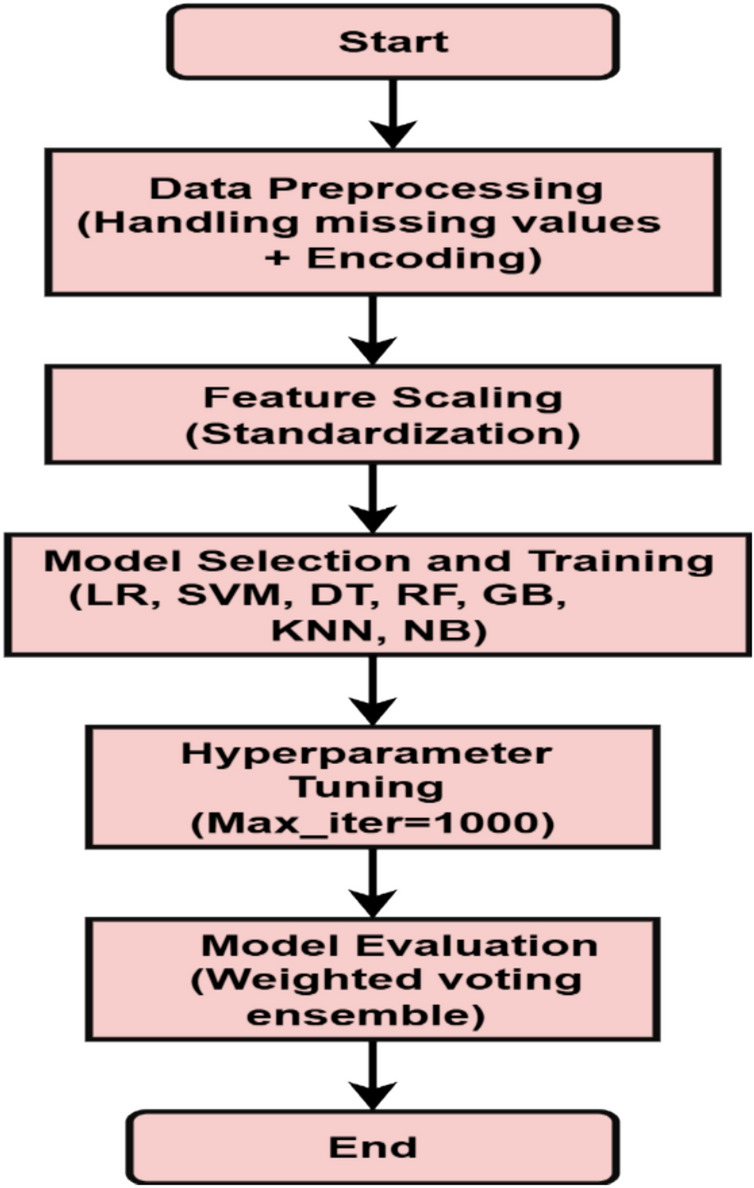
Brain stroke is a medical trauma that occurs when there is an impairment or decrease in blood circulation to a particular part of the brain, causing adjacent brain cells to die. Stroke diagnosis after an event is an ineffective method; other more labour-intensive and costly procedures exist for stroke diagnosis. This method involves directing a machine learning algorithm to a marked dataset to identify samples and irregularities indicative of stroke occurrence. This study focused on developing an ensemble machine learning model to predict brain stroke. The model combined the predictions of multiple individualistic classifiers, including random forest, eXtreme gradient boosting, and histogram-based gradient boosting, to improve accuracy. The proposed weighted voting-based ensemble (WVE) classifier model achieved an accuracy of 92.31% on a private stroke prediction dataset. The pre-assessment of stroke risk diagnosis, as suggested in this study, enables many people to take preventive actions well in advance, thereby lowering fatal effects. Our proposed method presents a feasible option for the early or initial diagnosis of stroke, as traditional methods, such as computed tomography (CT) scans and magnetic resonance imaging (MRIs), are time-consuming and costly. Future research could explore the use of intelligence-based optimization to enhance classification accuracy and address this limitation.
Keywords: Brain stroke detection; EXtreme gradient boosting (XGBoost); Histogram-based gradient boosting (HGB); Machine learning (ML); Random forest (RF); Weighted voting.
© 2025. The Author(s).
Conflict of interest statement
Declarations. Competing interests: The authors declare no competing interests. Ethics: A statement to confirm that all the methods and experiments conducted were purely computational and did not involve any human subjects directly. The names and personal details of the patients were highly confidential. All methods were carried out in accordance with relevant guidelines and regulations. All experimental protocols were approved by the KC Multi specialty Hospital in Chennai, India. Consent for publication: We confirm that informed consent was obtained from all subjects and/or their legal guardian(s).
Figures




References
-
- Polat, Ö., Dokur, Z. & Ölmez, T. Classification of brain strokes using divergence-based convolutional neural networks. Biomed. Signal Process. Control93, 106193. 10.1016/j.bspc.2024.106193 (2024). - DOI
-
- Goni, M. R., Ruhaiyem, N. I. R., Mustapha, M., Achuthan, A. & Che Mohd Nassir, C. M. N. Brain vessel segmentation using deep learning—a review. IEEE Access10, 111322–111336. 10.1109/access.2022.3214987 (2022). - DOI
MeSH terms
LinkOut - more resources
Full Text Sources
Medical
