Tirzepatide leads to weight reduction in people with obesity due to MC4R deficiency
- PMID: 40858971
- PMCID: PMC12532586
- DOI: 10.1038/s41591-025-03913-2
Tirzepatide leads to weight reduction in people with obesity due to MC4R deficiency
Abstract
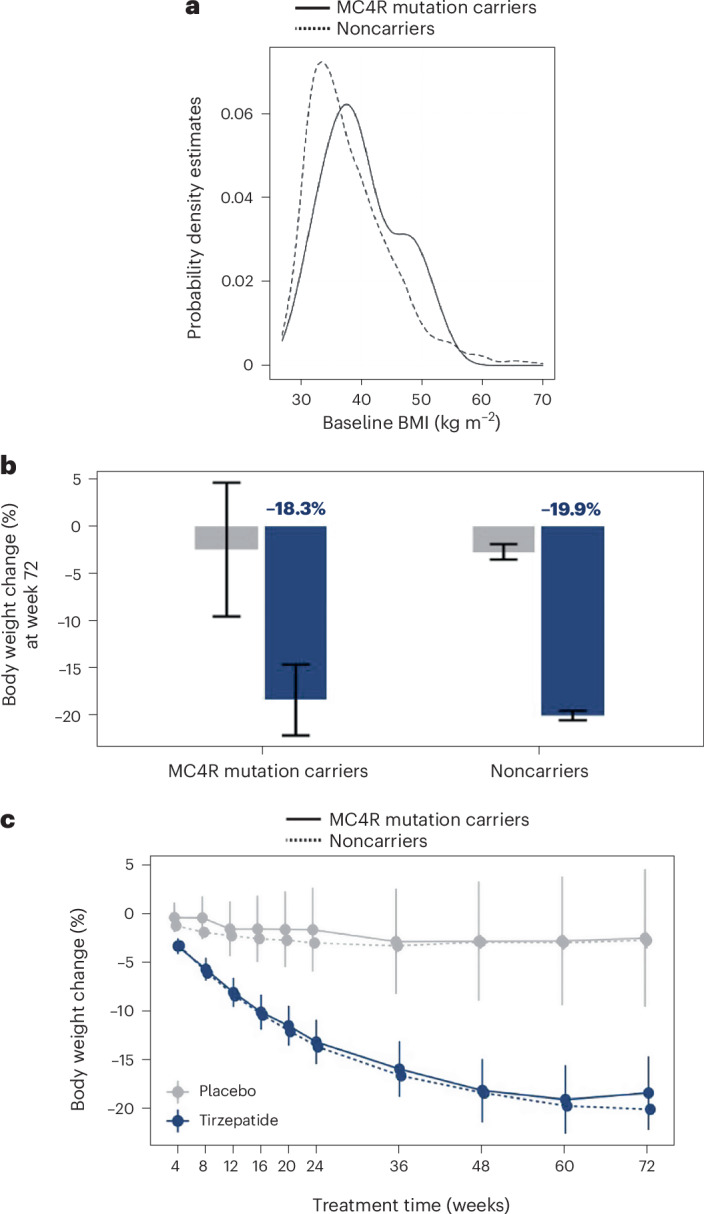
The magnitude of weight reduction in the SURMOUNT-1 trial of the dual GLP-1 and GIP receptor agonist tirzepatide suggests that this treatment may be particularly effective in addressing the treatment needs of people with severe obesity (body mass index >40 kg m-2), some of whom may carry rare penetrant genetic variants. Here we investigated the clinical response of men and women in the SURMOUNT-1 trial who carried pathogenic mutations in the melanocortin 4 receptor (MC4R) gene, the most common genetic cause of obesity. We found that 32 of 2,291 people (1.4%) for whom data were available carried pathogenic MC4R mutations. At baseline, MC4R mutation carriers exhibited a higher body mass index compared with noncarriers (40 kg m-2 versus 38 kg m-2; P = 0.036). In the treatment arm, the weight loss trajectory over 72 weeks was comparable in both groups: 18.3% weight reduction in MC4R mutation carriers versus 19.9% in noncarriers. We conclude that tirzepatide is an effective treatment for the most common genetic subtype of obesity, MC4R deficiency.
© 2025. The Author(s).
Conflict of interest statement
Competing interests: I.S.F. has consulted for Eli Lilly, Novo Nordisk, Sanofi, Nodthera Therapeutics and Rhythm Pharmaceuticals on anti-obesity medications. L.M.K. is a scientific and/or medical consultant to Altimmune, Amgen, Boehringer Ingelheim, Cytoki, Gilead, Johnson & Johnson, Kallyope, Eli Lilly and Company, Novo Nordisk, Optum, Perspectum, Pfizer, Xeno Biosciences and Zealand. N.N.A., M.C., X.L. and P.B. are employees and shareholders of Eli Lilly and Company.
Figures