


The causal effects of remnant cholesterol on increased risk of cardiovascular diseases in East Asians
- PMID: 40859268
- PMCID: PMC12382207
- DOI: 10.1186/s12916-025-04329-y
The causal effects of remnant cholesterol on increased risk of cardiovascular diseases in East Asians
Abstract
Background: Remnant cholesterol (RC) has been implicated in cardiovascular diseases (CVDs) in populations of European ancestry, yet its causal role remains underexplored in populations of East Asian ancestry, which are underrepresented in genetic studies. We sought to investigate the causal association between circulating RC levels and CVD risk in East Asian populations.
Methods: We first conducted observational analyses of RC and multiple CVD outcomes in Chinese populations. We then conducted genome-wide association studies (GWAS) of RC in 14,939 Chinese individuals and assessed its causal associations with CVD risk using two-sample Mendelian randomization (MR) with Biobank Japan data. Replication analyses in European ancestry populations utilized summary statistics from the UK Biobank and FinnGen.
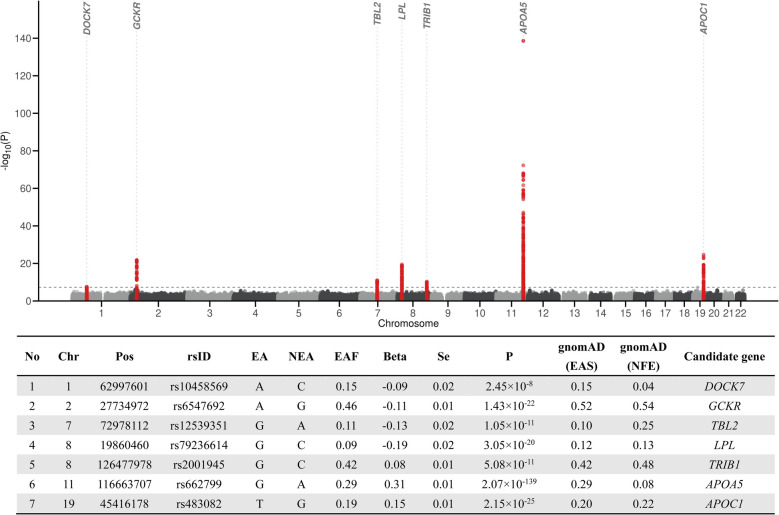
Results: Circulating RC levels were significantly associated with multiple CVD outcomes in Chinese individuals. Our GWAS identified seven significant loci associated with circulating RC levels in the Chinese population. In the MR analyses, we found that genetically predicted higher RC levels were significantly associated with increased risks of aortic aneurysm (odds ratio per standard deviation increase, 1.82; 95% CI, 1.53-2.17; P = 1.17 × 10⁻¹¹) and ischemic heart diseases, such as myocardial infarction (1.22, 1.13-1.32; P = 1.81 × 10⁻⁷) and stable angina pectoris (1.17, 1.11-1.23; P = 1.18 × 10⁻⁸). Notably, these associations persisted after adjustment for total cholesterol, low-density and high-density lipoprotein cholesterols, Apolipoprotein A1 and Apolipoprotein B, respectively. Replication in European ancestry populations confirmed consistent causal effects for aortic aneurysm and ischemic heart diseases. A suggestive East Asian-specific association was identified between genetically predicted higher RC levels and an increased risk of peripheral artery disease, whereas a suggestive association with a higher risk of atrial flutter/fibrillation and ventricular arrhythmia was only observed in populations of European ancestry.
Conclusions: Our findings establish RC as an independent causal CVD risk factor in East Asian ancestry individuals and highlight population-specific differences in CVD risk profiles, emphasizing the need for ethnicity-tailored prevention strategies.
Keywords: Cardiovascular diseases; Genome-wide association study; Mendelian randomization; Remnant cholesterol.
© 2025. The Author(s).
Conflict of interest statement
Declarations. Ethics approval and consent to participate: The National Survey of Physical Traits is the subproject of the National Science & Technology Basic Research Project which was approved by the Ethics Committee of Human Genetic Resources of the School of Life Sciences, Fudan University (14117). The Shanghai Changfeng study was approved by the Ethical Committee of Zhongshan Hospital, Fudan University (2013–132). The Rugao Longevity and Aging study was approved by the Human Ethics Committee of the School of Life Sciences, Fudan University (BE1815). The GRAND study was approved by the central Ethics Committee at Zhongshan Hospital, Fudan University (B2017-051). All participants or their legal representatives provided informed consent before joining the study. Consent for publication: All authors have consent for publication. Competing interests: The authors declare no competing interests.
Figures



References
-
- Ference BA, Braunwald E, Catapano AL. The LDL cumulative exposure hypothesis: evidence and practical applications. Nat Rev Cardiol. 2024;21(10):701–16. - PubMed
-
- Ference BA, Ginsberg HN, Graham I, Ray KK, Packard CJ, Bruckert E, Hegele RA, Krauss RM, Raal FJ, Schunkert H, et al. Low-density lipoproteins cause atherosclerotic cardiovascular disease. 1. Evidence from genetic, epidemiologic, and clinical studies. A consensus statement from the European Atherosclerosis Society Consensus Panel. Eur Heart J. 2017;38(32):2459–72. - PMC - PubMed
-
- Barter PJ, Caulfield M, Eriksson M, Grundy SM, Kastelein JJ, Komajda M, Lopez-Sendon J, Mosca L, Tardif JC, Waters DD, et al. Effects of torcetrapib in patients at high risk for coronary events. N Engl J Med. 2007;357(21):2109–22. - PubMed
-
- Lincoff AM, Nicholls SJ, Riesmeyer JS, Barter PJ, Brewer HB, Fox KAA, Gibson CM, Granger C, Menon V, Montalescot G, et al. Evacetrapib and cardiovascular outcomes in high-risk vascular disease. N Engl J Med. 2017;376(20):1933–42. - PubMed
Publication types
MeSH terms
Substances
Grants and funding
- 2022YFC3400700/National Key Research and Development Program of China
- 2023SHZDZX02/Shanghai Municipal Science and Technology Major Project
- 2022JC012/Grant of Shanghai Municipal Health Commission
- 22XD1423300/Program of Shanghai Academic Research Leader
- QNZH2024009/Shanghai Oriental Youth Elite Talents Program
LinkOut - more resources
Full Text Sources
Medical
