


Using operational research as a tool to improve eye health services and systems in low-and middle-income settings: lessons from India and Nepal
- PMID: 40859281
- PMCID: PMC12379328
- DOI: 10.1186/s12909-025-07803-6
Using operational research as a tool to improve eye health services and systems in low-and middle-income settings: lessons from India and Nepal
Abstract
Background: Operational Research (OR), as part of a quality assurance program, has become a standard feature of most health institutions in most high-income countries. In contrast, in low-income settings, operational research is less common, and almost no one has asssed operational research capacity building (ORCB) as a tool to improve efficacy, efficiency and quality in these settings. This study evaluated the impact of an ORCB program on participants' research competencies and the extent to which research findings were implemented in practice.
Materials and methods: This study combined quantitative and qualitative data to evaluate an ORCB intervention in eye hospitals in Nepal (3 sites) and northern India (1 site) from 2019 to 2022. A self-reported questionnaire was administered at the end of the study period, and formal interviews were conducted. The questionnaire covered knowledge improvement, practice implementation, and motivating and challenging factors. Statistical analysis included paired t-tests to compare pre- and post-training scores. Qualitative data were gathered through interviews and observations and analysed thematically.
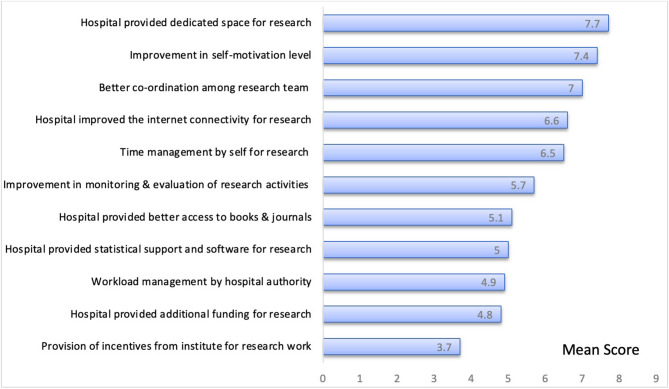
Results: The program demonstrated significant improvements in participants' research knowledge gain. Quantitative analysis revealed substantial gains in knowledge (p-values < 0.05 for all domains). Post-training, 66.7% developed study protocols, and 60% trained other staff or students. Qualitative feedback indicated overall positive impacts, including enhanced research and operational activities. However, reported challenges such as inconsistent mentorship quality, poor internet connectivity during online sessions, and difficulty in balancing clinical work with research. Despite these challenges, there was notable improvement in research practice and internal training within hospitals, and the program's approach was appreciated for its effectiveness.
Conclusion: The study highlights the need for standardized training modules, consistent mentorship, and stronger institutional support. Building operational research capacity in resource-poor settings with limited administrative staff and weak data infrastructure improves individual staff knowledge and skills. Participants learned about scientific principles of reliability and validity and their importance to efforts to improve service equity, efficiency, and effectiveness.
Keywords: Capacity building; Eye care; Low-and Middle-Income countries; Mentorship; Operational research.
© 2025. The Author(s).
Conflict of interest statement
Declarations. Ethics approval and consent to participate: The study was granted a waiver of ethical approval and consent to participate by the Institutional Ethics Committee (IEC) of the Indian Institute of Public Health – Hyderabad (IIPH-H), a constituent body of the Public Health Foundation of India (PHFI). It involved program evaluation using fully anonymized, de-identified data, and posed minimal to no risk to participants. No personal or sensitive information was collected, ensuring participant confidentiality. Participation in the program evaluation was voluntary. Self-reported questionnaires and interviews were conducted with the verbal agreement of participants and approval from the respective hospital administrations. The activities were part of a training and capacity-building program and did not involve any interventions or procedures that could harm participants. Consent for publication: Not Applicable. Competing interests: The authors declare no competing interests.
Figures
References
-
- Zachariah R, Harries AD, Ishikawa N, Rieder HL, Bissell K, Laserson K, et al. Operational research in low-income countries: what, why, and how? Lancet Infect Dis. 2009;9:711–7. - PubMed
-
- Zachariah R, Ford N, Maher D, Bissell K, Van den Bergh R, van den Boogaard W, et al. Is operational research delivering the goods? The journey to success in low-income countries. Lancet Infect Dis. 2012;12:415–21. - PubMed
Publication types
MeSH terms
LinkOut - more resources
Full Text Sources
