


Carrion Increases Landscape-Scale Scavenger Activity and Interactions
- PMID: 40860229
- PMCID: PMC12374251
- DOI: 10.1002/ece3.72059
Carrion Increases Landscape-Scale Scavenger Activity and Interactions
Abstract
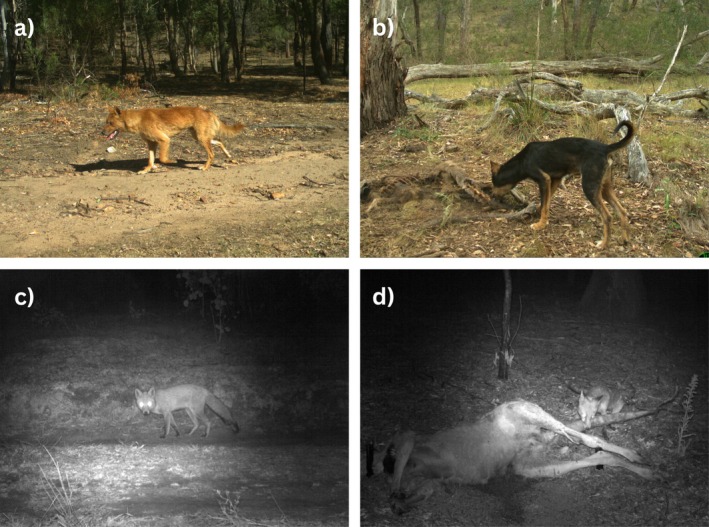
Carrion is a nutrient-rich but spatiotemporally unpredictable resource that supports diverse trophic interactions, and its consumption plays a key role in energy recycling within ecosystems. Although previous research has almost exclusively examined scavenger activity at carcasses, the broader impacts of fluctuating carrion availability on landscape-scale activity patterns and scavenger competitive interactions remain largely unexplored. Here, we investigate whether carrion provisioning influences broader road use activity in two competing facultative scavenger species: dingoes (Canis dingo), an apex scavenger, and red foxes (Vulpes vulpes), a mesoscavenger. Using camera traps, we monitored the activity of the two focal species on roads before and after the placement of 20 experimentally deployed eastern grey kangaroo (Macropus giganteus) carcasses in the surrounding landscape. Carcasses-also monitored using camera traps-were positioned at least 1 km apart at similar distances from roads across open forest and grassland habitats, in summer and winter in southeast Australia. Both dingoes and red foxes exhibited increased road use following carcass deployment, with red fox responses varying seasonally-showing a greater increase in road use during winter months. Overlap in activity times between the focal species on roads also increased post-carcass deployment-especially during the winter month; however, peak activity times remained slightly offset. The focal species temporal overlap at carcasses was also greater in the winter season. Our study provides novel insights into the ecological significance of carrion beyond local carcass sites, highlighting its potential role in influencing broader scavenger activity patterns. We also reveal that peak road use may serve as a reliable proxy for peak scavenging times in systems where carcasses are available near roads, given the overlap in diel activity patterns of both dingoes and red foxes on roads and at carcasses. These findings emphasize the need for further research to examine how carrion availability shapes scavenger dynamics at landscape scales.
Keywords: carrion availability; competitive interactions; road ecology; scavenger activity; temporal partitioning.
© 2025 The Author(s). Ecology and Evolution published by British Ecological Society and John Wiley & Sons Ltd.
Conflict of interest statement
The authors declare no conflicts of interest.
Figures



References
-
- Ahumada, J. , Fegraus E., Birch T., et al. 2019. “Wildlife Insights: A Platform to Maximize the Potential of Camera Trap and Other Passive Sensor Wildlife Data for the Planet.” Environmental Conservation 47: 1–6. 10.1017/S0376892919000298. - DOI
-
- Barton, P. S. , Cunningham S. A., Lindenmayer D. B., and Manning A. D.. 2013. “The Role of Carrion in Maintaining Biodiversity and Ecological Processes in Terrestrial Ecosystems.” Oecologia 171: 761–772. - PubMed
-
- Baruzzi, C. , Barton B. T., Cove M. V., and Lashley M. A.. 2022. “Mass Mortality Events and Declining Obligate Scavengers in the Anthropocene: Social Feeders May Be Critical.” Biological Conservation 269: 109527. 10.1016/j.biocon.2022.109527. - DOI
-
- Bragato, P. J. , Spencer E. E., Dickman C. R., Crowther M. S., Tulloch A., and Newsome T. M.. 2022. “Effects of Habitat, Season and Flood on Corvid Scavenging Dynamics in Central Australia.” Austral Ecology 47, no. 5: 939–953. 10.1111/aec.13177. - DOI
-
- Brooks, M. E. , Kristensen K., Van Benthem K. J., et al. 2017. “glmmTMB Balances Speed and Flexibility Among Packages for Zero‐Inflated Generalized Linear Mixed Modeling.” R Journal 9: 378–400.
LinkOut - more resources
Full Text Sources
Miscellaneous
