


Chemical tuning of quantum spin-electric coupling in molecular magnets
- PMID: 40866610
- PMCID: PMC12669029
- DOI: 10.1038/s41557-025-01926-5
Chemical tuning of quantum spin-electric coupling in molecular magnets
Abstract
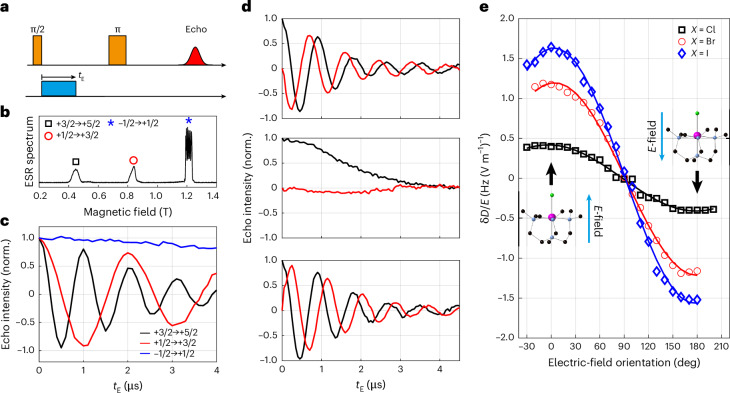
Controlling quantum spins using electric rather than magnetic fields promises substantial architectural advantages for developing quantum technologies. In this context, spins in molecular magnets offer tunability of spin-electric couplings (SECs) by rational chemical design. Here we demonstrate systematic control of SECs in a family of Mn(II)-containing molecules by varying the coordination environment of the spin centre. The trigonal bipyramidal (tbp) molecular structure with C3 symmetry leads to a substantial molecular electric dipole moment that is directly connected to its magnetic anisotropy. The interplay between these two features gives rise to experimentally observed SECs, which can be rationalized by wavefunction theoretical calculations. Our findings guide strategies for the development of electrically controllable molecular spin qubits for quantum technologies.
© 2025. The Author(s).
Conflict of interest statement
Competing interests: The authors declare no competing interests.
Figures


References
-
- Kane, B. E. A silicon-based nuclear spin quantum computer. Nature393, 133–137 (1998).
-
- Manipatruni, S. et al. Scalable energy-efficient magnetoelectric spin–orbit logic. Nature565, 35–42 (2019). - PubMed
-
- Long, J. et al. Room temperature magnetoelectric coupling in a molecular ferroelectric ytterbium(III) complex. Science367, 671–676 (2020). - PubMed
-
- Ramesh, R. & Manipatruni, S. Electric field control of magnetism. Proc. R. Soc. A Math. Phys. Eng. Sci.477, 20200942 (2021).
-
- Yang, Y., Hong, L., Bellaiche, L. & Xiang, H. Toward ultimate memory with single-molecule multiferroics. J. Am. Chem. Soc.145, 25357–25364 (2023). - PubMed
Grants and funding
- URF\R1\201132/Royal Society
- 862893/EC | Horizon 2020 Framework Programme (EU Framework Programme for Research and Innovation H2020)
- 863098/EC | Horizon 2020 Framework Programme (EU Framework Programme for Research and Innovation H2020)
- ANR-20-CE29-0010/Agence Nationale de la Recherche (French National Research Agency)
LinkOut - more resources
Full Text Sources
Miscellaneous
