


Genetic diversity assessment of bael (Aegle marmelos) varieties using morphometric, yield, and quality traits under semi-arid conditions
- PMID: 40866800
- PMCID: PMC12382197
- DOI: 10.1186/s12870-025-06985-x
Genetic diversity assessment of bael (Aegle marmelos) varieties using morphometric, yield, and quality traits under semi-arid conditions
Abstract
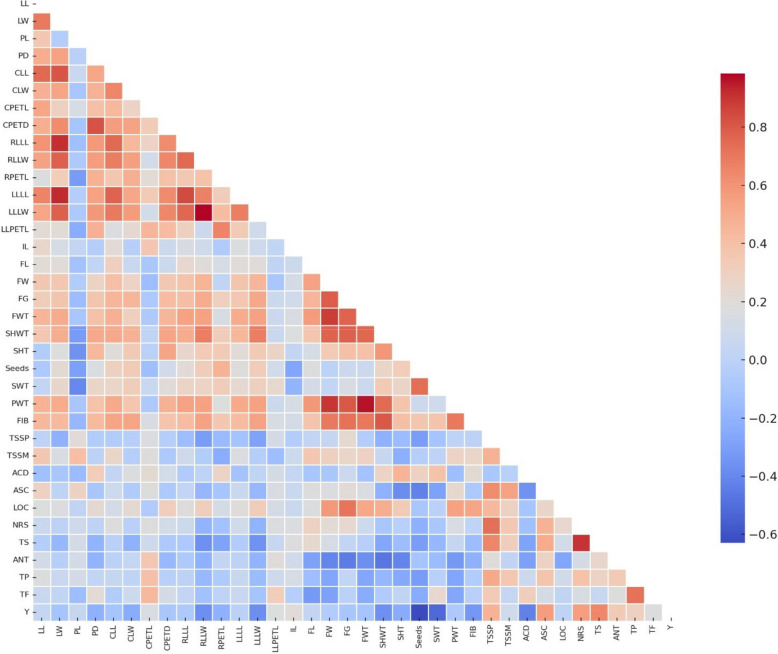
Bael (Aegle marmelos (L.) Correa) is a magnificent but underrated fruit species with medicinal and religious value. This study used 36 morphological, yield, and fruit quality variables to investigate the genetic diversity of 21 bael cultivars in rainfed, hot, semi-arid climates, including a local genotype and a national check (NB-5). Important characteristics such fruit color, shape, size, locule arrangement, thorn, seed, and fiber quality were found to exhibit morphometric variability. Principal component analysis (PCA) revealed that the first eight components described 87.50% of the overall variation, with the first component alone explaining 32.42%. Fruit weight and pulp weight were strongly and positively correlated with total and non-reducing sugars (r = + 1.0). Hierarchical clustering grouped the cultivars into three distinct clusters, Cluster I (varieties 1, 3, 5, 6, 7, and 9) exhibited higher means for fruit width, girth, weight, shell weight, and shell thickness, making them suitable candidates for yield-based selection. Cluster III cultivars demonstrated superior qualitative traits, including elevated levels of ascorbic acid, non-reducing sugar, total sugar, antioxidants, total phenolics, total flavonoids, and total soluble solids. These results are useful for selecting and breeding bael varieties with improved quality and production traits, as well as creating functional foods and nutraceuticals made from bael because of its therapeutic qualities. Future studies may concentrate on using the best cultivars found to extract and market bioactive substances that may have therapeutic uses. Lastly, the great genetic diversity of bael cultivars highlights their potential for both economic exploitation and genetic improvement, especially in dry and semi-arid environments.
Keywords: Aegle marmelos; Genetic diversity; Morphology; Phytochemical traits; Principal component analysis.
© 2025. The Author(s).
Conflict of interest statement
Declarations. Ethics approval and consent to participate: Not applicable. Consent for publication: Not applicable. Competing interest: The authors declare no competing interests.
Figures




References
-
- Amulya RN, Adivappar N, Shivakumar BS, Satish KM. Studies on genetic variability and relationship of bael (Aegle marmelos (L) Correa) using morphological and molecular markers. J Hortic Sci. 2022;17:88–94. 10.24154/jhs.v17i1.846.
-
- Andleeb R, Ijaz MU, Rafique A, Ashraf A, Bano N, Zafar N, Tasleem F, Marc RA, Pop OL, Ahmedah HT. Biological activities of Methanolic extract of Aegle marmelos against HN protein of Newcastle Disease Virus. Agronomy. 2021;11:1784.
-
- Apak R, Guclu K, Ozyurek M, Celik SE. Mechanismof antioxidant capacity assays and the CUPRAC (cupric ion reducing antioxidant capacity)assay. Microchim Acta. 2008;160:413-19.
-
- Bhatnagar P, Meena CB. Genetic Diversity of wild landraces of bael for rootstock purpose in South Eastern Rajasthan. Hort Flora Res Spectr. 2018;7(1):47–51.
-
- Burton, G. W. (1952). Quantitative inheritance in grasses. Proceedings of the 6th International Grassland Congress, 1, 277–283.
MeSH terms
Grants and funding
LinkOut - more resources
Full Text Sources
