Review
. 2025 Aug 17;14(8):1007.
doi: 10.3390/antiox14081007.

Cyclodextrin-Based Nanotransporters as a Versatile Tool to Manage Oxidative Stress-Induced Lung Diseases

Affiliations
Review

Cyclodextrin-Based Nanotransporters as a Versatile Tool to Manage Oxidative Stress-Induced Lung Diseases

Supandeep Singh Hallan et al. Antioxidants (Basel). .

Abstract

Oxidative stress is one of the key elements in lung-related complications such as cystic fibrosis, acute lung injury, pulmonary hypertension, bronchopulmonary dysplasia, chronic airway diseases, lung cancer, COVID-19, and many others. Antioxidant and anti-inflammatory therapy can be considered as supportive alternatives in their management. However, most naturally derived antioxidants face issues with poor aqueous solubility and stability, which hinder their clinical utility. Remarkably, local pulmonary delivery circumvents the severe limitations of oral delivery, including hepatic first-pass metabolism and organ toxicity, and enables a higher drug payload in the lungs. Here, in this review, we present cyclodextrin as a potential drug carrier for pulmonary administration, exploring the possibilities of its surface modification, complexation with other drug transporters, and loading of cannabidiols, siRNA, and antibodies as future trends. However, the lack of a robust physiological model for assessing the efficacy of lung-oriented drug targeting is a significant concern in its path to clinical and commercial success.

Keywords: cyclodextrins; drug delivery; inclusion complex; inflammation; lungs; oxidative stress; polyphenols; pulmonary drug delivery; solubility.


Conflict of interest statement

The authors declare no conflicts of interest.

Figures

Figure 1
Figure 1
Schematic representation of imbalance between free radicals, such as hydroxide ion (HO), hydroxyl radical (HO), peroxide ion (O22), superoxide (O2), superoxide anion (O2), hydrogen peroxide (H2O2), that can be neutralized by enzymatic (catalase, CAT; superoxide dismutase, SOD; glutathione peroxidase, GPx) or non enzymatic antioxidant mechanisms (vitamin C, VIT C; coenzyme Q10, CoQ10; reduced glutathione, GSH; uric acid, UA).
Figure 2
Figure 2
Schematic representation of factors influencing the pathogenesis of COPD and therapeutic effects of mitochondria-targeted antioxidants. Original figure created with www.BioRender.com (accessed on 30 June 2025).
Figure 3
Figure 3
The interplay of factors dictating pulmonary drug targeting, retention, and biotransformation.
Figure 4
Figure 4
Scheme illustrating the formation of an antioxidant’s inclusion complex and cyclodextrin frameworks with uniform inhalable particle size for the treatment of ALI. Original figure created with www.BioRender.com (accessed on 2 July 2025).
Figure 5
Figure 5
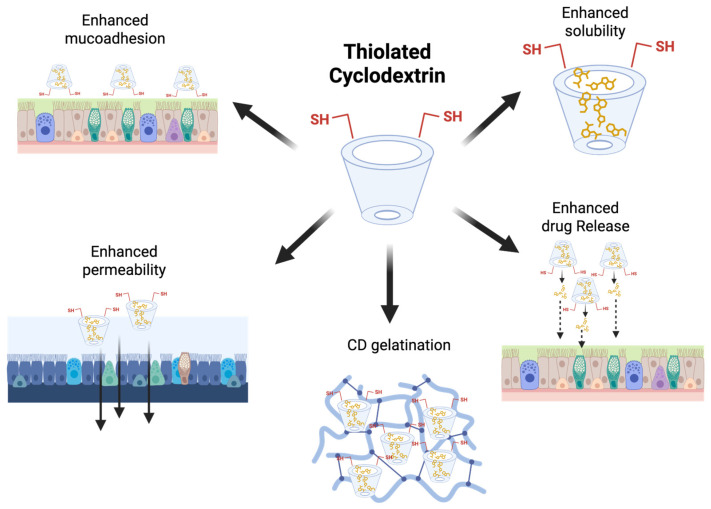
Schematic summary of the main properties of thiolated CDs. Original figure created with www.BioRender.com (accessed on 30 June 2025).
Figure 6
Figure 6
Schematic illustration of the preparation of a hybrid GelMA system combining hyaluronic acid (HA)-coated mesoporous silica nanoparticles (MSNs), which loaded complexes of chlorhexidine (CHX) with β-CDs for the bacteria-infected wound healing. Redrawn figure from reference [166] with BioRender.com.

References

    1. Pereira A.C., Martel F. Oxidative stress in pregnancy and fertility pathologies. Cell Biol. Toxicol. 2014;30:301–312. doi: 10.1007/s10565-014-9285-2. - DOI - PubMed
    1. Liu X., Chen Z. The pathophysiological role of mitochondrial oxidative stress in lung diseases. J. Transl. Med. 2017;15:207. doi: 10.1186/s12967-017-1306-5. - DOI - PMC - PubMed
    1. Hecker L. Mechanisms and consequences of oxidative stress in lung disease: Therapeutic implications for an aging populace. Am. J. Physiol. Lung Cell. Mol. Physiol. 2018;314:L642–L653. doi: 10.1152/ajplung.00275.2017. - DOI - PMC - PubMed
    1. van der Vliet A., Janssen-Heininger Y.M.W., Anathy V. Oxidative stress in chronic lung disease: From mitochondrial dysfunction to dysregulated redox signaling. Mol. Aspects Med. 2018;63:59–69. doi: 10.1016/j.mam.2018.08.001. - DOI - PMC - PubMed
    1. Hallan S.S., Ferrara F., Cortesi R., Sguizzato M. Potential of the Nano-Encapsulation of Antioxidant Molecules in Wound Healing Applications: An Innovative Strategy to Enhance the Bio-Profile. Molecules. 2025;30:641. doi: 10.3390/molecules30030641. - DOI - PMC - PubMed

LinkOut - more resources