. 2025 Aug 13;25(16):5008.
doi: 10.3390/s25165008.

Manufacturing and Preliminary Testing of Nano-Filled Elastomeric Film Cover for Morphing Airfoil

Affiliations

Manufacturing and Preliminary Testing of Nano-Filled Elastomeric Film Cover for Morphing Airfoil

Monica Ciminello et al. Sensors (Basel). .

Abstract

In this paper, a strain-temperature sensor with medium-high stretchability is proposed for aeronautic applications. The elastomer is conceived to be used as a protective cover on a morphing airfoil characterized by high curvatures. The main novelties in design and manufacturing compared to the state of the art are: use of a non-commercial, low-viscosity PDMS crosslinked with TEOS and DBTDL to enable effective graphene dispersion; innovative sensor design featuring an insulating interlayer on the substrate; and presence of micro-voids to enhance adhesion to the substrate. The resistive performance of the nano-filled matrix is preliminarily verified through a basic functionality test during tensile and bending solicitation at room temperature first and then by considering a thermal cycle while imposing a fixed curvature. During tensile tests, the sensor could withstand an imposed elongation of 30%. The bending tests highlighted the capability of the sensors to withstand low curvature radii, lower than 7.5 cm. Then, within the thermal characterization between -20 and +50 °C, a stability of the signal was observed. A basic resistivity (zero strain) of 3.69 MΩ over a sensor 20 mm long (distance between the electrodes), 5 mm wide, and 1 mm thick. All these features make the sensors a good candidate for laboratory prototypes of morphing concepts. Among the most critical applications in the morphing field, one recalls the possibility of integrating many spots of such sensors at the leading-edge zone of a wing, monitoring the strain at extreme curvature points.

Keywords: elastomer matrix; high deformation; morphing; nanomaterials.


Conflict of interest statement

The authors declare no conflicts of interest.

Figures
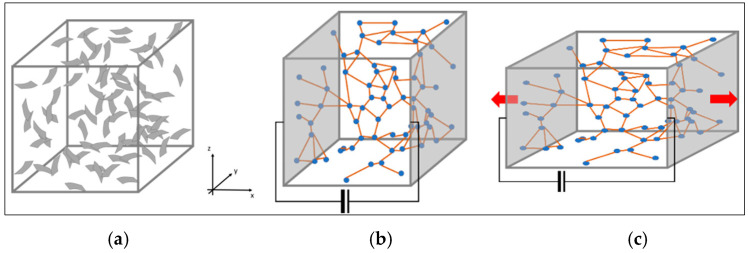
Figure 1
Figure 1
Modeling and simulation phases: random generation of the particle distribution (a), equivalent electric network in undeformed (b) and deformed (c) configurations.
Figure 2
Figure 2
Percolation region: model (red bars) vs. reference (blue bars).
Figure 3
Figure 3
Resistivity/strain % ratio vs. platelet volumetric concentration.
Figure 4
Figure 4
Example of 3D printed mold: (a) circular titanium-made mold, (b) example of elastomer surface effect.
Figure 5
Figure 5
Schematic of the deposition tool: titanium mold (in yellow), ABS mask (in red).
Figure 6
Figure 6
Example of sensor item: (a) sketch of electrodes integration by conductive adhesive paste, (b) manufactured sensor.
Figure 7
Figure 7
Bulk sensor elongation test.
Figure 8
Figure 8
Numerical–experimental comparison of resistive trend during elongation.
Figure 9
Figure 9
Sensor bonding visual inspection: (a) M-Bond 200 adhesive produces an opaque film layer at the interface, (b) Master Bond MasterSil 153 adhesive produces a cleaner interface.
Figure 10
Figure 10
Sensor patch on aluminum beam: resistance value of 2.82MOhm at max tip displacement.
Figure 11
Figure 11
Bonded sensor patch under bending load: (a) strain values as a function of the tip displacement, (b) resistance variance as a function of the tip displacement.
Figure 12
Figure 12
Sensor patch on steel beam: (a) resistance value of 18.5 MOhm at offset, (b) max curvature with 27.3 MOhm.
Figure 13
Figure 13
Strain values as a function of the edge distances.
Figure 14
Figure 14
Displacement–resistance curves: (a) strain cycle values as a function of the edge position, (b) resistance variance as a function of the edge position.
Figure 15
Figure 15
Delta strain patch values with respect to the SG reference.
Figure 16
Figure 16
Visual inspection: evidence of bubbles at the interface.
Figure 17
Figure 17
Morphing skin concept with aluminum, foam, and elastomer foil cover with one sensor spot (in the red frame).
Figure 18
Figure 18
Morphing structural skin: (a) example of flexible skin for leading edge, (b) high curvature during chamber variation of a leading edge.
Figure 19
Figure 19
Morphing skin concept with elastomer sensor during thermal cycle.
Figure 20
Figure 20
Resistance variance during the thermal cycles.

References

    1. Deng W., Bai J., Zhou M. Skin-Interfaced Entirely Self-Contained Wearable Biosensor for the Noninvasive and Dynamic Monitoring of Sweat Myo-Inositol. ACS Sens. 2025;10:5166–5175. doi: 10.1021/acssensors.5c01284. - DOI - PubMed
    1. Hu X., Liu Z., Zhang Y. Three-Dimensionally Architected Tactile Electronic Skins. ACS Nano. 2025;19:14523–14539. doi: 10.1021/acsnano.5c02232. - DOI - PubMed
    1. Chen J., Li Y., Shen Y., Jiang B., Wang Y., Huang C., Lu Y., Zhang S., Li Y. Bio-Inspired Smart Wings with PGPE-Enhanced Liquid Metal Circuits for Micro Flapping-Wing Robotics. ACS Appl. Electron. Mater. 2025;7:4582–4595. doi: 10.1021/acsaelm.5c00452. - DOI
    1. Van Nguyen D., Song P., Manshaii F., Bell J., Chen J., Dinh T. Advances in Soft Strain and Pressure Sensors. ACS Nano. 2025;19:6663–6704. doi: 10.1021/acsnano.4c15134. - DOI - PubMed
    1. Luo J., Deng J., Wu Z., Wang Y. Investigation on Piezoelectric Output Property of Bi2.5Na3.5Nb5O18 Modified P(VDF-TrFE) Piezoelectric Composite Films with Hierarchical Layer Structure. Langmuir. 2025;41:20227–20236. doi: 10.1021/acs.langmuir.5c02546. - DOI - PubMed

Grants and funding

LinkOut - more resources