. 2025 Aug 20;14(16):2586.
doi: 10.3390/plants14162586.

Optimizing Growth Regulator Concentrations for Cannabis sativa L. Micropropagation

Affiliations

Optimizing Growth Regulator Concentrations for Cannabis sativa L. Micropropagation

Gabrielle A Johnson et al. Plants (Basel). .

Abstract

In this study, the effect of growth regulators on shoot proliferation and rooting were evaluated to develop an efficient micropropagation protocol for the Cannabis sativa L. cultivars 'Cherry Soda' and 'Purple'. Apical meristems were isolated from actively growing shoots of stock plants and transferred to Driver and Kuniyuki Walnut (DKW) culture medium containing either 0.0, 0.5, 1.0, 2.0, or 5.0 μM meta-Topolin to study their shoot proliferation response. Resulting shoot cultures were transferred to medium containing varying levels of Indole Acetic Acid (IAA), Indole Butyric Acid (IBA), or Naphthalene Acetic Acid (NAA), solely or in combination, and were subjected to a 10-day dark incubation followed by a 16 h/8 h light/dark period to identify the best treatment for root production. Among the different shoot proliferation treatments studied, the maximum number of shoots was produced on the control medium that was devoid of any meta-Topolin. Cultures grown on medium containing 5.0 μM meta-Topolin exhibited hyperhydricity, where shoots appeared translucent and pale green in color; were characterized by water-soaked lesions; and leaves appeared curled and brittle in contrast to healthy looking cultures. Among the various rooting treatments studied, shoots grown in the dark for 10 days exhibited the highest frequency of rooting on medium containing 4.0 μM NAA or 6.0 μM IBA + 1.0 μM NAA. Full developed plants with a robust shoot and root system were transferred to soil, acclimatized under conditions for high humidity, and then transferred to ambient conditions in 4 weeks. The micropropagation protocol developed here allows for rapid multiplication of disease-free plants in C. sativa cultivars.

Keywords: auxin; contamination; cytokinin; hyperhydricity; industrial hemp.


Conflict of interest statement

The authors declare no conflict of interest.

Figures

Figure 1
Figure 1
Micropropagation of Cannabis sativa L. Stock plants grown under indoor conditions (A) were used to obtain shoot tips (B) and excise the shoot apical meristem, comprising two leaf primordia (C) and the meristematic dome (D). Growth (E) and leaf production (F) from shoot apical meristem resulted in shoot proliferation (G,H). Rooting of shoots with 1–2 nodes (I) to produce fully developed plants. Fully developed plants are transferred to sterile potting mix and maintained under conditions of high humidity (J). Fully acclimated plants growing under ambient conditions (K). Scale bars: (B) = 10 mm, (C) = 1 mm, (D) = 0.2 mm, (F) = 5 mm.
Figure 2
Figure 2
Boxplots showing shoot proliferation across cultivars (A), treatments (B), and the cultivar × treatment interaction (C). Proliferation represents the mean number of shoots per explant pooled across all four subculture periods. Values represent means and standard error (SE) from five replications per treatment. Statistical analysis was performed using two-way ANOVA to assess the main and interaction effects of cultivar and mT concentration.
Figure 3
Figure 3
Linear regression of shoot proliferation for ‘Purple’ (blue) and ‘Cherry Soda’ (red) across meta-Topolin concentrations (A). Linear regression lines with confidence intervals are shown for each cultivar. The R2 values indicate the proportion of variance explained by the linear regression: R2 = 0.04 for ‘Purple’ and R2 = 0.062 for ‘Cherry Soda’. (B) Polynomial regression (degree 2) of shoot proliferation across meta-Topolin concentrations for the same cultivars. Polynomial regression captures the non-linear relationship between meta-Topolin concentration and proliferation, with R2 = 0.173 for ‘Purple’ and R2 = 0.069 for ‘Cherry Soda’. Shaded regions represent 95% confidence intervals for the regression lines.
Figure 4
Figure 4
Endophytic contamination and growth abnormalities in Cannabis sativa L. Bacteria contamination can be observed occurring from the cut end of the explant (A). Occurrence of hyperhydricity in shoot cultures where normal shoots appear dark green in color (B) compared to hyperhydric shoots characterized by translucent appearance (C) with chlorotic, curled leaves (D). Scale bar: A = 5 mm.
Figure 5
Figure 5
In vitro flowering in Cannabis sativa L. Occurrence of male (A,B) and female inflorescences (C) in proliferating shoot cultures. Female flower parts including the stigma, style and ovary (D). Scale bars: (C) = 10 mm, (D) = 1 mm.
Figure 6
Figure 6
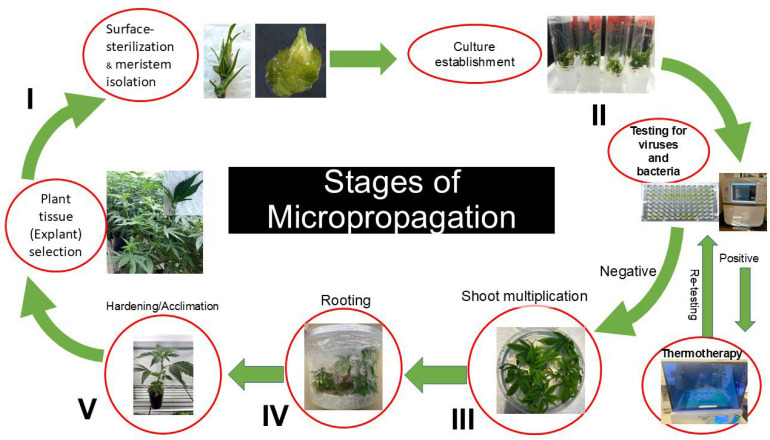
Flowchart for micropropagation of Cannabis sativa L. Phase I includes collection of shoot tips from actively growing female stock plants, their surface sterilization and isolation of apical meristems under a dissecting microscope. Phase II includes culture establishment and testing for the presence of endophytic pathogens, and their elimination. Phase III includes shoot proliferation for bulking up clean plant materials. Multiplied shoots are then rooted to produce fully developed plants in Phase IV, which are then acclimated under conditions of high humidity in Phase V and ready for commercial cultivation.

References

    1. Monthony A.S., Page S.R., Hesami M., Jones A.M.P. The Past, Present, and Future of Cannabis sativa Tissue Culture. Plants. 2021;10:185. doi: 10.3390/plants10010185. - DOI - PMC - PubMed
    1. Small E., Cronquist A. A Practical and Natural Taxonomy for Cannabis. Taxon. 1976;25:405–435. doi: 10.2307/1220524. - DOI
    1. Clarke R.C., Merlin M.D. Cannabis: Evolution and Ethnobotany. Plant Ecol. Evol. 2013;147:149.
    1. McPartland J.M. Cannabis Systematics at the Levels of Family, Genus, and Species. Cannabis Cannabinoid Res. 2018;3:203–212. doi: 10.1089/can.2018.0039. - DOI - PMC - PubMed
    1. Clarke R.C., Merlin M.D. Cannabis Domestication, Breeding History, Present-Day Genetic Diversity, and Future Prospects. Crit. Rev. Plant Sci. 2016;35:293–327. doi: 10.1080/07352689.2016.1267498. - DOI

LinkOut - more resources