


Analysis of Sequential Pneumococcal Vaccination Coverage in the Elderly Resident Population of the Viterbo Local Health Authority from 2018 to 2023
- PMID: 40872894
- PMCID: PMC12390200
- DOI: 10.3390/vaccines13080807
Analysis of Sequential Pneumococcal Vaccination Coverage in the Elderly Resident Population of the Viterbo Local Health Authority from 2018 to 2023
Abstract
Background: Pneumococcal disease is a significant health burden, particularly among older adults and individuals with chronic conditions. Sequential pneumococcal vaccination (PCV13 followed by PPSV23) has been recommended in Italy since 2017 for its demonstrated efficacy, safety, and cost-effectiveness in preventing invasive pneumococcal disease (IPD). Nevertheless, limited data are available on the sequential pneumococcal vaccination coverage in Italy. This study aimed to evaluate the coverage and trends of sequential pneumococcal vaccination among individuals who turned 65 years old within the Viterbo Local Health Authority between 2018 and 2023.
Methods: A retrospective cohort study was conducted using data from the Regional Vaccination Registry (AVR), a comprehensive digital vaccination dataset. Vaccination coverage was calculated based on individuals completing the sequential pneumococcal vaccination within two years after turning 65 years old. Trends as well as subgroup variations based on sex, citizenship, district of residence, and municipality size were analyzed.
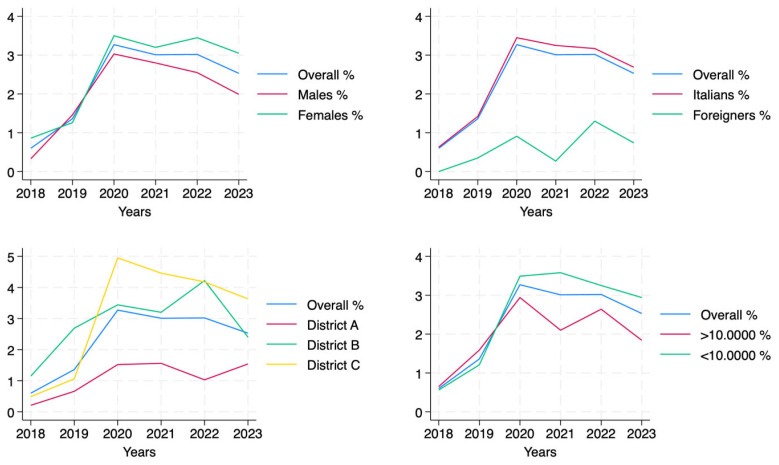
Results: Among 27,657 individuals who turned 65 years of age during the study period, only 2.32% completed the sequential pneumococcal vaccination. Coverage increased steadily from 2018 (0.60%) to a peak in 2020 (3.27%), followed by a plateau and a decline in 2023 (2.53%). Coverage varied across demographic and geographic subgroups: females (2.58%) had higher coverage than males (2.04%), Italian citizens (2.45%) exceeded foreign residents (0.64%), and residents in District C (3.03%) led over District A (1.08%). Smaller municipalities (≤10,000 inhabitants) showed higher coverage (2.52%) than larger ones (1.98%).
Conclusions: Adherence to sequential pneumococcal vaccination has been very low throughout the considered study period. This is highly relevant information to consider in the view of new available pneumococcal vaccines for immunization of the elderly. Furthermore, geographic and demographic differences highlight the need for targeted public health interventions.
Keywords: elderly immunization; immunization trends; pneumococcal vaccination; vaccination coverage.
Conflict of interest statement
The authors declare no conflicts of interest.
Figures


References
-
- ECDC . Invasive Pneumococcal Disease—Annual Epidemiological Report for 2022. ECDC; Arlington, VA, USA: 2022.
-
- Istituto Superiore di Sanità Sorveglianza Nazionale Delle Malattie Batteriche Invasive. Dati 2021–2023. 2024. [(accessed on 18 June 2025)]. Available online: https://www.epicentro.iss.it/meningite/pdf/RIS%202-2024.pdf.
-
- Wahl B., O’Brien K.L., Greenbaum A., Majumder A., Liu L., Chu Y., Lukšić I., Nair H., McAllister D.A., Campbell H., et al. Burden of Streptococcus pneumoniae and Haemophilus influenzae type b disease in children in the era of conjugate vaccines: Global, regional, and national estimates for 2000–15. Lancet Glob. Health. 2018;6:e744–e757. doi: 10.1016/S2214-109X(18)30247-X. - DOI - PMC - PubMed
-
- Félix S., Handem S., Nunes S., Paulo A.C., Candeias C., Valente C., Simões A.S., Almeida S.T., Tavares D.A., Brito-Avô A., et al. Impact of private use of the 13-valent pneumococcal conjugate vaccine (PCV13) on pneumococcal carriage among Portuguese children living in urban and rural regions. Vaccine. 2021;39:4524–4533. doi: 10.1016/j.vaccine.2021.06.035. - DOI - PubMed
LinkOut - more resources
Full Text Sources
