


A New Ashwagandha Formulation (Zenroot™) Alleviates Stress and Anxiety Symptoms While Improving Mood and Sleep Quality: A Randomized, Double-Blind, Placebo-Controlled Clinical Study
- PMID: 40875185
- PMCID: PMC12474591
- DOI: 10.1007/s12325-025-03327-z
A New Ashwagandha Formulation (Zenroot™) Alleviates Stress and Anxiety Symptoms While Improving Mood and Sleep Quality: A Randomized, Double-Blind, Placebo-Controlled Clinical Study
Abstract
Introduction: Prolonged exposure to stress may lead to low mood, anxiety, depression, insomnia, and metabolic disorders. Ashwagandha, an established adaptogen, is known to combat stress. We studied the safety and efficacy of Ashwagandha formulation, Zenroot™ (ZEN), containing 1.5% total withanolides on stress, anxiety, mood, and sleep quality in human subjects with non-chronic mild to moderate stress.
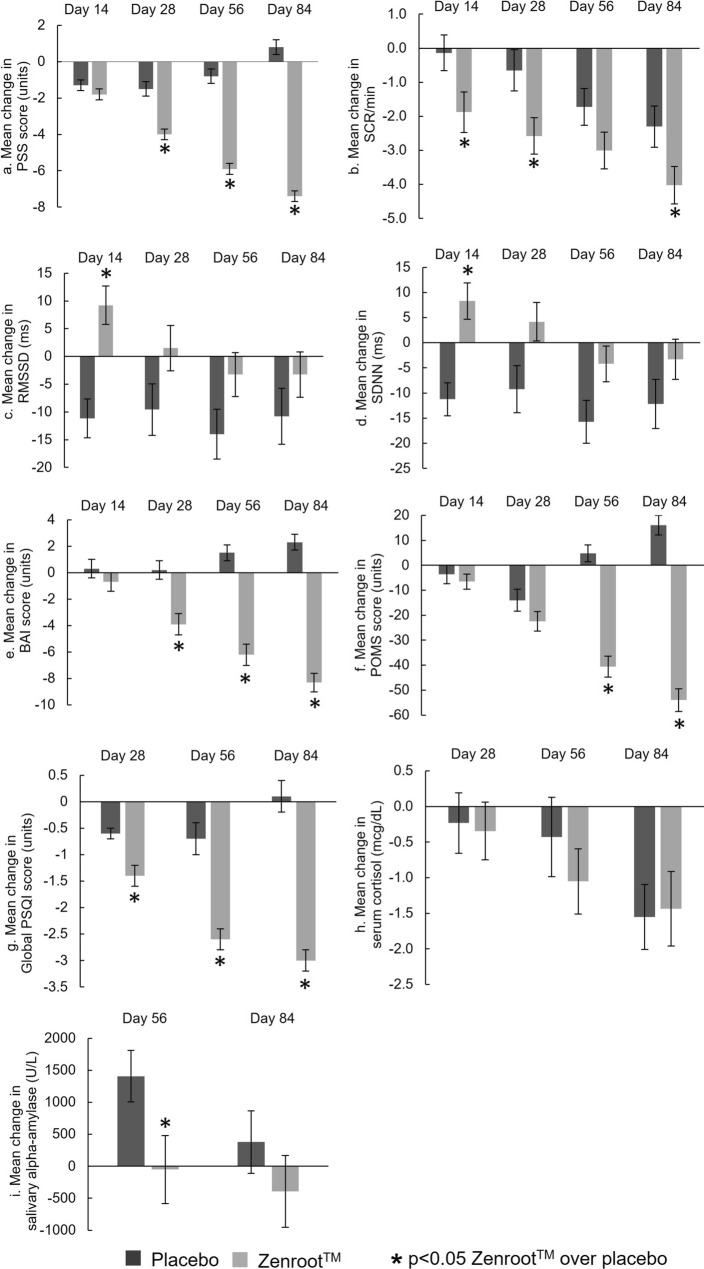
Methods: This was a prospective, randomized, double-blind, parallel, placebo-controlled, clinical interventional study with supplementation duration of 84 days. Ninety subjects were randomly assigned in a 1:1 ratio to receive 125 mg of ZEN or placebo. We measured stress using the Perceived Stress Scale (PSS) score as a primary endpoint. Various secondary endpoints included Mindfield eSense Skin Response (SCR) and Mindfield eSense PULSE Heart Rate Variability (HRV)-Root Mean Square of Successive Differences (RMSSD), and standard deviation of normal NN interval (SDNN), Beck Anxiety Inventory (BAI), Profile of Mood States (POMS), Pittsburgh Sleep Quality Index (PSQI), stress biomarkers of serum cortisol, and salivary alpha amylase (sAA) levels and safety parameters. The study assessments were performed on days 0, 14, 28, 56, and 84.
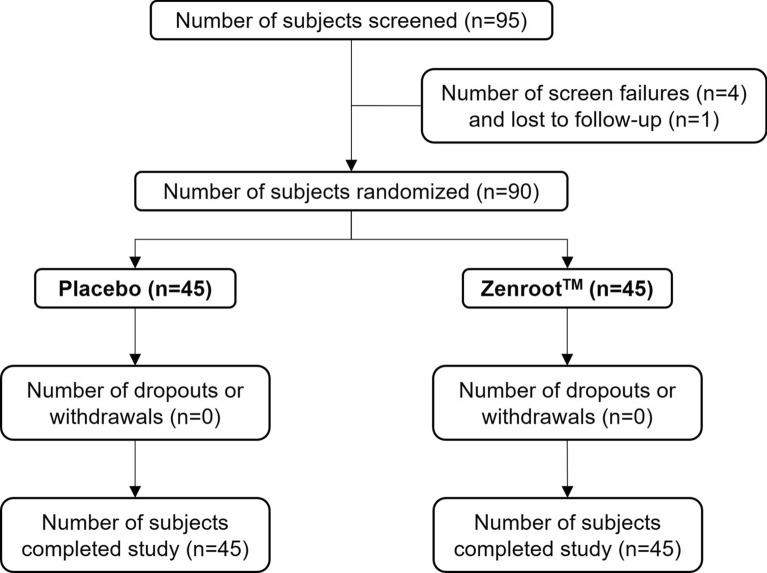
Results: All 90 randomized subjects completed the study. Mean ± standard error (SE) age of subjects in the ZEN group was 35.5 ± 1.3 years and in the placebo group was 34.5 ± 1.2 years. ZEN 125 mg showed significant (p < 0.05) improvements in PSS, BAI, and PSQI scores on days 28, 56, and 84; SCR on days 14, 28, and 84 and trend (p < 0.1) on day 56; HRV-RMSSD and SDNN on day 14; and POMS on days 56 and 84. No significant differences were observed between the two groups for serum cortisol and sAA. The study product was well tolerated without any safety concerns.
Conclusion: We observed significant reductions in both subjective and objective measures of stress with improvement in mood, sleep quality, and occasional anxiety symptoms. ZEN was well tolerated without any related adverse events. Future clinical studies are warranted to evaluate the effect of ZEN on chronically stressed adults.
Clinical trial registration number: http://ctri.nic.in/ Identifier:CTRI/2024/03/063786.
Keywords: Anxiety; Ashwagandha; Mood; Sleep quality; Stress; Withanolides; Zenroot™.
© 2025. The Author(s).
Conflict of interest statement
Declarations. Conflict of interest: Manasvi Mahadevan, Kumarpillai Gopukumar are the clinical investigators at Bengaluru Neuro Center, Ruchi Gupta is a clinical investigator at Santosh hospital. Sahitya Sarvamangala Srinivas, Arun Bhuvanendran and Abhijith Phanindra are employees of Invitro Research Solutions Private Limited. Abhijeet Morde and Paras Patni are employees of OmniActive Health Technologies. Ethical approval: All procedures performed in studies involving human participants were in accordance with the Good Clinical Practice guidelines, the ethical principles originated from Helsinki Declaration and in strict compliance with the “New Drugs and Clinical Trial Rules- 2019,” the Ministry of Health and the Government of India, at all stages of the trial for adherence to protocol. The study activities commenced after obtaining an approval from Santhosh Hospital Institutional Ethics Committee, Bengaluru, India, on the 21st February 2024. The EC was duly apprised of the progress and updates of the trial at regular intervals as per prescribed guidelines.
Figures
References
-
- Sanford LD, Suchecki D, Meerlo P. Stress, arousal, and sleep. In: Meerlo P, Benca RM, Abel T, editors. Sleep neuronal plasticity and brain function, vol. 25. Springer. Berlin, Heidelberg: Berlin Heidelberg; 2014. p. 379–410.
-
- Gasperin D, Netuveli G, Dias-da-Costa JS, Pattussi MP. Effect of psychological stress on blood pressure increase: a meta-analysis of cohort studies. Cad Saude Publica. 2009;25(4):715–26. - PubMed
-
- Herd JA. Cardiovascular response to stress. Physiol Rev. 1991;71(1):305–30. - PubMed
Publication types
MeSH terms
Substances
LinkOut - more resources
Full Text Sources
Medical
