Randomized Controlled Trial
. 2025 Aug 28;16(1):7786.
doi: 10.1038/s41467-025-62752-4.

Long-term health outcomes in adolescents with obesity treated with faecal microbiota transplantation: 4-year follow-up

Collaborators, Affiliations
Randomized Controlled Trial

Long-term health outcomes in adolescents with obesity treated with faecal microbiota transplantation: 4-year follow-up

Brooke C Wilson et al. Nat Commun. .

Abstract

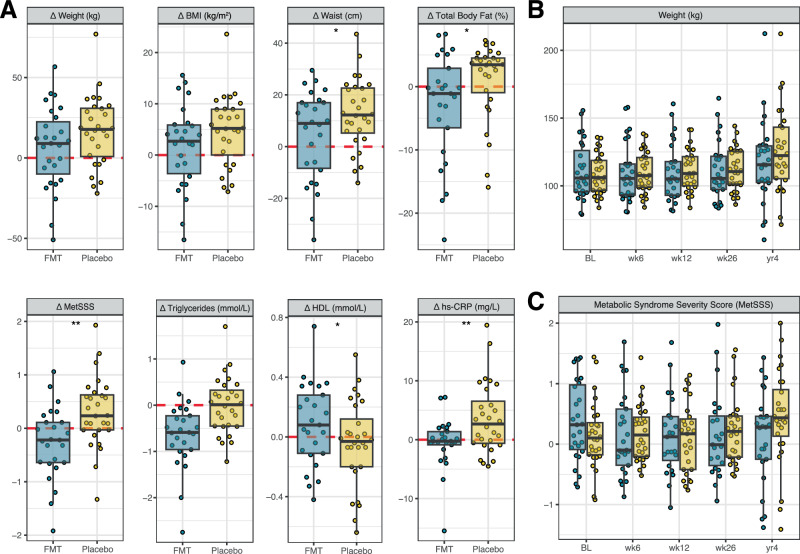
Faecal microbiota transplantation (FMT) has been explored as a potential treatment for obesity, but its long-term effects on metabolic health remain unclear. Here, we report 4-year follow-up findings from a double-blind, randomised, placebo-controlled trial assessing FMT in adolescents with obesity (ACTRN12615001351505, Australian New Zealand Clinical Trials Registry). This unblinded follow-up study evaluated 63% (55/87) of the original participants (27 FMT, 28 placebo). There was no difference in BMI between the two groups, after adjusting for sex, age, diet, and physical activity (-3.6 kg/m2, p = 0.095). However, FMT recipients showed clinical improvements in body composition and metabolic health compared to the placebo group. Specifically, FMT recipients had smaller waist circumference (-10.0 cm, p = 0.026), total body fat (-4.8%, p = 0.024), metabolic syndrome severity score (-0.58, p = 0.003), and systemic inflammation (-68% hs-CRP, p = 0.002) and higher levels of HDL cholesterol (0.16 mmol/L, p = 0.037). No group differences were observed in glucose markers, or other lipid parameters. Shotgun metagenomic sequencing revealed sustained long-term alterations in gut microbiome richness, composition and functional capacity, with persistence of donor-derived bacterial and bacteriophage strains. These findings highlight the potential relevance of FMT as a microbiome-augmenting intervention for obesity management and metabolic health, warranting further investigation.


Conflict of interest statement

Competing interests: The authors declare no competing interests.

Figures

Fig. 1
Fig. 1. Study flow from treatment randomisation to the 6-month follow-up (end of the original trial period), through to the 4-year follow-up assessment.
Note that some participants who did not complete the initial 6-month follow-up did return for the 4YFU. DXA, whole-body dual-energy X-ray absorptiometry scans; FMT faecal microbiota transplantation.
Fig. 2
Fig. 2. Longitudinal changes in anthropometry and metabolic health among participants treated with FMT or placebo.
A Individual changes (Δ) in anthropometric and metabolic outcomes at 4 years compared to baseline. Points represent individual participants. The boxes represent the interquartile range (IQR) split by the median, with whiskers expanding up to 1.5× the IQR. The dashed red line at 0 represents the reference baseline value. *p < 0.05 and **p < 0.01 for between-group differences, derived from linear models; p-values are nominal (unadjusted for multiple comparisons) and two-sided. Exact sample sizes for each analysis are indicated Fig. 1. BMI body mass index, FMT faecal microbiota transplantation, HDL high-density lipoprotein cholesterol, hs-CRP high-sensitivity C-reactive protein; and metabolic syndrome severity scores (MetSSS). B Weight and C MetSSS over the full study period, including only participants (FMT, blue; Placebo, yellow) who returned for the 4-year follow-up.
Fig. 3
Fig. 3. Long-term gut microbiome dynamics in FMT and placebo recipients.
A Individual changes (Δ) in species richness from baseline (dashed red line). Points represent individual participants. The boxes represent the interquartile range (IQR) split by the median, with whiskers expanding up to 1.5× the IQR. Total sample size for microbiome analysis (FMT n = 23, Placebo n = 26). Significance based on linear model (*p < 0.05 and **p < 0.01; p-values are nominal (unadjusted for multiple comparisons) and two-sided. B Bray-Curtis dissimilarity in microbiome species or pathway composition at the 4YFU compared to baseline. Boxplot parameters and sample size as described above. C Top 50 differentially abundant species from baseline among FMT recipients, ranked by strength of association (−log(qval) × |coef|) from the Maaslin2 model. ‘+’ and ‘−’ indicate increased and decreased abundance from baseline, respectively. D Proportion of donor-matching bacterial strains in the individual recipient’s gut microbiome. Boxplot parameters and sample size as described above. E Proportion of engrafted bacterial strains detected in FMT recipients at the 4YFU by donor. F Proportion of viral operational taxonomic units (vOTUs) matching the recipient’s baseline strain, matching one or more of their donor strains, or that were newly detected (Other). G Proportion of vOTUs detected in FMT recipients at 4YFU by donor.
Fig. 4
Fig. 4. Associations between microbiome components and changes in clinical outcomes at the 4-year follow-up (4YFU) compared to baseline.
A Baseline gut microbiome samples and B 4YFU gut microbiome samples. Bacterial species relative abundances associated with changes in Metabolic Syndrome Severity Score (MetSSS) were identified using Maaslin2 (coefficients (coef) and unadjusted two-sided p-values reported). Spearman rank correlations assessed associations between viral family richness/relative abundance and weight changes (Spearman rho and unadjusted p-values reported). Each point represents an individual participant. The solid line indicates the linear regression fit, with the shaded area showing the 95% confidence interval.

References

    1. NCD Risk Factor Collaboration (NCD-RisC) Trends in adult body-mass index in 200 countries from 1975 to 2014: a pooled analysis of 1698 population-based measurement studies with 19·2 million participants. Lancet387, 1377–1396 (2016). - PMC - PubMed
    1. Singh, A. S., Mulder, C., Twisk, J. W. R. et al. Tracking of childhood overweight into adulthood: a systematic review of the literature. Obes. Rev.9, 474–488 (2008). - PubMed
    1. Must, A., Jacques, P. F., Dallal, G. E. et al. Long-term morbidity and mortality of overweight adolescents. A follow-up of the Harvard Growth Study of 1922 to 1935. N. Engl. J. Med.327, 1350–1355 (1992). - PubMed
    1. Twig, G., Yaniv, G., Levine, H. et al. Body-mass index in 2.3 million adolescents and cardiovascular death in adulthood. N. Engl. J. Med.374, 2430–2440 (2016). - PubMed
    1. Popkin, B. M., Adair, L. S. & Ng, S. W. Global nutrition transition and the pandemic of obesity in developing countries. Nutr. Rev.70, 3–21 (2012). - PMC - PubMed

Publication types