


Exploring movement entrainment in an ecologically valid concert setting
- PMID: 40877320
- PMCID: PMC12394413
- DOI: 10.1038/s41598-025-13376-7
Exploring movement entrainment in an ecologically valid concert setting
Abstract
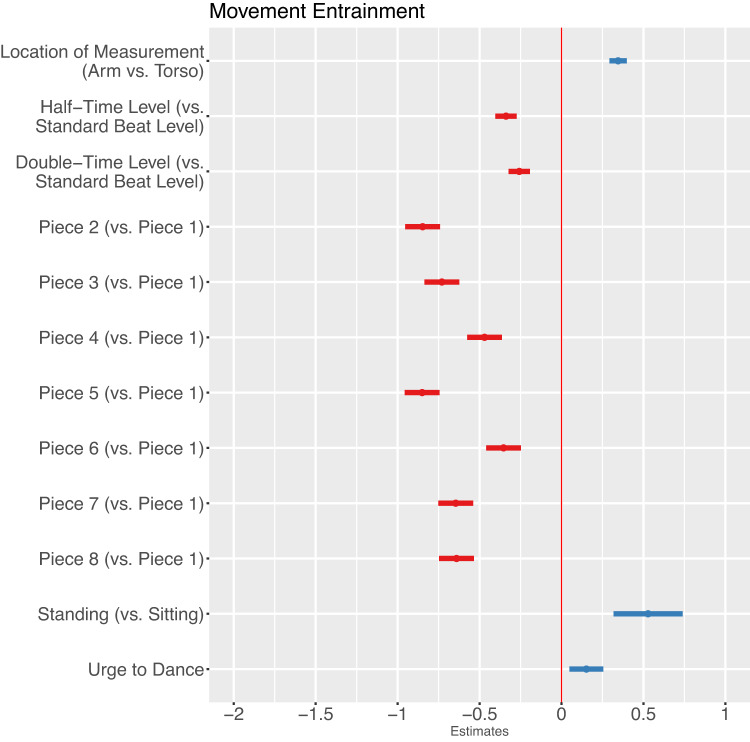
Moving to the beat is one of the most natural human reactions while listening to music and can be defined as movement entrainment. Listeners' reactions to music have been discussed as the result of the music, the context, and the listener. However, as music is a social phenomenon typically performed in live settings, movement entrainment and its contributing factors have never been investigated in ecologically valid concerts. In a preliminary study (n = 42) during a rock/pop concert, we confirmed the validity of our method of measuring acceleration data of the audience with portable devices on the arm and torso. In our main study (n = 69), we measured audience data at two big band concerts with different conditions: One was seated, the other unseated. With several consecutive Hierarchical Linear Models, we identified factors predicting movement entrainment: location of measurement (arm vs. torso), metrical level (BPM vs. half- and double-time level), musical factors (the different pieces), concert condition (seated vs. unseated), and the personal characteristic of urge to dance. Our study shows that there are multiple factors contributing to movement entrainment and can be seen as a first step towards studying this phenomenon in ecologically valid concert settings.
Keywords: Dance; Live concert; Movement entrainment; Popular music.
© 2025. The Author(s).
Conflict of interest statement
Declarations. Competing interests: The authors declare no competing interests.
Figures


References
-
- Godøy, R. I. & Leman, M. Musical Gestures. Sound, Movement, and Meaning (Routledge, 2010).
-
- Lesaffre, M. et al. How potential users of music search and retrieval systems describe the semantic quality of music. J. Am. Soc. Inform. Sci. Technol.59, 695–707. 10.1002/asi.20731 (2008).
-
- Anonymous. Earth, Wind & Fire (ARC/Columbia 1-11093) In The Stone (3:32). Cash BoxXLI, 18 (1979).
-
- Merriam, A. P. The Anthropology of Music (Northwestern University Press, 1964).
MeSH terms
LinkOut - more resources
Full Text Sources
Miscellaneous
