


Self-relevant facial threat attracts peripheral attention
- PMID: 40883375
- PMCID: PMC12397305
- DOI: 10.1038/s41598-025-15695-1
Self-relevant facial threat attracts peripheral attention
Abstract
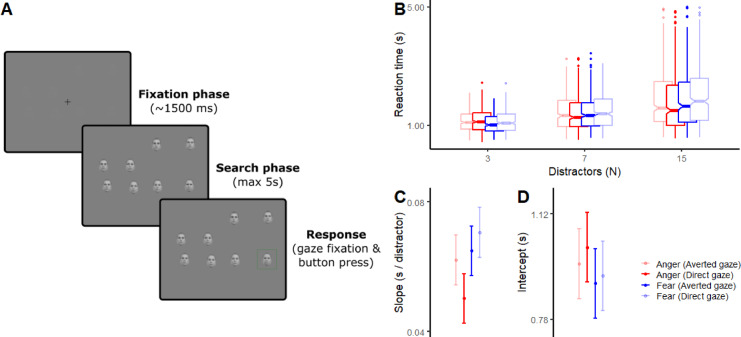
Threat-relevance theory suggests that gaze direction determines the self-relevance of facial threats. Indeed, angry eye-contact is a more relevant threat compared to its counterpart with averted gaze. Similarly, fearful eye-contact is not a threat to the observer, but averted fearful gaze can signal a relevant threat nearby. Following evidence that amygdala-reactivity to self-relevant threat depends on coarse visual processing, we investigate whether self-relevant threat attracts attention due to processing of low spatial frequency information via peripheral vision. Furthermore, we aim to provide behavioral relevance to this mechanism by investigating whether the psychopathic trait fearless-dominance promotes attention to self-relevant anger. Across three studies (N = 12, 31 and 36), we find that, during visual-search for emotional faces, less gaze-fixations are needed to find facial fear and anger when they are self-relevant. Self-relevance, however, does not promote peripheral identification of fear and anger in a signal-detection experiment. Together, this confirms that self-relevant facial threats indeed attract peripheral-attention. Moreover, image-analysis suggests that this is due to their low spatial-frequency content. Lastly, peripheral-attention to angry eye-contact is indeed more pronounced in relation to the psychopathic trait fearless-dominance, while diminished in relation to the psychopathic trait impulsive-antisociality, which provides preliminary behavioral relevance to this mechanism.
Keywords: Fearless dominance; Image statistics; Impulsive antisociality; Psychopathy; Response modulation theory; Visual search.
© 2025. The Author(s).
Conflict of interest statement
Declarations. Competing interests: The authors declare no competing interests.
Figures


References
-
- Adams, R. B., Gordon, H. L., Baird, A. A., Ambady, N. & Kleck, R. E. Effects of gaze on amygdala sensitivity to anger and fear faces. Sci. (1979). 300, 1536 (2003). - PubMed
-
- Adams, R. B. & Kleck, R. E. Effects of direct and averted gaze on the perception of facially communicated emotion. Emotion5, 3–11 (2005). - PubMed
-
- Adams, R. B. & Kleck, R. E. Perceived gaze direction and the processing of facial displays of emotion. Psychol. Sci.14, 644–647 (2003). - PubMed
MeSH terms
LinkOut - more resources
Full Text Sources
