


Assessing inequality of opportunity in access to maternal healthcare services in pakistan: A quantitative attempt
- PMID: 40890779
- PMCID: PMC12403915
- DOI: 10.1186/s12913-025-13312-5
Assessing inequality of opportunity in access to maternal healthcare services in pakistan: A quantitative attempt
Erratum in
-
Correction: Assessing inequality of opportunity in access to maternal healthcare services in Pakistan: A quantitative attempt.BMC Health Serv Res. 2025 Oct 1;25(1):1280. doi: 10.1186/s12913-025-13525-8. BMC Health Serv Res. 2025. PMID: 41034960 Free PMC article. No abstract available.
Abstract
Background: Maternal healthcare services are an important goal in SDGs around the world. Persistent inequalities and gaps in maternal healthcare access are strongly linked to poor maternal health outcomes. This study aims to evaluate inequality of opportunity in access to maternal healthcare services by assessing the contributions of circumstances and efforts to these inequalities. Additionally, it analyzes the key determinants influencing the utilization of maternal healthcare services in Pakistan.
Method: Using data from the Pakistan Demographic Health Surveys (2012-13 and 2017-18), the research examines determinants of MHCS access, focusing on circumstances and efforts and their contribution to IO. This study uses the human opportunity index, Shapley decomposition index, and logistic regression.
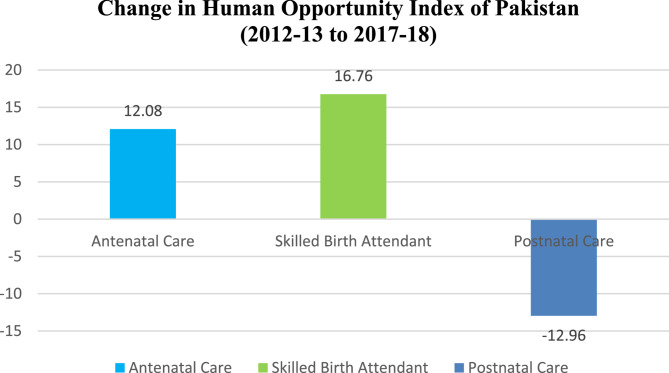
Result: The Human Opportunity Index findings indicate notable improvements in antenatal care (from 25.70% in 2013 to 37.78% in 2018) and skilled birth attendance (from 38.97 to 55.73%), while postnatal care coverage declined significantly (from 35.56 to 22.56%) over the same period, underscoring the need for increased policy attention to postnatal services. Decomposition analysis reveals that the main circumstantial factors contributing to inequality are place of residence, region, and household wealth, while factors like the husband's education and proximity to healthcare facilities play a minor role. Efforts such as women's education, exposure to mass media, and women's autonomy in health decisions have a significant impact on the inequality in MHCS access. Binary logistic regression analysis indicates that the probability of accessing MHCS varies by region, with women in Sindh having higher odds compared to those in Khyber Pakhtunkhwa (KP) and Balochistan. Urban women are more likely to receive skilled birth attendance and postnatal care than rural women. Women with basic education and decision-making power regarding their health are more likely to use MHCS. The study emphasizes the need for targeted interventions to address these disparities and improve maternal healthcare outcomes in Pakistan.
Keywords: Inequality of opportunity; MHCS; PDHS; Pakistan.
© 2025. The Author(s).
Conflict of interest statement
Declarations. Ethics approval and consent to participate: This study is based on a secondary analysis of existing datasets from the Pakistan Demographic and Health Surveys (PDHS) 2012–13 and 2017–18, with all participant identifiers removed. Informed consent is obtained from all participants before data collection. The survey protocol and instruments follow the ethical guidelines outlined in the Declaration of Helsinki and are reviewed and approved by the National Institute of Population Studies (NIPS), operating under the Ministry of National Health Services, Regulations and Coordination, Government of Pakistan. Consent for publication: Not Applicable. Competing interests: The authors declare no competing interests.
Figures
References
-
- Afridi JR, Jan SA. Assessment of inequality of opportunity in access to maternal healthcare services in Khyber pakhtunkhwa, Pakistan. Bull Bus Econ (BBE). 2024;13(2):870–6. - DOI
-
- Ahmad N, Hyder AA. Factors affecting prenatal care use in pakistan: A logistic regression analysis. East Mediterr Health J. 2016;22(4):262–9.
-
- Akram S, Pervaiz Z. Assessing Inequality of Opportunities for Child Well-being in Pakistan. Child Indic Res. 2025;18(2):525-42. 10.1007/s12187-024-10205-7.
-
- Alam AS, Alam S, Mobasshira K, Anik SN, Hasan MN, Chowdhury MAB, Uddin MJ. Exploring urban-rural inequalities of maternal healthcare utilization in Bangladesh. Heliyon. 2025;11(2):1–15.
MeSH terms
LinkOut - more resources
Full Text Sources
Medical
