Review
. 2025 Sep 24;125(18):8956-9011.
doi: 10.1021/acs.chemrev.5c00245. Epub 2025 Sep 2.

Gel-Based Ionic Circuits

Affiliations
Review

Gel-Based Ionic Circuits

Hyunjae Yoo et al. Chem Rev. .

Abstract

Ionic circuits have emerged as a promising candidate to bridge the gap between biological and artificial systems by applying the mechanically compliant and adaptive nature of gels as ionic conductors. Gel-based ionic circuits exploit the intrinsic characteristics of ions, such as their mass, diversity, and local accumulation, to achieve selectivity, hysteresis, and chemical-electric signal transduction. Their dynamic and nonlinear behaviors not only emulate traditional solid-state electronic systems but also exhibit unique functionalities and operating mechanisms extending beyond established electronic paradigms. In this review, we categorize gel-based ionic circuits into four major functional classes: passive circuit elements, active circuit elements, power sources, and noncircuit elements. We comprehensively discuss the fundamental operating principles, materials strategies, and current challenges, eventually highlighting opportunities for future advancement in ionic devices.


Figures

1
1
Gel-based ionic circuits. (a) Unique characteristics of ions compared to electrons. (b) Key advantages of gels as ionic conductors. (c,d) Schematic illustrations of representative gel-based (c) ionic circuit elements and (d) noncircuit elements.
2
2
Ionic conduction in various matrices under external electrical fields. (a) Ion migration and ionic conductivity in aqueous solutions. (b) Ionic conduction in gels composed of polymer networks. (c) Selective ionic conduction in polyelectrolyte gels that have fixed charges in their polymer networks. (d) Ionic conduction in zwitterionic gels, where internal ion pairs facilitate charge transport while maintaining charge neutrality.
3
3
Various ionic conductors developed through the application of the diverse properties of gels. (a) A transparent and stretchable ionic hydrogel touch panel that senses position by measuring the current differences across each resistive part. Reproduced with permission from ref . Copyright 2016, The American Association for the Advancement of Science. (b) A hydrogel-based self-healing wearable strain sensor fabricated through 3D printing. Reproduced with permission from ref . Copyright 2023 Springer Nature under CC BY 4.0 http://creativecommons.org/licenses/by/4.0/. (c) A stretchable ionogel-based ionic skin with a self-healing property in underwater environments. Reproduced with permission from ref . Copyright 2019 Springer Nature. (d) An ionogel touch panel with triboresistive sensing for grid-free touch recognition. Reproduced with permission from ref . Copyright 2022 John Wiley and Sons. (e) Highly conductive and stretchable nanostructured ionogel fabricated through 3D printing with excellent ionic conductivity over a wide temperature range. Reproduced from ref . Copyright 2024 Springer Nature under CC BY-NC-ND 4.0 https://creativecommons.org/licenses/by-nc-nd/4.0/. (f) A zwitterionic hydrogel-based strain sensor with skin-like properties, featuring high stretchability (∼1600%) and strain-stiffening (∼24-fold modulus enhancement). Reproduced with permission from ref . Copyright 2021 Springer Nature under CC BY 4.0 https://creativecommons.org/licenses/by-nc-nd/4.0/.
4
4
An ionic conductor harnessing the diverse properties and selectivity of ionic materials. (a) Ionic conductivity modulation through photothermally responsive AZIM ions for mimicking synaptic functions. Reproduced with permission from ref . Copyright 2023 The American Association for the Advancement of Science under CC BY 4.0 http://creativecommons.org/licenses/by/4.0/. (b) Optoionic hydrogels with UV-light-regulated ionic conductivity for ionic-based logic processing and image sensing. Reproduced with permission from ref . Copyright 2024 The American Association for the Advancement of Science under CC BY 4.0 http://creativecommons.org/licenses/by/4.0/. (c) An astringency sensing device that detects changes in ion conductivity induced by the degree of hydrophobic nanochannel formation. Reproduced with permission from ref . Copyright 2020 The American Association for the Advancement of Science under CC BY 4.0 http://creativecommons.org/licenses/by/4.0/. (d) Temperature-interactive display utilizing ionic conductivity changes driven by differences in ion diffusion rates due to the crystallization of the matrix at different temperatures. Reproduced with permission from ref . Copyright 2022 John Wiley and Sons.
5
5
Gel-based ionic capacitors. Schematic diagrams of a gel-based ionic capacitor. (a) Ionic capacitor and the mechanism of EDL formation. When an electric field is applied to a gel conductor, the mobile ions within the gel behave similarly to electrons, thereby exhibiting capacitance. An EDL forms at the interface between the metal and the gel, effectively localizing the ions in place. Ionic circuit analysis of gel-based ionic capacitors. (b) Bode plot and (c) Nyquist plot of the ionic capacitor, highlighting its electrical performance. Reproduced with permission from ref . Copyright 2020 The American Association for the Advancement of Science.
6
6
Applications of ionic capacitors using gel dielectrics. Gel-based ionic capacitors with gel dielectrics. (a) Schematic diagrams of a gel-based ionic capacitor incorporating a gel dielectric. (b) Thanks to the high compliance and transformability of gel, the movement of ions within gel changes under pressure, effectively enabling the device to function as a potentiometer. Reproduced with permission from ref . Copyright 2020 The American Association for the Advancement of Science. (c) By using the EDL, the capacitor dynamically adjusts its capacitance in response to pressure. Reproduced from ref . Copyright 2020 The American Association for the Advancement of Science under CC BY-NC 4.0 https://creativecommons.org/licenses/by-nc/4.0/. Constructed from soft materials, gel-based ionic capacitors can be deformed, demonstrating (d) flexibility, (e) stretchability, and self-healing properties. Reproduced with permission from ref . Copyright 2017 American Association for the Advancement of Science. Reproduced with permission from ref . Copyright 2019 Springer Nature under CC BY 4.0 http://creativecommons.org/licenses/by/4.0/.
7
7
Applications of ionic capacitors using gel conductors. Gel-based ionic capacitors using gel conductors. (a) A schematic diagram of gel-based ionic capacitor incorporating a gel conductor. (b) By employing a gel as a reservoir for mobile ions, stretchable and transparent conductors can be developed. Reproduced with permission from ref . Copyright 2013 The American Association for the Advancement of Science. (c) Owing to the transparency of the gel conductor, ACEL can be demonstrated. Reproduced with permission from ref . Copyright 2016 American Association for the Advancement of Science. (d) When used in a DEA with photonic crystal gel, the gel conductor can display various colors with electrical signals. Reproduced with permission from ref . Copyright 2018 John Wiley and Sons. (e) By simultaneously cross-linking the gel conductor and the electroluminescent layer, a fiber-shaped display can be fabricated. Reproduced from ref . Copyright 2024 Springer Nature under CC BY-NC-ND 4.0. http://creativecommons.org/licenses/by-nc-nd/4.0/.
8
8
Applications of ionic capacitor using ion’s properties. By using ions as the electrical carriers, a distinctively functional ionic capacitor can be achieved. (a) Owing to the slow relaxation of ions, which facilitates the formation of the EDL in ionic capacitors, supercapacitors with higher capacitance and prolonged energy storage capabilities can be achieved. Reproduced with permission from ref . Copyright 2015 John Wiley and Sons. (b,c) By utilizing an IL and its sol–gel transition, a supercapacitor is proposed that can switch between storage mode and operation mode. Reproduced from ref . Copyright 2022 American Chemical Society under CC BY-NC-ND 4.0. http://creativecommons.org/licenses/by-nc-nd/4.0/. (d) By harnessing the inherent properties of ionsnamely, that ion migration dominates at low frequencies while polarization dominates at high frequenciesa sensor is demonstrated that uses ionic relaxation dynamics to simultaneously detect mechanical signals and temperature. Reproduced with permission from ref . Copyright 2020 The American Association for the Advancement of Science. (e) By manipulating the transistor gate’s capacitance through dynamic ion migration and a gel, the device achieves a high on/off ratio (>105) at low voltages (<1 V) and operates stably even at high temperatures (150 °C). Reproduced with permission from ref . Copyright 2020 American Chemical Society.
9
9
Electrical characteristics of ionic memristors and gel-based memristive devices. (a) The four fundamental passive circuit elements: resistor, capacitor, inductor, and memristor. The functional relationship of Memristance (M) = dφ = Mdq = v/i, but its value is dynamically determined by the history of charge accumulation and depletion over time. (b) Current (I)–voltage (V) curves of the digital-type memristors. Two discrete types of resistive switching between high-resistance state and low-resistance state are shown. (c) I–V curves of the analog-type memristors under various frequencies. The loop area of pinched hysteresis curves decreases as the frequencies are increased. (d) Schematic depiction of synaptic plasticity: short-term plasticity, long-term potentiation, and long-term depression. (e) Soft memristor based on a polyelectrolyte gel and liquid metal. The formation and modulation of oxide layer at the gel/liquid metal interface show memristive behavior. Reproduced with permission from ref . Copyright 2011 John Wiley and Sons. (f) Polyelectrolyte gel/ITO electrode-based memristor. The migration of polyelectrolyte chains and counterions under an applied bias exhibited synaptic plasticity. Reproduced with permission from ref . Copyright 2022 American Chemical Society. (g) Bipolar polyelectrolyte hydrogel-based iontronic memristors. The electroneutral gel layer between the oppositely charged polyelectrolyte gels facilitates the effective modulation of ion transport and conductance. Reproduced with permission from ref . Copyright 2024 American Chemical Society. (h) Iontronic analogue of synaptic plasticity via reversible chemical precipitation and dissolution. Reproduced with permission from ref . Copyright 2022 the National Academy of Sciences under CC BY- NC-ND 4.0 https://creativecommons.org/licenses/by-nc-nd/4.0/.
10
10
Polyelectrolyte gel and ionic diode. (a) Schematic depiction of p-type (left) and n-type (right) polyelectrolyte gel. Various chemical structures of p-type and n-type polyelectrolyte are presented. (b) Donnan equilibrium, an ion distribution, and electric potential at the membrane/solution interface. (c) Working mechanism of PN bipolar ionic diode.
11
11
Various ionic diodes leveraging the advantages of gels. (a) Sandwich-type ionic diodes using two agarose gels with oppositely charged polyelectrolytes. Reproduced with permission from ref . Copyright 2007 American Chemical Society. (b) Microchip-type ionic diode composed of p- and n-type polyelectrolyte gels with fluorescein to visualize the ion accumulation and depletion. Reproduced with permission from ref . Copyright 2009 John Wiley and Sons. (c) Stretchable and transparent bipolar polyelectrolyte hydrogel-based ionic diode which can rectify ionic current under 300% strain. Reproduced with permission from ref . Copyright 2018 John Wiley and Sons. (d) Stretchable ionic skin composed of bipolar double-network polyelectrolyte hydrogels with hygroscopic substances. Reproduced with permission from ref . Copyright 2020 Royal Society of Chemistry. (e) Flexible and temperature tolerant ionic diode by using one ion-gel and an asymmetric reduction potential of aqueous H+. Reproduced with permission from ref . Copyright 2022 John Wiley and Sons. (f) Ionic-junction fiber made of bipolar polyelectrolyte gels and a carbon nanotube. It demonstrated functionality as ionic diodes and ionic bipolar junction transistors and exhibited synaptic characteristics. Reproduced with permission from ref . Copyright 2023 Springer Nature under CC BY 4.0 http://creativecommons.org/licenses/by/4.0/.
12
12
Applications of gel-based ionic diode using unique properties of ions. (A) Gel polymer electrolyte ionic diode. This system demonstrated higher temperature tolerance and thermal stability than hydrogel ionic diodes. Reproduced with permission from ref . Copyright 2022 Springer Nature under CC BY 4.0 http://creativecommons.org/licenses/by/4.0/. (B) Ion-to-ion signal sensing, conversion, and amplification system. The system facilitated direct communication between the ionic input signal and iontronic devices. Reproduced with permission from ref . Copyright 2019 The National Academy of Sciences. (C) Hydrogel ionic diode-based mechanical energy harvesting device. Reproduced with permission from ref . Copyright 2021 John Wiley and Sons. (D) Polyelectrolyte hydrogel-based ionic drug delivery system. The efficiency and off-target immune toxicity was analyzed through an in vivo antitumor drug delivery experiment. Reproduced with permission from ref . Copyright 2024 John Wiley and Sons.
13
13
Mechanisms and applications of organic field-effect transistor (OFET). (a,b) Schematic depiction of p-type OFET (a) and n-type OFET (b). (c) Printable ion-gel film used as dielectrics for flexible electronics. The high polarizability of ion-gels enables simplified transistor architecture. Reproduced with permission from ref . Copyright 2008 Springer Nature. (d) Transparent, low-power pressure sensor by graphene field-effect transistor with an ion-gel gate dielectric. Reproduced with permission from ref . Copyright 2014 John Wiley and Sons. (e) Polyelectrolyte junction field-effect transistors which control ionic flow in an aqueous medium. Reproduced with permission from ref . Copyright 2010 AIP Publishing. (f) Artificial afferent nerve based on a synaptic field-effect transistor. Ionogel was used as the gate dielectric, and allowed the active channel to be gated by multiple electrodes. Reproduced with permission from ref . Copyright 2018 American Association for the Advancement of Science.
14
14
Mechanisms and applications of organic electrochemical transistor (OECT). (a,b) Schematic depiction of accumulation mode OECT (a) and depletion mode OECT (b). (c) IV curves of the accumulation mode of the OECT (top) and depletion mode of the OECT (bottom). (d) Solid state organic electrochemical transistors and its application as electrocardiography monitoring system. Ionic gels were used for flexibility and ion migration efficiency. Reproduced with permission from ref . Copyright 2022 John Wiley and Sons. (e) Nonvolatile glycerol ionic gel was used for nonvolatile and thin electrolyte reservoir in OECT. Reproduced with permission from ref . Copyright 2019 John Wiley and Sons.
15
15
Mechanisms and applications of ion bipolar junction transistor (IBJT). (a,b) Schematic depiction of cutoff mode of the OECT (a) and active mode of the OECT (b). (c) Characteristic I C V C curves under various I B . (d) Architecture of the prototype IBJT. The mobile ions are extracted from or accumulated within the intermediate gel layer. Reproduced with permission from ref . Copyright 2010 The National Academy of Sciences. (e) Microscale droplet silk hydrogel assembly for an npn-type dropletronic transistor. Reproduced with permission from ref . Copyright 2024 The American Association for the Advancement of Science.
16
16
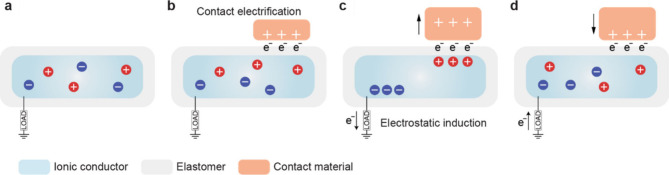
Potential generation mechanism of a TENG with soft materials. (a) The ionic conductor maintains charge balance in its initial state. (b) When two materials (contact material and elastomer) with different triboelectric properties come into contact and then separate, electrons transfer between them. (c) When the contact material moves away, the transferred electrons at the contact surface attract cations in the ionic conductor. The repelled anions generate current in the load by pushing electrons through the wire. (d) As the contact material approaches again, a reverse electron flow is induced by electrostatic induction.
17
17
TENGs using an ionic conductor. (a) Highly stretchable (∼330%), self-cleanable, and transparent (∼99.6%) TENG communicator with a conductive hydrogel and a chemically modified elastomer. Reproduced with permission from ref . Copyright 2018 Springer Nature under CC BY 4.0 http://creativecommons.org/licenses/by/4.0/. (b) TENG using self-healing (∼95%) and nondrying conductive organohydrogel. Reproduced with permission from ref . Copyright 2021 Elsevier. (c) A highly conductive and stretchable click-ionogel-based wearable TENG application operable over a wide temperature range (−75 to 340 °C). Reproduced with permission from ref . Copyright 2019 The American Association for the Advancement of Science under CC BY 4.0 http://creativecommons.org/licenses/by/4.0/. (d) Wearable and battery-free TENG ionic patch for rapid wound healing. Reproduced with permission from ref . Copyright 2021 Elsevier.
18
18
The two major mechanisms of thermoelectric generator (TEG). (a) The thermodiffusion effect caused by differences in ion mobility under a temperature gradient. (b) The thermogalvanic effect involving redox reactions at electrodes with different temperatures.
19
19
The gel-based thermoelectric generators with distinct ionic properties. (a) Bidirectionally tunable thermopower enabled by selective ion doping. Reproduced with permission from ref . Copyright 2022 The American Association for the Advancement of Science under CC BY 4.0 http://creativecommons.org/licenses/by/4.0/. (b) Modulated thermopower with ion mobility controlled by a phase-transition matrix. Reproduced with permission from ref . Copyright 2022 John Wiley and Sons. (c) Effective thermogalvanic properties in photocatalyst-doped hydrogels that have a high ion concentration difference. Reproduced with permission from ref . Copyright 2023 The American Association for the Advancement of Science. (d) Enhanced thermopower with synergistic thermodiffusion and thermogalvanic effect. Reproduced with permission from ref . Copyright 2020 The American Association for the Advancement of Science.
20
20
A power source driven by an ion concentration gradient. (a) Representative configuration of a power source based on an ion concentration gradient. (b) When they come into physical contact, the potential is generated by the ion-selective membranes.
21
21
Power sources using ion-selective membranes and gels. (a–c) Hydrogel-based soft power source with an ion-selective membrane inspired by an electric eel. Reproduced with permission from ref . Copyright 2017 Springer Nature. (a) Structure of electric organs of electric eel. (b) Artificial design of a hydrogel power source. (c) A hydrogel power source printed over a large area. (d,e) A microscale soft ionic power source. Reproduced with permission from ref . Copyright 2023 Springer Nature under CC BY 4.0 http://creativecommons.org/licenses/by/4.0/. (d) A process of power generation using a microscale soft ionic power source. (e) Image of a microscale soft ionic power source. (f,g) Highly stretchable hydrogel power source. Reproduced with permission from ref . Copyright 2024 The American Association for the Advancement of Science under CC BY 4.0 http://creativecommons.org/licenses/by/4.0/. (f) Host–guest interaction-based supramolecular cross-links for high stretchability. (g) Stable voltage generation under applied strain using a hydrogel power source.
22
22
The fundamental mechanisms and various strategies of piezoionics. (a) Potential generation in a neutral gel by an externally induced force. (b) Potential generation with fixed charges and mobile counterions. (c) Methods of ion trapping and releasing through various interactions and materials.
23
23
Various piezoionic devices utilizing ion selectivity and gel properties. (a) Piezoionic sensor mimicking the principle of biological tactile perception. Reproduced with permission from ref . Copyright 2022 American Association for the Advancement of Science. (b) High-current power source with selective ion adsorption and a pyramid-structured hydrogel. Reproduced with permission from ref . Copyright 2024 Springer Nature under CC BY 4.0 http://creativecommons.org/licenses/by/4.0/. (c) Force-induced ion generation sensing in a zwitterionic hydrogel. Reproduced with permission from ref . Copyright 2023 Springer Nature under CC BY 4.0 http://creativecommons.org/licenses/by/4.0/. (d) Ion-dipole interaction for ion trapping in a self-healable ionogel. Reproduced with permission from ref . Copyright 2022 Springer Nature under CC BY 4.0 http://creativecommons.org/licenses/by/4.0/.
24
24
Representative processes of the moisture electricity generator mechanism. (a) Anisotropic water adsorption through a water-permeable electrode. (b) Ion dissociation by adsorbed water molecules. (c) Ion diffusion driven by ion concentration difference.
25
25
Various strategies for moisture electricity generation. (a,b) Moisture-enabled electric generator using a hygroscopic gel. Reproduced from ref . Copyright 2025 Springer Nature under CC BY-NC-ND 4.0 https://creativecommons.org/licenses/by-nc-nd/4.0/. (a) Ion dissociation through moisture absorption in a hygroscopic gel. (b) Process of ion migration in hydrogel with photocatalytic effect. (c,d) Hydrogel based moisture-electric generator. Reproduced with permission from ref . Copyright 2024 Springer Nature under CC BY 4.0 http://creativecommons.org/licenses/by/4.0/. (c) Enhanced water absorption through a hygroscopic network. (d) Quantitatively calculated adsorption energy of various polymers and water molecules. (e) Selective ion transportation driven by directed water flow. Reproduced with permission from ref . Copyright 2024 Springer Nature under CC BY 4.0 http://creativecommons.org/licenses/by/4.0/. (f) Large-scale bilayer of polyelectrolyte film for moisture-enabled electric generation. Reproduced with permission from ref . Copyright 2021 Springer Nature.
26
26
A mechanism of electro-osmosis. Due to the formation of an EDL, counterions are gathered at the diffuse layer. When an electric field is applied, these ions move, causing the surrounding solution to flow in the same direction.
27
27
Electro-osmotic systems using gels. (a) Under an electric field, polyelectrolyte gels enable electro-osmosis, resulting in rapid swelling and thereby fast, strong actuation. (b) By utilizing electro-osmotic pressure along with the blocking force of the external layer, an actuation could be sufficiently strong to break bricks. Reproduced with permission from ref . Copyright 2022 The American Association for the Advancement of Science. (c) By harnessing the flexibility and shape-retainability of a hydrogel along with cracked electrodes, a high-energy density actuator could achieve diverse motion. Reproduced with permission from ref . Copyright 2020 American Chemical Society. (d) Wrinkled electrodes created by the gel’s deswelling process enhance both conductivity and mechanical flexibility, ultimately enabling insect-scale untethered soft aquabots that operate at voltages below 3 V. Reproduced with permission from ref . Copyright 2018 The American Association for the Advancement of Science. (e) Swelling mismatch and geometric confinement induce mechanical instability; when an electric field is applied, ions and solvents move rapidly, causing a snapping motion. Reproduced from ref . Copyright 2022 The American Association for the Advancement of Science under CC BY-NC 4.0 https://creativecommons.org/licenses/by-nc/4.0/
28
28
Mechanisms of ion polymer metal composite (IPMC). Two main mechanisms of IMPCs have been proposed: (a) cations and anions polarize toward the anode, causing bending due to size or hydration-radius differences, or (b) cations migrate toward the cathode, inducing an osmotic pressure that swells one side and shrinks the other. In both cases, ions and water in the gel drive the actuation, while electrons remain confined to the metal electrodes.
29
29
Applications of ion–polymer metal composite with gels. (a) Mitigation of water evaporation in early IPMCs through IL integration and vertically aligned nickel oxide nanowalls, enabling over 500,000 cycles and rapid ion intercalation. Reproduced with permission from ref . Copyright 2013 Royal Society of Chemistry. (b) High-deformation electro-ionic soft actuator with [EMIM]­[TFSI] and a covalent triazine framework in PIM-1, achieving 17.0 mm displacement at ±0.5 V and reduced phase delay. Reproduced with permission from ref . Copyright 2020 Springer Nature under CC BY 4.0 http://creativecommons.org/licenses/by/4.0/. (c) Biocompatible IPMC bioartificial muscles using functional carboxylated bacterial cellulose, polypyrrole nanoparticles, [EMIM]+[BF4], PEDOT:PSS, and DMSO for potential implant applications. Reproduced with permission from ref . Copyright 2020 John Wiley and Sons. (d) Micelle-based ion-conducting channel formation via amphiphilic Nafion and IL, resulting in a sub-1 s rise time, a 36-fold increase in bending displacement, and long-term stability. Reproduced with permission from ref . Copyright 2024 Springer Nature under CC BY 4.0 http://creativecommons.org/licenses/by/4.0/. (e) By mimicking plant osmotic strategies, reversible electro-osmosis and electrosorption can be harnessed to develop devices with tunable stiffness. Reproduced with permission from ref . Copyright 2019 Springer Nature under CC BY 4.0 http://creativecommons.org/licenses/by/4.0/. (f) Layered nanocomposite electrode gel using 2D MXene platelets and 1D cellulose nanofibrils, achieving electrical conductivity over 200 S cm–1, ionic conductivity above 0.1 S cm–1, and tensile strength near 100 MPa. Reproduced from ref . Copyright 2023 John Wiley and Sons under CC BY-NC-ND 4.0. http://creativecommons.org/licenses/by-nc-nd/4.0/.
30
30
A mechanism of a gel-based electrochromic system. When an electric field is applied, the electrochromic material undergoes a redox reaction, causing it to either deposit or dissolve. By alternating between colored and bleached states, the system generates visible color changes.
31
31
Gel-based electrochromic systems. (a) By using an ion-transport layer composed of an ionically cross-linked gel, a wide range of optical modulation and long-term stability can be achieved. Reproduced with permission from ref . Copyright 2013 Royal Society of Chemistry. (b) Thanks to the flexibility of the gel for ion transport, combined with MXene electrodes, the electrochromic device can be made highly flexible. Reproduced with permission from ref . Copyright 2021 Springer Nature under CC BY 4.0 http://creativecommons.org/licenses/by/4.0/. (c) Incorporating a thermoresponsive polymer (NIPAAm) enables both thermal and electrical stimuli control of the colored state. Reproduced with permission from ref . Copyright 2017 Royal Society of Chemistry. Since gels can be fabricated through various methods, gel-based electrochromic systems can be manufactured via multiple processes, including (d) transfer, (e) photopatterning, and (f) direct-ink writing. Reproduced with permission from ref . Copyright 2016 American Chemical Society. Reproduced with permission from ref . Copyright 2019 John Wiley and Sons. Reproduced with permission from ref . Copyright 2018 Royal Society of Chemistry.
32
32
Gel-based iontophoresis. (a) Operating principles of iontophoresis with gel-based substances. (b) High-intensity iontophoresis device for intraocular delivery of macromolecules and nanoparticles, employing the PEG hydrogel for an aqueous two-phase separation. Reproduced with permission from ref . Copyright 2021 John Wiley and Sons. Wearable iontophoretic device powered by (c) a TENG, and (d) an integrated Mg battery, eliminating the need for external power sources. Reproduced with permission from ref . Copyright 2019 John Wiley and Sons, and from ref . Copyright 2023 Springer Nature under CC BY 4.0 http://creativecommons.org/licenses/by/4.0/. (e) A closed-loop diabetes treatment system based on mesoporous microneedle platform made of PEG. Reproduced with permission from ref . Copyright 2021 John Wiley and Sons under CC BY 4.0 http://creativecommons.org/licenses/by/4.0/.

References

    1. Chun H., Chung T. D.. Iontronics. Annu. Rev. Anal Chem. (Palo Alto Calif) 2015;8:441–462. doi: 10.1146/annurev-anchem-071114-040202. - DOI - PubMed
    1. Cohen-Cory S.. The developing synapse: construction and modulation of synaptic structures and circuits. Science. 2002;298(5594):770–776. doi: 10.1126/science.1075510. - DOI - PubMed
    1. Branco T., Clark B. A., Häusser M.. Dendritic discrimination of temporal input sequences in cortical neurons. Science. 2010;329(5999):1671–1675. doi: 10.1126/science.1189664. - DOI - PMC - PubMed
    1. Hanlon R.. Cephalopod dynamic camouflage. Current biology. 2007;17(11):R400–R404. doi: 10.1016/j.cub.2007.03.034. - DOI - PubMed
    1. Song W. J., Lee Y., Jung Y., Kang Y.-W., Kim J., Park J.-M., Park Y.-L., Kim H.-Y., Sun J.-Y.. Soft artificial electroreceptors for noncontact spatial perception. Science advances. 2021;7(48):eabg9203. doi: 10.1126/sciadv.abg9203. - DOI - PMC - PubMed

LinkOut - more resources