Review

Multi-omics Quality Assessment in Personalized Medicine Through European Infrastructure for Translational Medicine (EATRIS): An Overview

EATRIS-Plus Multi-omics working group and Stakeholders. Phenomics. .

Abstract

Molecular characterization of a biological sample, e.g., with omics approaches, is fundamental for the development and implementation of personalized and precision medicine approaches. In this context, quality assessment is one of the most critical aspects. Accurate performance and interpretation of omics techniques is based on consensus, harmonization, and standardization of protocols, procedures, data analysis and reference values and materials. EATRIS, the European Infrastructure for Translational Medicine (www.EATRIS.eu), brings together resources and services to support researchers in developing their biomedical discoveries into novel translational tools and interventions for better health outcomes. Here we describe the efforts within the Horizon 2020 EATRIS-Plus project and activities of member facilities of EATRIS towards quality assessment of pre-clinical sample processing, clinical omics data generation, multi-omics data integration, and dissemination of the resources in a Multi-Omics Toolbox, which is the principal deliverable of the EATRIS-Plus project for the consolidation of EATRIS towards translational medicine.

Supplementary information: The online version contains supplementary material available at 10.1007/s43657-024-00170-0.

Keywords: European infrastructure for translational medicine; Multi-omics; Multi-omics toolbox; Quality; Reference samples.


Conflict of interest statement

Conflict of interestThe authors declare no competing interests.

Figures
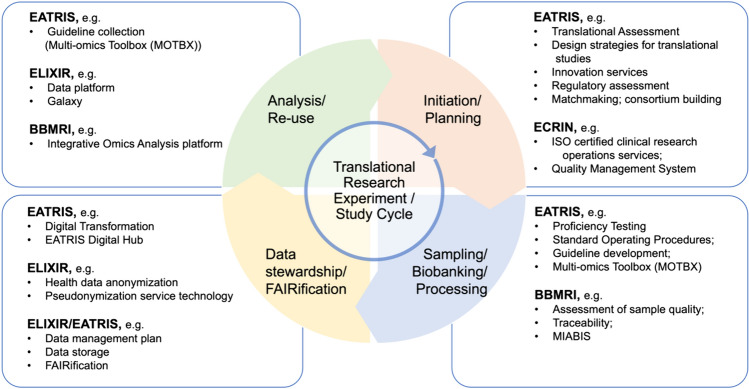
Fig. 1
Fig. 1
The translational biomedical process and involvement of selected biomedical Research Infrastructures (RIs) as stakeholders in quality assessment. EATRIS is involved in quality assessment checkpoints along the translational trajectory, while other RIs tend to focus on specific aspects or technologies. ECRIN, https://ecrin.org; BBMRI-ERIC, https://bbmri-eric.eu; Elixir, https://elixir-europe.org
Fig. 2
Fig. 2
External quality assessment. History of z-Scores of one of the four EATRIS-Plus omics sites participating in the “RNA Extraction from Whole Blood” scheme (a), and “RNA Extraction from FFPE Tissue”-scheme of the IBBL PT program from 2020 until 2022 (b). In the long run, a large proportion of results giving rise to |z|> 2 (more than 5%) and |z|> 3 (more than 0.3%) indicates either a biased mean, or a standard deviation of the participant which is higher than the Proficiency Testing Standard Deviation. The participating site used a magnetic bead-based RNA isolation method, whereas the comparative score “All results” is an average z-Scores from all participants using magnetic bead-based, silica membrane-based or other RNA isolation methods. FFPE, formalin-fixed paraffin-embedded
Fig. 3
Fig. 3
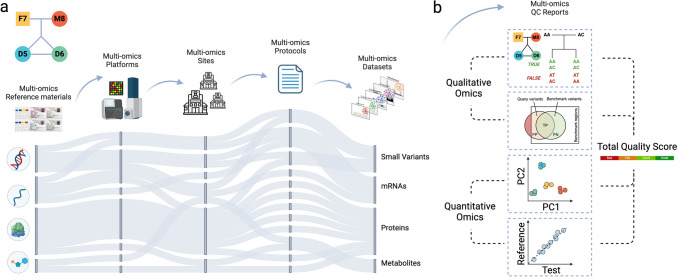
The Chinese Quartet reference materials and the quality assessment system. a Data generation by using Quartet reference materials across multiple platforms, sites, and protocols. b visual representation of several quality assessment parameters. The quality assessment system is embedded on the Quartet Data Portal (https://chinese-quartet.org/#/dashboard). A total quality score is calculated from several individual aspects of quality, for qualitative omics including Mendelian concordance rate and F1 score and for quantitative omics including signal-to-noise ratio (SNR) and relative correlation with reference dataset (RC) (Zheng et al. 2023). QC Quality control; PC principal component
Fig. 4
Fig. 4
Quality assessment of multi-omics, multi-site, and multi-protocol datasets in proficiency testing. Chinese Quartet reference material was subjected to omics analysis in different EATRIS-Plus facilities. a The total quality scores of all datasets with ranking labels among all historical datasets in genomics, transcriptomics, proteomics and metabolomics. The label “Bad”, “Fair”, “Good” or “Great” manifests as the dataset ranking below the lower 20%, the 50%, the upper 20%, or above the upper 20% quantiles of the historical datasets. be Scatter plots of quality assessment results in genomics (b), transcriptomics (c), proteomics (d) and metabolomics (e) data; each datapoint shows the values of specific QC metrics across the samples in each dataset. F1-Score is the harmonic mean of precision and recall for variant calling. Signal-to-noise ratio (SNR) is defined as the ratio of the power of a signal to the power of noise. RC, the relative correlation with reference datasets, was calculated based on the Pearson correlation coefficient between the relative expression levels of a dataset for a given pair of groups and the corresponding reference fold-change values. CV Coefficient of variation. All historical datasets are colored gray to be distinguished from the tested datasets. All scatter plots were added with frequency distribution bars. Table S1 provides information on key aspects of the workflows. Table S2 provides the coordinates of the data points
Fig. 5
Fig. 5
The multi-omics toolbox (MOTBX). The MOTBX  (https://motbx.eatris.eu) is an open access knowledge hub for translational researchers supporting development, implementation and adoption of multi-omics approaches for personalized medicine, including quality assessment aspects. The MOTBX has been developed by EATRIS-Plus partners across Europe to support the translational biomedical research communities, as the result of collaborative work on data stewardship, the generation of a multi-omics dataset of healthy individuals, quality assessment studies, and the help and input of stakeholders from industry and academia

References

    1. Ahmad A, Imran M, Ahsan H (2023) Biomarkers as biomedical bioindicators: approaches and techniques for the detection, analysis, and validation of novel biomarkers of diseases. Pharmaceutics. 10.3390/pharmaceutics15061630 - PMC - PubMed
    1. Ahmed Z (2022) Multi-omics strategies for personalized and predictive medicine: past, current, and future translational opportunities. Emerg Top Life Sci 6(2):215–225. 10.1042/ETLS20210244 - PubMed
    1. Ali S, Abuhmed T, El-Sappagh S et al (2023) Explainable artificial intelligence (XAI): what we know and what is left to attain trustworthy artificial intelligence. Inform Fusion. 10.1016/j.inffus.2023.101805
    1. Analytical Method Committee TRSoC (2010) The role of proficiency testing in method validation. Accredit Qual Assur 15(2):73–79. 10.1007/s00769-009-0560-5
    1. Argelaguet R, Arnol D, Bredikhin D et al (2020) MOFA+: a statistical framework for comprehensive integration of multi-modal single-cell data. Genome Biol 21(1):111. 10.1186/s13059-020-02015-1 - PMC - PubMed

LinkOut - more resources