


Impact of Domestication on Floral Traits and Rewards: A Comparison Between Wild and Domesticated Squash (Cucurbita)
- PMID: 40896107
- PMCID: PMC12397498
- DOI: 10.1002/ece3.72028
Impact of Domestication on Floral Traits and Rewards: A Comparison Between Wild and Domesticated Squash (Cucurbita)
Abstract
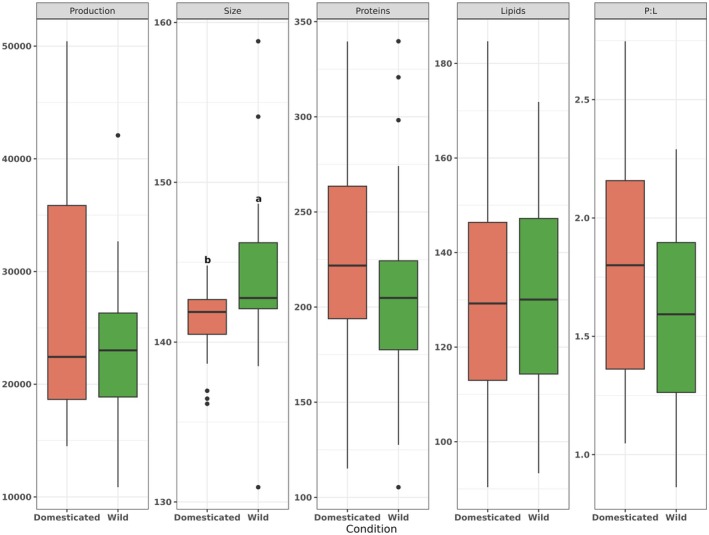
Plant domestication primarily targets traits of direct human interest, such as fruit and seed characteristics; however, its indirect effects on other traits, including floral morphology and rewards (nectar and pollen), remain less understood. In this study, we investigated how domestication has influenced floral traits and rewards in domesticated and wild species of the genus Cucurbita. We compared three domesticated and three wild Cucurbita species in an experimental plot. We measured floral morphological traits, nectar volume, sugar (fructose, glucose, and sucrose), and amino acid concentrations in staminate and pistillate flowers. In addition, we evaluated pollen production and size, as well as protein and lipid concentrations, and the protein: lipid ratio in staminate Cucurbita flowers. Our results show that domesticated Cucurbita species exhibit larger floral morphological traits in both pistillate and staminate flowers compared to their wild relatives. While nectar volume increased in domesticated species, sugar and amino acid concentrations remained unchanged. In contrast, domestication had no significant effect on pollen traits, including production, size, and protein and lipid content. These findings highlight that domestication differentially affects floral traits: while floral morphology is significantly altered, most of the traits of floral rewards remain largely unaffected. This conservation may arise from the recent evolutionary history of these species and their close coevolutionary relationship with Eucera bees, emphasizing pollinator nutritional needs over artificial selection. These results underscore the complex interplay between domestication, resource allocation, and plant-pollinator interactions in shaping floral traits.
Keywords: artificial selection; flower morphology; nectar; phenotypic variation; pollen.
© 2025 The Author(s). Ecology and Evolution published by British Ecological Society and John Wiley & Sons Ltd.
Conflict of interest statement
The authors declare no conflicts of interest.
Figures


References
-
- Bai, S.‐L. , Peng Y.‐B., Cui J.‐X., et al. 2004. “Developmental Analyses Reveal Early Arrests of the Spore‐Bearing Parts of Reproductive Organs in Unisexual Flowers of Cucumber (<styled-content style="fixed-case"> Cucumis sativus </styled-content> L.).” Planta 220: 230–240. - PubMed
-
- Baker, H. G. , and Baker I.. 1983. “Floral Nectar Sugar Constituents in Relation to Pollinator Type.” In Handbook of Pollination Biology, edited by Jones C. E. and Little R. J., 117–141. Van Nostrand Reinhold.
-
- Balvino‐Olvera, F. J. , Sánchez‐Gómez K. F., Lobo J. A., et al. 2017. “Latitudinal Structured Populations of the Mexican Wild Squash <styled-content style="fixed-case"> Cucurbita argyrosperma </styled-content> Subsp. sororia Revealed by Microsatellite Markers.” Crop and Pasture Science 68: 850.
LinkOut - more resources
Full Text Sources
