


How place shapes genital herpes simplex distribution in South Korea: a Bayesian spatial analysis using National Health Insurance Service data
- PMID: 40898057
- PMCID: PMC12403936
- DOI: 10.1186/s12889-025-24171-4
How place shapes genital herpes simplex distribution in South Korea: a Bayesian spatial analysis using National Health Insurance Service data
Abstract
Background: Genital herpes simplex (GHS) infections have increased in South Korea over the past decade, yet the geographic distribution of GHS incidence rates remains poorly understood. This study examined the geographic distribution of GHS incidence rates across South Korea and identified place-specific risk factors to inform targeted prevention strategies.
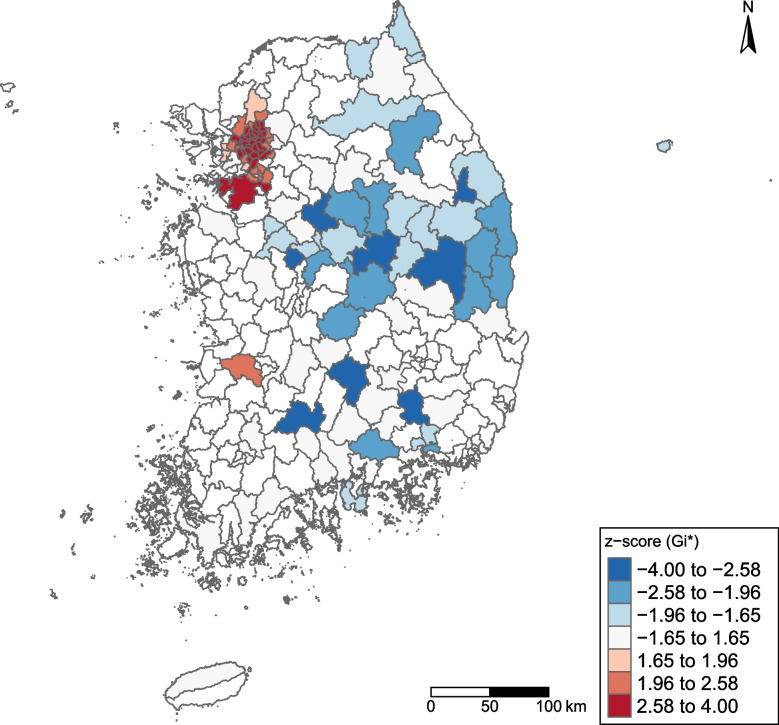
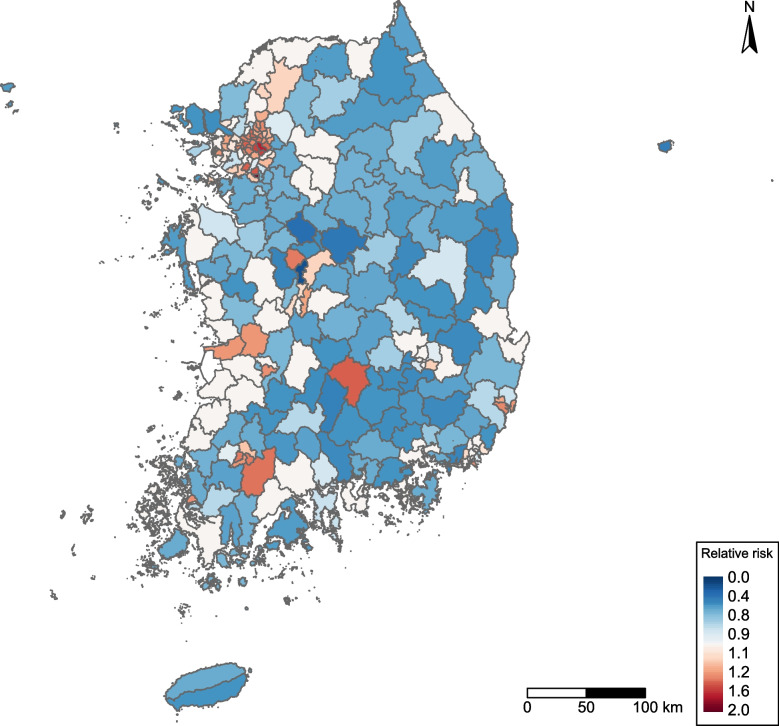
Methods: Using the Korean National Health Insurance Service data from 2019, we analyzed age-standardized GHS incidence rates across 250 municipalities in South Korea. Spatial autocorrelation was assessed using Global Moran's I and hot spots were identified using the Getis-Ord Gi* analysis. Bayesian hierarchical regression models were used to quantify the associations between regional risk factors and GHS risk while accounting for spatial dependence. The area-specific posterior mean was used to map the relative risk (RR) of GHS.
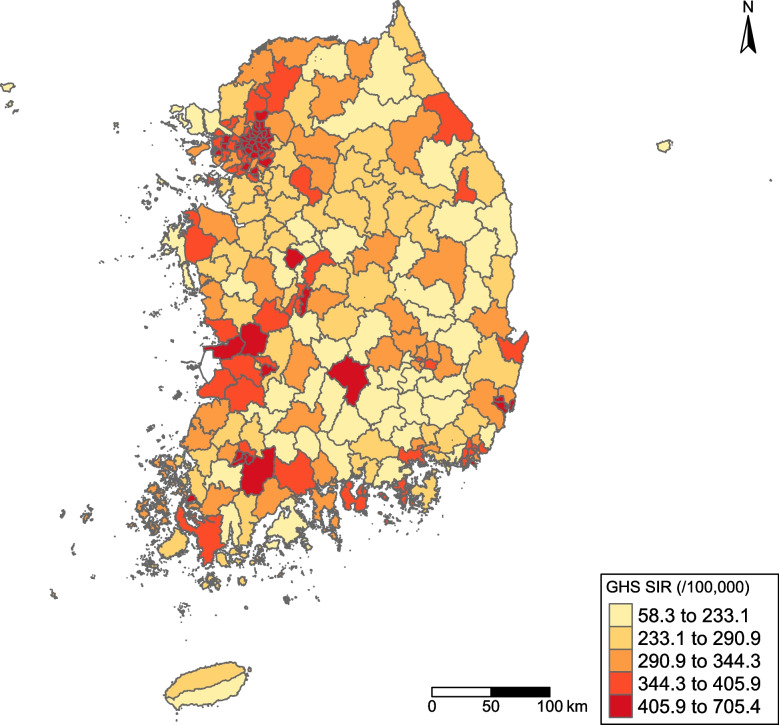
Results: In total, 182,289 patients with GHS were identified. Significant positive spatial autocorrelation was observed (Moran's I = 0.431, p < 0.001), with distinct hot spots concentrated in the Seoul Capital Area. After adjusting for covariates and spatial effects, the proportion of single-person households (RR = 1.026, 95% credible interval (CrI) = 1.017-1.035) and sexual violence risk (2nd quartile: RR = 1.106, 95% CrI = 1.018-1.201; 3rd quartile: RR = 1.095, 95% CrI = 1.003-1.195) were significant place-based risk factors associated with higher GHS incidence rates. High-risk areas for GHS were found in the Seoul Capital Area and some mid-southern cities.
Conclusions: This study reveals distinct geographic patterns in GHS incidence rates that are not fully explained by demographic composition alone. The significant associations with household structure and sexual violence risk suggest that place-specific social contexts influence GHS incidence rates. These findings highlight the importance of spatially targeted interventions to address contextual vulnerabilities in regions with high GHS incidence rates.
Keywords: Bayesian spatial modeling; Genital herpes simplex; Sexually transmitted infections; South Korea; Spatial epidemiology.
© 2025. The Author(s).
Conflict of interest statement
Declarations. Ethics approval and consent to participate: This study was approved by the Institutional Review Board (IRB) of Korea University (IRB number: KUIRB- 2021–0382–01). Consent for publication: Not applicable. Competing interests: The authors declare no competing interests.
Figures
References
-
- World Health Organization. Global progress report on HIV, viral hepatitis and sexually transmitted infections, 2021: accountability for the global health sector strategies 2016–2021: actions for impact. 2021.
-
- Groves MJ. Genital herpes: a review. Am Fam Physician. 2016;93:928–34. - PubMed
-
- Korea Disease Control and Prevention Agency. Korean sexually transmitted infection guidelines 2023 revision. 2023. p.
MeSH terms
Grants and funding
LinkOut - more resources
Full Text Sources
Medical
Molecular Biology Databases
Miscellaneous
