


Analysis of the efficacy of conventional, skeletal and invisible orthodontic appliance for upper molar distalization in Class II Malocclusion patients: a systematic review and meta-analysis
- PMID: 40898166
- PMCID: PMC12403286
- DOI: 10.1186/s12903-025-06378-4
Analysis of the efficacy of conventional, skeletal and invisible orthodontic appliance for upper molar distalization in Class II Malocclusion patients: a systematic review and meta-analysis
Abstract
Background/objectives: To assess the efficacy of conventional, skeletal and invisible orthodontic appliance for maxillary first molar distalization.
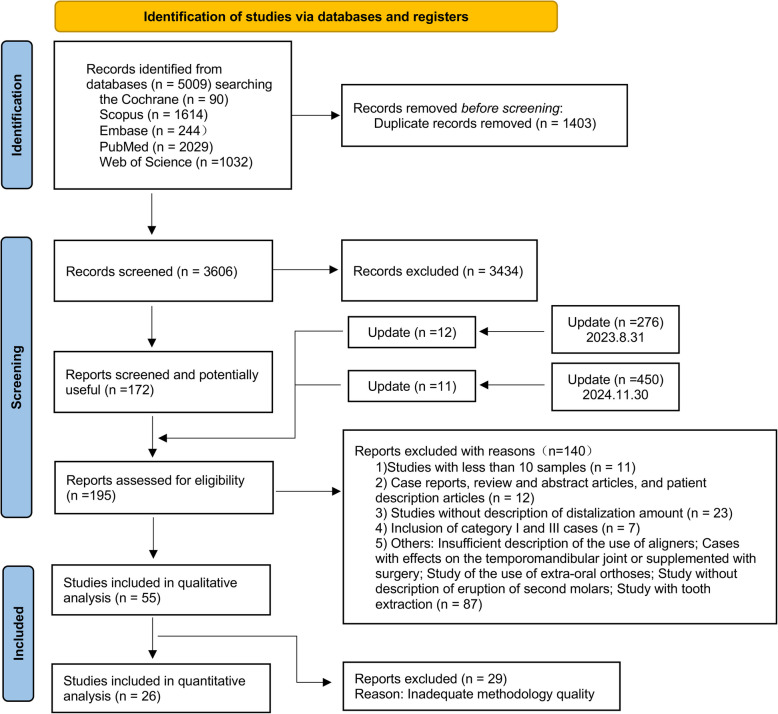
Methods: On February 14, 2023, an electronic search was conducted to review molar distalization using conventional, skeletal and invisible appliance, and two updated searches were conducted on August 31, 2023 and November 31,2024. After study selection, data extraction and risk of bias assessment, meta-analyses were performed for molar distalization, molar tipping, incisor movement, incisor tipping and mandibular plane angle change using random-effects model.
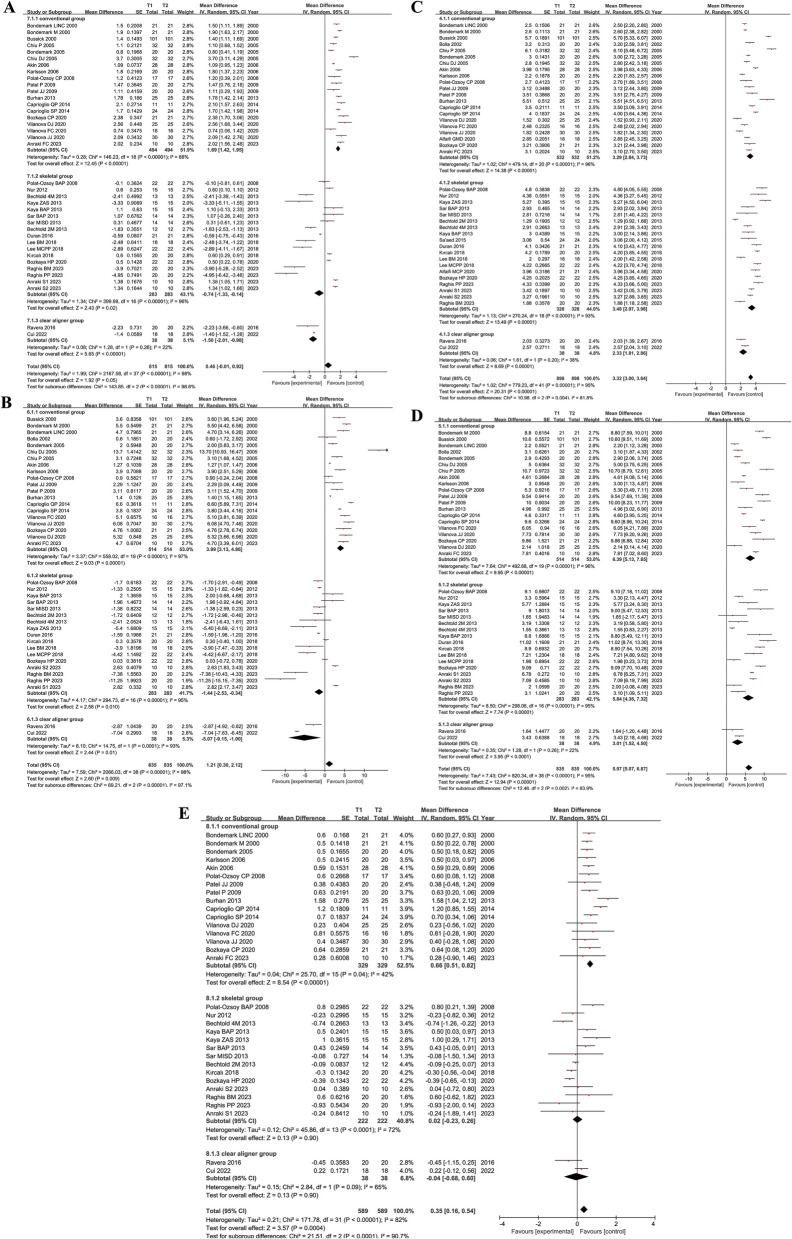
Results: 55 studies fulfilled inclusion criteria, and 26 studies underwent meta-analysis. The clear aligner group demonstrated a significant reduction in upper molar distalization and tipping (2.33mm; 3.01°) compared to conventional appliance (3.29mm; 6.39°) and skeletal appliance (3.48mm; 5.84°) groups. Conventional appliance group experienced a significantly greater loss of anchorage (1.69mm; 3.99°) and a greater increase in mandibular plane angle (0.66°). Molar distalization after the eruption of the maxillary second molar may lead to greater loss of anchorage (1.76mm; 3.99°). 4-premolar-support group (4.09mm; 8.24°) appeared to produce more molar distalization and tipping than 2-premolar-support group (2.72mm; 4.90°). Buccal-miniscrew subgroup exhibited a smaller molar distalization(2.01mm) compared to palatal-miniscrew (3.81mm) and infrazygomatic-miniscrew subgroups(4.90mm).
Conclusions: The use of clear aligners resulted in a decrease in molar distal tipping but also led to a reduction in distalization, while the use of conventional appliances resulted in higher anchorage loss and a greater increase in mandibular plane angle. Distalization after the eruption of U7 may increase the risk of anchorage loss. 4-premolar-support anchorage improved the molar distalization, but also increased molar tipping in comparison to 2-premolar-support anchorage. Alternatively, palatal miniscrew support resulted in higher distal tipping but less incisor distal movement and tipping. However, additional RCTs or prospective studies are strongly recommended to provide further clinical evidence.
Keywords: Clear aligner; Conventional appliance; Molar distalization; Skeletal anchorage.
© 2025. The Author(s).
Conflict of interest statement
Declarations. Ethics approval and consent to participate: Not applicable. Consent for publication: Not applicable. Competing interests: The authors declare no competing interests.
Figures


References
-
- Lombardo G, Vena F, Negri P, Pagano S, Barilotti C, Paglia L, et al. Worldwide prevalence of malocclusion in the different stages of dentition: a systematic review and meta-analysis. Eur J Paediatr Dent. 2020;21(2):115–22. 10.23804/ejpd.2020.21.02.05. Available from: http://www.ncbi.nlm.nih.gov/entrez/query.fcgi?cmd=Retrieve&db=pubmed&dop.... - PubMed
-
- Keim RG, Berkman C. Intra-arch maxillary molar distalization appliances for class ii correction. J Clin Orthod. 2004;38(9):505–11. Available from: http://www.ncbi.nlm.nih.gov/entrez/query.fcgi?cmd=Retrieve&db=pubmed&dop.... - PubMed
-
- Janson G, Maria FRT, Barros SEC, de Freitas MR, Henriques JFC. Orthodontic treatment time in 2- and 4-premolar-extraction protocols. Am J Orthod Dentofacial Orthop. 2006;129(5):666–71. 10.1016/j.ajodo.2005.12.026. Available from: https://linkinghub.elsevier.com/retrieve/pii/S0889540606000126.. - PubMed
-
- Bondemark L, Karlsson I. Extraoral vs intraoral appliance for distal movement of maxillary first molars: a randomized controlled trial. Angle Orthod. 2005;75(5):699–706. Available from: https://www.embase.com/search/results?subaction=viewrecord&id=L41297030&.... - PubMed
-
- Kinzinger GSM, Eren M, Diedrich PR. Treatment effects of intraoral appliances with conventional anchorage designs for non-compliance maxillary molar distalization. A literature review. Eur J Orthod. 2008;30(6):558–71. 10.1093/ejo/cjn047. Available from: https://go.exlibris.link/gvwXm28T. - PubMed
Publication types
MeSH terms
LinkOut - more resources
Full Text Sources
