


Investigating effective factors on musculoskeletal pain prevention behaviors in the elderly population living in nursing homes, based on the health belief model: structural equation modeling approach
- PMID: 40903726
- PMCID: PMC12406486
- DOI: 10.1186/s12877-025-06229-5
Investigating effective factors on musculoskeletal pain prevention behaviors in the elderly population living in nursing homes, based on the health belief model: structural equation modeling approach
Abstract
Background: The world's elderly population is increasing. Due to the increase in musculoskeletal disorders in this group and the multifactorial nature of this disease, this study investigated the effective factors in preventing musculoskeletal pain in the elderly living in nursing homes, based on the Health Belief Model.
Methods: A cross-sectional design was conducted with a random sample of 311 older adult nursing home residents in the Kahrizak nursing home, whose aims were to identify the determinants influencing musculoskeletal pain prevention practices (intake of vitamin D, stress management, and correct body posture). Health Belief Model (HBM) questionnaires were employed to gather data, Visual Analog Scale (VAS) for pain severity, and the Depression, Anxiety, and Stress Scale (DASS). Data analysis was done using SPSS version 22 software and statistical indicators (frequency, percentage, and correlation). This study applied the Partial Least Squares technique of Structural Equation Modeling (PLS-SEM) using Smart PLS software to test the proposed relationships among the study variables. AMOS was employed to verify the hypothesized relationships between the constructs of the HBM using covariance-based structural equation modeling, whereas Smart PLS was utilized to evaluate the predictive performance of the model, especially for formative constructs like cues to action.
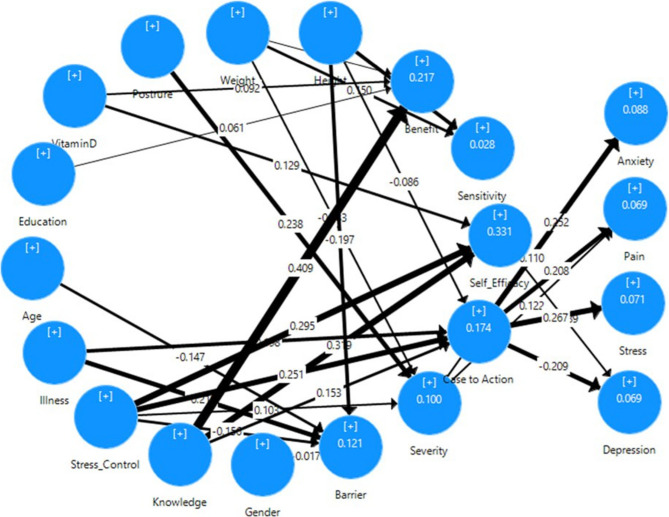
Results: The average age of the elderly was 75.3. The correlation between age, weight, and depression was significant. The highest R² value for cues to action was 0.426. Results showed that knowledge had a strong impact on perceived benefits and self-efficacy, perceived sensitivity and severity had moderate impacts, and perceived barriers had a negative correlation with preventive behaviors. R² value of 0.426 indicated that measures like knowledge, self-efficacy, and stress management captured some variance on the construct cues to action and are an important element in HBM's core model, driving seniors to perform musculoskeletal pain prevention activities.
Conclusion: Given that cues to action were a significant predictor of doing MSD preventive behaviours, frequent reminder mechanisms, such as daily reminders or educational programming, are recommended to convince older adults to take preventive measures, including vitamin D intake and correct posturing.
Trial registration: IRCT20220904055881N1. Registered on 11 February 2023.
Keywords: Elderly; Health belief model; Musculoskeletal disorder; Pain; Structural equation modeling.
© 2025. The Author(s).
Conflict of interest statement
Declarations. Ethics approval and consent to participate: This study has received ethical approval from the Ethics Committee of Tarbiat Modares University (IR. MODARES. REC.1401.111), and it was registered with the Iranian Clinical Trial Registration (IRCT20220904055881N1). Informed written consent was obtained from all the participants after a verbal explanation of the study’s objectives and their rights. Consent forms were provided in simple language and large print to the elderly population. The data were stored anonymously using identification codes within a secure database. Access to the data was restricted to the research team, and no identifying data were included in the reports. To protect vulnerable older participants, stringent inclusion criteria and close monitoring of the data collection process were employed. Consent for publication: Not applicable. Competing interests: The authors declare no competing interests.
Figures
References
-
- World Health Organization. Available from: https://www.who.int/news/item/30-09-2019-who-launches-digital-app-to-imp.... Accessed 02 Aug 2025.
-
- United Nations Department of Economic and Social Affairs. Population Division. Available from: https://population.un.org/wpp/DataQuery/. Accessed 02 Aug2025.
-
- Qadmpur E, Karami A, Khodarahimi S. Comparison of spiritual well-being, ambiguity tolerance, and happiness in elderly people living in homes and nursing homes. Q J Med Ethics. 2019;13(44):1–13.
-
- Centers for Disease Control and Prevention. Available from: https://www.cdc.gov/niosh/topics/aircrew/musculoskeletaldisorders.html. Accessed 2017.
-
- World Health Organization. Available from: https://www.who.int/news-room/fact-sheets/detail/musculoskeletal-conditions. Accessed 2021.
MeSH terms
LinkOut - more resources
Full Text Sources
Medical
