Review
. 2025 Oct 1;54(19):8888-8924.
doi: 10.1039/d4cs01037j.

Advances in applied supramolecular technologies 2021-2025

Affiliations
Review

Advances in applied supramolecular technologies 2021-2025

Dominick E Balderston et al. Chem Soc Rev. .

Abstract

Supramolecular chemistry is a rapidly evolving field that has focused on building a foundation of fundamental understanding in controlling molecular self-assembly, through the use of non-covalent interactions. A common criticism of the field is that whilst the systems produced are very elegant, they do not have real-world use. Therefore, focus is now moving to applying the fundamental understanding of supramolecular chemistry to the production of commercially viable products. Building on our previous review in this area, which described the translational potential of innovations within the field of supramolecular chemistry up to the year 2020, we now review the progress of this field over the years 2021-2025 with the aim to inspire researchers to apply supramolecular chemistry to solve real world problems, moving innovation out of the laboratory and into the commercial marketplace.


Conflict of interest statement

PAG is a member of Chemical Society Reviews Advisory Board and is a former Chair of the Editorial Board.

Figures

Fig. 1
Fig. 1. Chemical structures of (A) α-CD (B) β-CD and (C) γ-CD.
Fig. 2
Fig. 2. (A) Chemical structure of cucurbit[n]urils (CB). (B) Illustration depicting the virucidal antiviral effect of CB[7].
Fig. 3
Fig. 3. Overview of the roll-to-roll (R2R) production of photonic films from cellulose nanocrystals (CNC) (A) activation of the polymer substrate via corona etching. (B) Deposition of CNC suspension onto a polymer substrate. (C) Static drying of the CNC film at room temperature. (D) Stepwise hot air drying of the CNC film. (E) Peeling of the CNC film from the polymer substrate. (F) Red, green, and blue CNC films on a black polymer substrate. (G) Free-standing CNC film. (H) Pristine (left) and heat-treated (right) photonic CNC particles in varnish. (I) Heat-treated photonic particles in ethanol (left), 50% aqueous ethanol (centre), and water (right). Reproduced from ref. with permission from Springer Nature, copyright 2021.
Fig. 4
Fig. 4. (A) Chemical structure of SLIC polymer. (B) Illustration depicting the effect of stretching the SLIC polymer. (B) Is reproduced from ref. under creative commons license CC BY 4.0.
Fig. 5
Fig. 5. Diagram depicting the intermolecular interactions between CB, PC, and Li+ ions within the electrolyte.
Fig. 6
Fig. 6. (A) Chemical structure of tetrahydroxy-1,4-benzoquinone disodium salt and (B) quinone-fused aza-phenazines 1–3.
Fig. 7
Fig. 7. Chemical structure of the macrocyclic aniline MA[6], as well as the emeraldine salt and emeraldine base forms.
Fig. 8
Fig. 8. Schematic of the supramolecular perovskite interface and the dual host–guest complexation strategy.
Fig. 9
Fig. 9. Photoswitches developed by Han and co-workers which are orientated by supramolecular interactions to enable efficient cycoadditions: (A) styrylpyrilliums, (B) 9,10-di-substituted anthracenes and (C) p-functionalised phenylbenzoxazoles.
Fig. 10
Fig. 10. Structure of boronic based probes (A) Mc-CDBA and (B) Ca-CDBA.
Fig. 11
Fig. 11. Fluorescence and glucose sensitivity of Ca-CDBA and Mc-CDBA (A) fluorescence response (FF0)/F0) of Mc-CDBA and Ca-CDBA to alternate saccharides at a 1.56 mM concentration. (B) Linear fluorescence response of Mc-CDBA (10 μM) to increasing glucose concentrations (0–195 μM). (C) pH dependent fluorescence intensity of 10 μM Mc-CDBA in PBS buffer. (D) pH dependent fluorescence intensity of 10 μM Mc-CDBA in various glucose concentrations (0–0.1 M). Measurements of both Mc-CDBA and Ca-CDBA were analysed in 0.5% MeOH/PBS buffer and 0.5% DMSO/PBS buffer, respectively, pH = 7.4 at 25 °C (Mc-CDBA, λex/em = 393/457 nm; Ca-CDBA, λex/em = 382/438 nm). Data are presented as the means ± SD (n = 3). Reproduced from ref. with permission from Journal of the American Chemical Society copyright 2023.
Fig. 12
Fig. 12. Confocal microscopy images of zebrafish embryos (1–10 days post fertilisation) incubated for 3 hours with 50 μM Mc-CDBA. Reproduced from ref. with permission from journal of the American Chemical Society copyright 2023.
Fig. 13
Fig. 13. In vivo fluorescence imaging of Ca-CDBA and Mc-CDBA in zebrafish embryos. (A) Confocal fluorescence images in zebrafish embryos 7 days post-fertilisation pre-treated for 4 hours with a blank medium (i) and (ii), and 20 μM ampkinone (iii) followed by a 1-hour incubation with 50 μM Mc-CDBA (ii) and (iii). (B) Confocal fluorescence images in zebrafish embryos 7 days post-fertilisation pre-treated for 4 hours with a blank medium (i) and (ii), and 20 μM ampkinone (iii) followed by a 1-hour incubation with 50 μM Ca-CDBA (ii) and (iii). Imaging was performed using a Leica TCS SP8 confocal microscope (excitation at 405 nm; emission collected at 410–600 nm). Data are presented as mean values (n = 5); ****P < 0.0001. Scale bar = 500 μm. Reproduced from ref. with permission from Journal of the American Chemical Society copyright 2023.
Fig. 14
Fig. 14. (A) The bis-anthracenyl macrocycle that achieved glucose binding in aqueous conditions (Ka = 60 M−1) and (B) the chemical structure of ‘GluHUT’.
Fig. 15
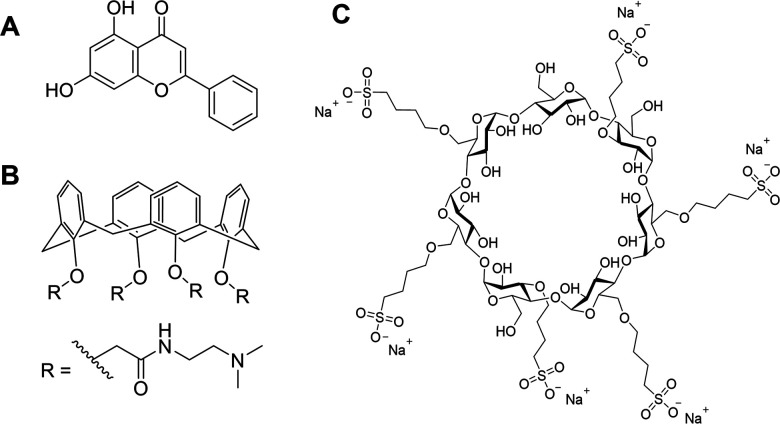
Fig. 15. The chemical structure of (A) chrysin, (B) calixarene 0118 (OTX008) and (C) sulfobutylated β-CD (SBECD).
Fig. 16
Fig. 16. The hierarchical self-assembly of a hydrogel through the non-covalent interactions of monomers.
Fig. 17
Fig. 17. A biodegradable hydrogel that enables the monitoring of chemotherapeutic drug photoacoustically. Here, MB-Dox is loaded into a DNA cross-linked hydrogel. The MB-Dox retains an activatable wavelength-specific photoacoustic signal both when loaded and following drug release. Reproduced from ref. with permission from Advanced Science copyright 2022.
Fig. 18
Fig. 18. The structure of hydroxyapatite (HA) hydrogel structure and gel–sol transitions under a load.
Fig. 19
Fig. 19. The structure of the texaphyrin based oxaliplatin drug conjugate OxaliTex.
Fig. 20
Fig. 20. (A) The dimer structure of UPy, highlighting the 4 hydrogen bonds formed. (B) The self-healing and the strength capable of the UPy containing polymer from reproduced from Zhang et al. with permissions from Elsevier, copywrite 2022. (C) The phase changes of Suprapolix produced, UPy modified Kraton®, (poly(ethylene-co-butylene). Highlighting the phase behaviour change due to the supramolecular interactions. Reproduced from Bosman et al. with permission from Elsevier, copyright 2004.
Fig. 21
Fig. 21. (A) Schematic overview of crosslinked polymers versus slide-ring polymers and their differing response to strain. (B) The structure of the supramolecular elastomer, PAcγCDAAmMe produced by Nomimura et al.
Fig. 22
Fig. 22. (A) The structure of P(TUEG3-co-TUCy2M). (B) The hydrogen bonding patterns of thiourea and the tacking patterns of dicyclohexylmethane units.
Fig. 23
Fig. 23. (A) Molecular structures of SHMP (orange) and a Gu-based monomer (alkylGu2) (blue), spontaneously liquid–liquid phase separating upon mixing at a molar ratio of 1 : 3. Leading to two macroscopically separated phases: a water-rich upper phase containing Na+ and SO42−, and a condensed lower-phase containing a 3D cross-linked supramolecular polymer network between HMP and alkylGu2. (B) A plastic film formed by the evaporation of the condensed phase followed by hot pressing. Made available by the Aida lab at https://www.aidacreativehub.com/. (C) 3D printed objects from the Gu-ChS polymers. Reproduced from work by Cheng et al. under creative commons license CC BY 4.0.
Fig. 24
Fig. 24. (A) The structures of the two hydrogels formed by Osaki et al., containing the host–guest units of β-CD and Ad and the condensation units of carboxyl and amino groups. (B) Schematic overview of the host–guest interaction facilitating the correct spatial distance to facilitate the condensation reaction.
Fig. 25
Fig. 25. Schematic of the fabrication and structure of SC(DMAAm).
Fig. 26
Fig. 26. (A) CC3, a porous organic cage developed by Cooper and colleagues; (B) the formation of crystalline CC3 membranes at the interface between two immiscible solvents. The membranes reversibly transition between two crystalline phases in response to the solvent environment.
Fig. 27
Fig. 27. (A) Two views of the hexagonal units within the 3D honeycomb-like frameworks in the HOF reported by Stoddart and colleagues for hydrogen storage; (B) catenation of two hexagons linking two distinct layers (green and purple) within the HOF material.
Fig. 28
Fig. 28. (A) Reversible binding of an analyte to a chemosensor. (B) Irreversible reaction-based recognition of an analyte with a chemodosimeter.
Fig. 29
Fig. 29. (A) A general schematic showing the insertion of a pore-forming toxin released by bacteria into the phospholipid vesicle membrane, triggering the release and ‘turn-on’ of a self-quenched fluorescent dye. (B) A photograph of the working wound dressing under visible light. (C) A photograph of the wound dressing model demonstrating its specificity of Enterococcus faecalis, Pseudomonas aeruginosa and Staphylococcus aureus over Escherichia coli. (B) and (C) Reproduced with from ref. and with permission from ACS, copyright 2016.
Fig. 30
Fig. 30. A schematic representation of the self-quenching an analyte induced fluorescence turn on mechanism of the dimer dyes.
Fig. 31
Fig. 31. The aggregation induced emission phenomenon exemplified by tetraphenyletheylene.
Fig. 32
Fig. 32. (A) The structure and activation of the bis(2-(2-hydroxybenzylidene)amino)aryl disulfides by biological thiols to form fluorescent AIEgens. Fluorescent microscopy images of HeLa cells treated with (B) photoactivated AIEgen (50 μM), (C) BODIPY493/503 and (D) a merged image of the two. Reproduced with ref. and under creative commons license CC BY 4.0.
Fig. 33
Fig. 33. (A) The structure of the AIEgen developed by Yan and co-workers for imaging renal fibrosis. Live mouse fluorescence image of healthy mice (B) and those with induced renal fibrosis (C) after injection of AIEgen. Reproduced from ref. and with permission from Wiley, copyright 2022.
Fig. 34
Fig. 34. (A) Hydrogen bond mediated complexation between poly(4-vinylpyridine) and a hydroxy azobenzene. (B) A schematic representation of the measurement set up used to measure the changing rate of thermal reversion; the orange bar represents a thin film (10 μm) of PVP-azo which is placed on top of a transparent substrate. (C) A typical thermal reversion measurement of the cis to trans isomerisation of an azobenzene measured in the set up. Adapted from ref. and under creative commons license CC BY 4.0.
Fig. 35
Fig. 35. Chemical structures of the POCs used as sensors for humidity ((A) ref. and (B) ref. 286) and organic vapours ((C) ref. 287). (D) A general schematic showing how a POC-based robot could grip and then release a cotton ball by having three thin films twisting around it when immersed in a chamber of either acetone or ethanol.
Fig. 36
Fig. 36. Gold recovery processes using cyclodextrins: (A) additive-induced supramolecular polymerisation, in which the addition of an additive causes the precipitation of gold-containing solids; (B) a schematic representation of the supramolecular stripping process to remove immobilised Au(CN)2 from the surface of activated carbon.
Fig. 37
Fig. 37. A schematic depiction of the solid-state structure of [HPAL][AuCl4], a gold containing precipitate enabling the isolation of gold from electronic waste.
Fig. 38
Fig. 38. A schematic depiction of the synergistic liquid–liquid extraction of rhodium ions from iridium-containing mixtures. LA = PrimeneTM 81R, a mixture of isomers with R = C12–14H26–30.
Fig. 39
Fig. 39. The structure of the strapped calix[4]pyrrole reported by Sessler, which contains a methacrylate unit for cross-linking into a polymeric gel.
Fig. 40
Fig. 40. (A) Chemical structure of the POC for selective encapsulation of hydrocarbons (R = H, H-cage), or fluorinated compounds (R = F, F-cage); (B) general chemical structures of PFCAs and PFSAs, PFOS and PFOA are the structures corresponding to n = 7; (C) chemical structure of the MOC used to trap PFOS selectively.
Fig. 41
Fig. 41. (A) A 3-step CO2 capture and release cycle based reported by Custelcean and co-workers based on the crystallisation of MBIG carbonate; (B) a schematic illustration of a continuous-flow direct-steam sorbent regeneration (DSR) protocol, reported to increase the efficiency of step iii) in part (A). Reproduced from ref. in line with Elsevier's STM Permission Guidelines (2024).
Fig. 42
Fig. 42. Chemical representation of the sheet-like structure of the bis-amidinium sulfate precipitate reported by White and co-workers.
None
Dominick E. Balderston
None
Elba Feo
None
Anamaria Leonescu
None
Mackenzie Stevens
None
Alexander M. Wilmshurst
None
Philip A. Gale
None
Cally J. E. Haynes
None
George T. Williams
None
Jennifer R. Hiscock

References

    1. Grabowski S. J. Chem. Commun. 2024;60:6239–6255. doi: 10.1039/D4CC01769B. - DOI - PubMed
    1. Lehn J. M. Acc. Chem. Res. 1978;11:49–57. doi: 10.1021/ar50122a001. - DOI
    1. Kolesnichenko I. V. Anslyn E. V. Chem. Soc. Rev. 2017;46:2385–2390. doi: 10.1039/C7CS00078B. - DOI - PubMed
    1. McLeod N. K. Stokes L. Lewis J. Smith D. K. Langmuir. 2025;41:13932–13947. doi: 10.1021/acs.langmuir.5c00755. - DOI - PMC - PubMed
    1. Williams G. T. Haynes C. J. E. Fares M. Caltagirone C. Hiscock J. R. Gale P. A. Chem. Soc. Rev. 2021;50:2737–2763. doi: 10.1039/D0CS00948B. - DOI - PubMed

LinkOut - more resources