


PAX3-FOXO1 Drives Targetable Cell State-Dependent Metabolic Vulnerabilities in Rhabdomyosarcoma
- PMID: 40911784
- PMCID: PMC12477665
- DOI: 10.1158/0008-5472.CAN-25-0315
PAX3-FOXO1 Drives Targetable Cell State-Dependent Metabolic Vulnerabilities in Rhabdomyosarcoma
Abstract
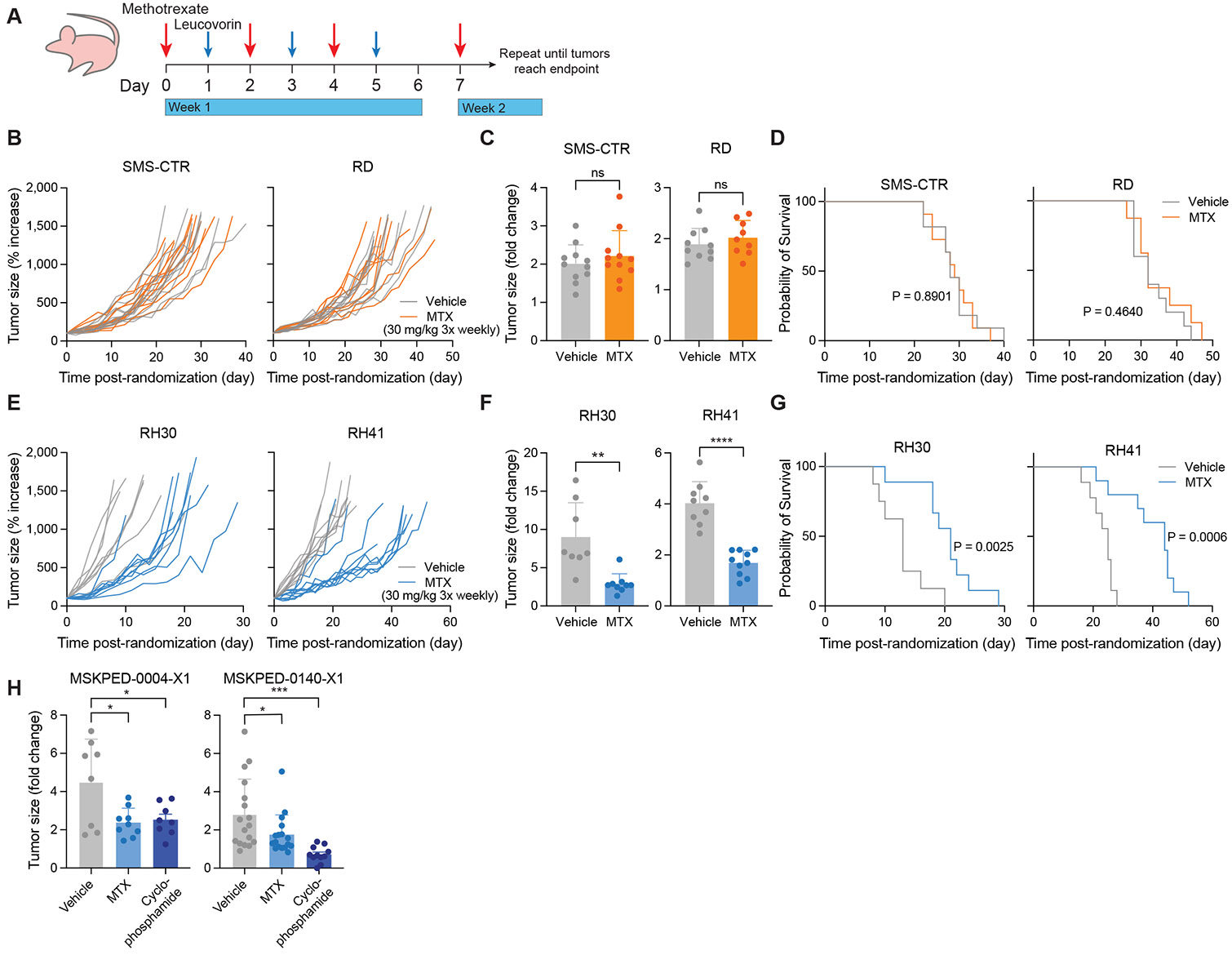
PAX3-FOXO1, an oncogenic transcription factor, drives a particularly aggressive subtype of rhabdomyosarcoma (RMS) by enforcing gene expression programs that support malignant cell states. In this study, we show that PAX3-FOXO1+ RMS cells exhibit altered pyrimidine metabolism and increased dependence on enzymes involved in de novo pyrimidine synthesis, including dihydrofolate reductase (DHFR). Consequently, PAX3-FOXO1+ cells display increased sensitivity to inhibition of DHFR by the chemotherapeutic drug methotrexate, and this dependence is rescued by provision of pyrimidine nucleotides. Methotrexate treatment mimics the metabolic and transcriptional impact of PAX3-FOXO1 silencing, reducing expression of genes related to PAX3-FOXO1-driven malignant cell states. Accordingly, methotrexate treatment slows the growth of multiple PAX3-FOXO1+ tumor xenograft models but not their fusion-negative counterparts. Taken together, these data demonstrate that PAX3-FOXO1 induces cell states characterized by altered pyrimidine dependence and nominates methotrexate as an addition to the current therapeutic arsenal for treatment of these malignant pediatric tumors.
Significance: PAX3-FOXO1+ rhabdomyosarcoma cells and tumors exhibit increased sensitivity to DHFR inhibition via methotrexate, identifying a potential therapeutic vulnerability that can be exploited to treat this aggressive pediatric sarcoma.
©2025 American Association for Cancer Research.
Conflict of interest statement
The authors declare no potential conflicts of interest.
Figures


Update of
-
PAX3-FOXO1 drives targetable cell state-dependent metabolic vulnerabilities in rhabdomyosarcoma.bioRxiv [Preprint]. 2025 Jan 19:2025.01.15.633227. doi: 10.1101/2025.01.15.633227. bioRxiv. 2025. Update in: Cancer Res. 2025 Dec 1;85(23):4718-4733. doi: 10.1158/0008-5472.CAN-25-0315. PMID: 39868247 Free PMC article. Updated. Preprint.
References
-
- Tu WB, Christofk HR, Plath K. Nutrient regulation of development and cell fate decisions. Development. Oct 15 2023;150(20)
-
- Erez A, DeBerardinis RJ. Metabolic dysregulation in monogenic disorders and cancer - finding method in madness. Nat Rev Cancer. Jul 2015;15(7):440–8. - PubMed
MeSH terms
Substances
Grants and funding
- F30 CA284711/CA/NCI NIH HHS/United States
- P30 CA008748/CA/NCI NIH HHS/United States
- T32 HD060600/HD/NICHD NIH HHS/United States
- F30 HD107943/HD/NICHD NIH HHS/United States
- T32 GM152349/GM/NIGMS NIH HHS/United States
- T32HD060600/Eunice Kennedy Shriver National Institute of Child Health and Human Development (NICHD)
- F30HD107943/Eunice Kennedy Shriver National Institute of Child Health and Human Development (NICHD)
- L1000200/2021-L/Human Frontier Science Program (HFSP)
- Damon Runyon Cancer Research Foundation (DRCRF)
- F30CA284711/National Cancer Institute (NCI)
- T32GM152349/National Institute of General Medical Sciences (NIGMS)
- P30CA08748/National Cancer Institute (NCI)
- New York Stem Cell Foundation (NYSCF)
- Pershing Square Sohn Cancer Research Alliance (PSSCRA)
- Memorial Sloan-Kettering Cancer Center (MSK)
- Geoffrey Beene Cancer Research Center
- PaulieStrong Foundation
LinkOut - more resources
Full Text Sources
Research Materials
Miscellaneous
