. 2025 Oct 15;138(20):jcs264009.
doi: 10.1242/jcs.264009. Epub 2025 Oct 24.

ARL13B-Cerulean rescues Arl13b-null mouse from embryonic lethality and reveals a role for ARL13B in spermatogenesis

Affiliations

ARL13B-Cerulean rescues Arl13b-null mouse from embryonic lethality and reveals a role for ARL13B in spermatogenesis

Alyssa B Long et al. J Cell Sci. .

Abstract

ARL13B is a regulatory GTPase enriched in cilia, making it a popular marker for this organelle. Arl13bhnn/hnn mice lack ARL13B expression, die during mid-gestation, and exhibit defects in ciliogenesis. The R26Arl13b-Fucci2aR biosensor mouse line directs the expression of fluorescently tagged full-length Arl13b cDNA upon Cre recombination. To determine whether constitutive, ubiquitous expression of Cerulean-tagged ARL13B (ARL13B-Cerulean) can replace endogenous gene expression, we generated Arl13bhnn/hnn animals expressing ARL13B-Cerulean. We show that Arl13bhnn/hnn;Arl13b-Cerulean mice survive to adulthood with no obvious physical or behavioral defects, indicating that the fluorescently tagged protein can functionally replace the endogenous protein during development. However, we observed that rescued males failed to sire offspring, revealing a role for ARL13B in spermatogenesis. This work shows that the R26Arl13b-Fucci2aR mouse contains an inducible allele of Arl13b capable of functioning in most tissues and biological processes.

Keywords: ARL13B; Cilia; Inducible; Infertility; Lethality; Spermatogenesis.


Conflict of interest statement

Competing interests The authors declare no competing or financial interests.

Figures
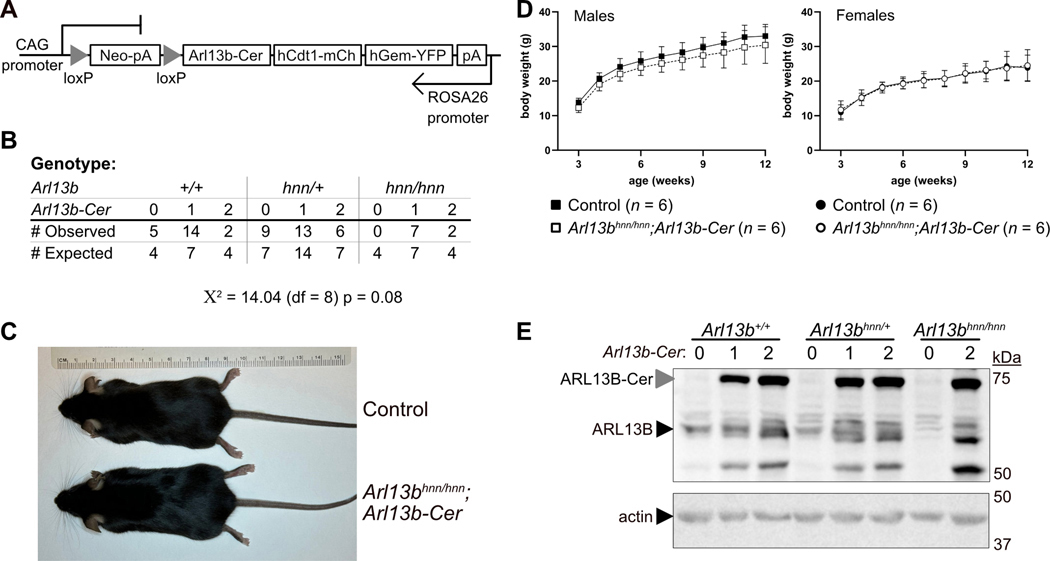
Figure 1.
Figure 1.. Arl13bhnn/hnn;Arl13b-Cerulean mice are viable.
A) Schematic of the inducible R26Arl13b-Fucci2aR allele. B) Numbers of observed (n = 58) and expected pups from nine litters of Arl13bhnn/+;Arl13b-Cerulean intercrosses genotyped at 2 weeks. The genotype of endogenous Arl13b and the number of Arl13b-Cerulean alleles (0, 1, 2) are indicated. Chi-square test with 8 degrees of freedom (df) indicates the observed values do not significantly differ from expected; p value = 0.08. C) Arl13bhnn/+;Arl13b-Cerulean (control) and Arl13bhnn/hnn;Arl13b-Cerulean (rescue) female mice at 21 weeks. D) Weekly body weights of male and female control (black) and Arl13bhnn/hnn;Arl13b-Cerulean (white) mice, n = 6 for each group. Two-way ANOVA with Sidak’s multiple comparisons test was not significant at any time point for either sex; overall fixed effects (age by genotype) p values = 0.62 for males and 0.69 for females. E) Western blot of E12.5 whole-embryo lysates without (0) or with (1, 2 copies) Arl13b-Cerulean, probed with antibody against ARL13B (top image) or actin (bottom image).
Figure 2.
Figure 2.. Arl13b-Cerulean rescues Arl13bhnn/hnn MEF ciliary phenotypes.
Immortalized and serum-starved A) Arl13b+/+, B) Arl13bhnn/hnn, and C) Arl13bhnn/hnn;Arl13b-Cerulean MEFs stained with antibodies against ARL13B, GFP (recognizes Cerulean), and glutamylated tubulin GT335 (cilia marker). D) Percentage ciliated Arl13b+/+, Arl13bhnn/+, and Arl13bhnn/hnn MEFs without (0), or with (1, 2 copies) Arl13b-Cerulean, as indicated. One-way ANOVA with Tukey’s multiple comparisons test; adjusted p values: ns, not significant, p > 0.99; ****p < 0.0001. None of the ciliation rates were significantly different when comparing cells with one or two copies of Arl13b-Cerulean, p > 0.52. E) Ciliary length based on the tubulin channel (glutamylated, red or acetylated, black). One-way ANOVA with Tukey’s multiple comparisons test; adjusted p values: ns, not significant, p > 0.92; **p < 0.01; ****p < 0.0001. None of the cilia length measurements were significantly different when comparing cells with one or two copies of Arl13b-Cerulean, p > 0.85. F) Percent SMO-positive cilia observed under unstimulated (0.5% FBS, open bars) or stimulated (SAG, patterned bars) conditions. Two-way ANOVA with Tukey’s multiple comparisons test; adjusted p values: ns, not significant, p > 0.98; *p < 0.05. None of the SMO-positive percentages were significantly different when comparing cells with one or two copies of Arl13b-Cerulean, p > 0.99, except for the Arl13bhnn/hnn MEFs, p = 0.014. In the graphs, each point represents data from a single field of view with at least 150 total cilia examined for each genotype. Each MEF line was derived from a single embryo, and experiments were repeated three times.
Figure 3.
Figure 3.. Arl13bhnn/hnn;Arl13b-Cerulean kidneys do not develop cysts.
A) Gross morphology of adult control and rescue kidneys. B) Kidney weight as a percentage of body weight for males: control (black, n = 64), Arl13bhnn/hnn;Arl13b-Cerulean with one copy of Arl13b-Cerulean (gray, n = 16), Arl13bhnn/hnn;Arl13b-Cerulean with two copies of Arl13b-Cerulean (white, n = 6). Welch’s t-test showed a significant increase in the kidney weight of male mice carrying one copy of the biosensor compared to controls, *p < 0.05. C) Kidney weight as a percentage of body weight for females: control (black, n = 55), Arl13bhnn/hnn;Arl13b-Cerulean with one copy of Arl13b-Cerulean (gray, n = 19), Arl13bhnn/hnn;Arl13b-Cerulean with two copies of Arl13b-Cerulean (white, n = 7). Welch’s t-test showed no significant change in kidney weight of female mice carrying Arl13b-Cerulean compared to controls, p > 0.23. D) Arl13b+/+, E) Arl13bhnn/+;Arl13b-Cerulean, and F) Arl13bhnn/hnn;Arl13b-Cerulean kidney sections from adult mice stained with hematoxylin-eosin or antibodies against ARL13B, GFP, and glutamylated tubulin GT335. These images are representative of observed kidneys from at least three animals of each genotype.
Figure 4.
Figure 4.. Cerebellar patterning is normal in Arl13bhnn/hnn;Arl13b-Cerulean mice.
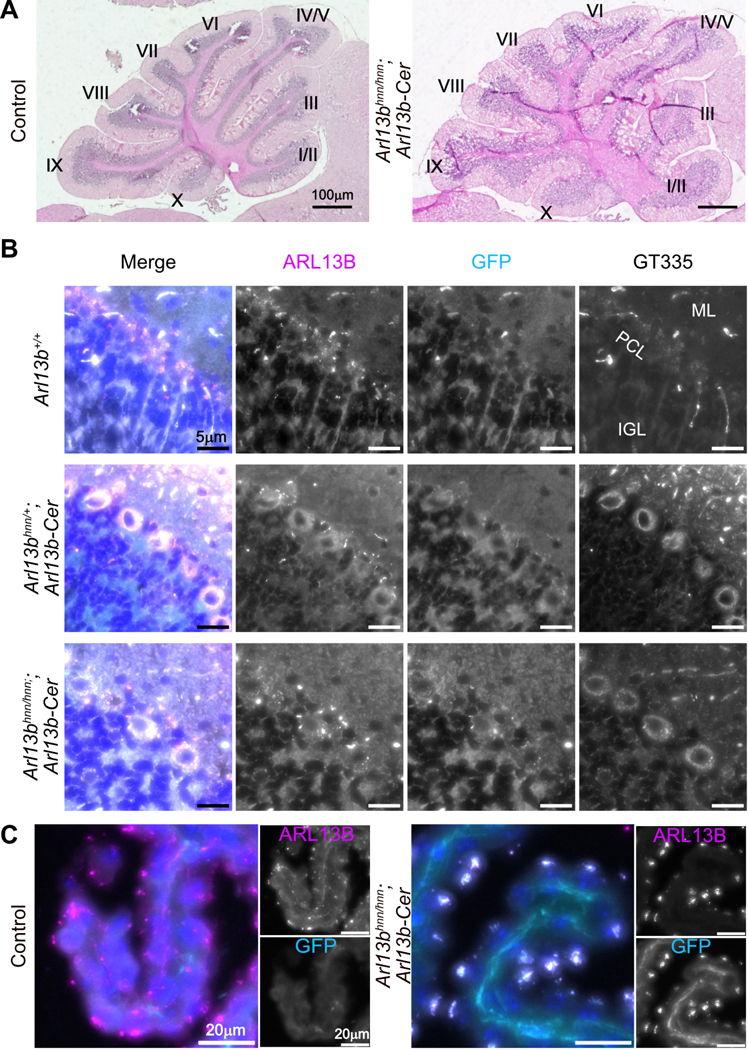
A) Sagittal sections of adult control and Arl13bhnn/hnn;Arl13b-Cerulean cerebella stained with hematoxylin-eosin. Roman numerals indicate major folia. B) ARL13B, GFP, and glutamylated tubulin GT335 staining of cilia in the Purkinje cell layer (PCL) of the cerebellum. ML (molecular layer), IGL (inner granule layer). C) Choroid plexus of control and Arl13bhnn/hnn;Arl13b-Cerulean brains stained with ARL13B and GFP antibodies.
Figure 5.
Figure 5.. Arl13bhnn/hnn;Arl13b-Cerulean pancreatic islets appear normal.
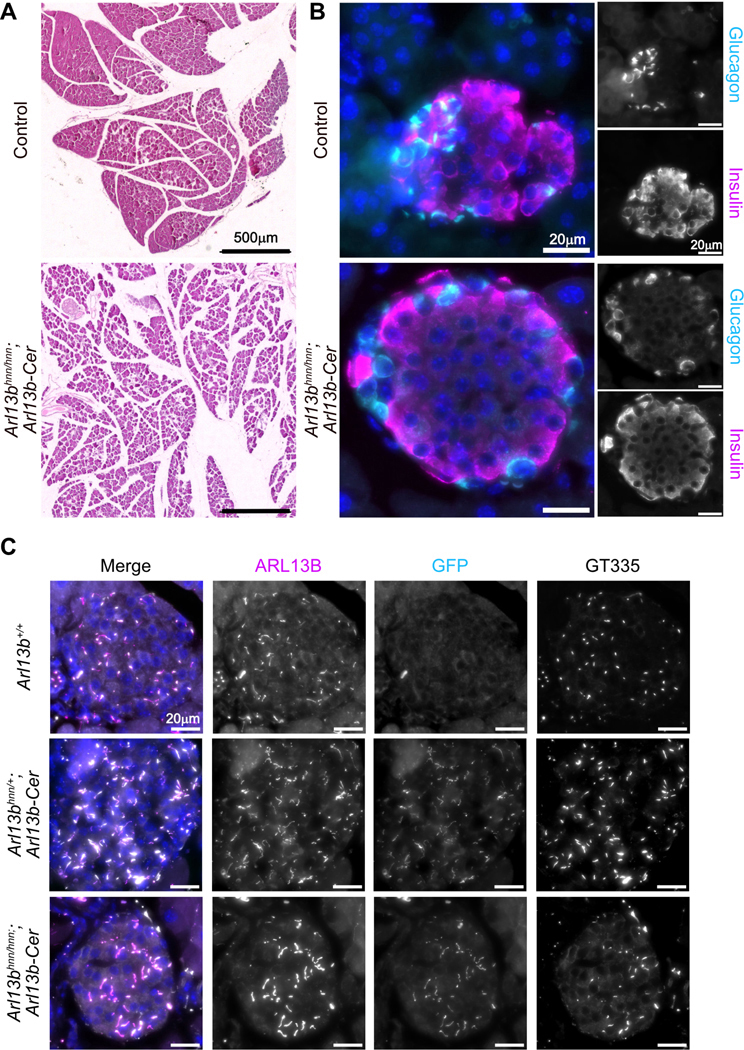
A) Pancreas sections from adult control or Arl13bhnn/hnn;Arl13b-Cerulean mice stained with hematoxylin-eosin. B) Immunofluorescent staining of islet cells in control and Arl13bhnn/hnn;Arl13b-Cerulean pancreas sections using antibodies against glucagon and insulin. C) Antibody staining of pancreatic islets showing ciliary ARL13B, GFP, and glutamylated tubulin GT335.
Figure 6.
Figure 6.. Arl13bhnn/hnn;Arl13b-Cerulean males are infertile.
A) Average pups per litter when females of the indicated genotype were mated to control males (Arl13bhnn/+;Arl13b-Cerulean, n = 12 females tested: 181 pups from 29 litters; and Arl13bhnn/hnn;Arl13b-Cerulean, n = 6 heterozygous and 2 homozygous for Arl13b-Cerulean females tested: 122 pups from 18 litters). Mann Whitney test: ns, not significant, p > 0.95. B) Average pups per litter when males of the indicated genotype were mated to control females (Arl13bhnn/+;Arl13b-Cerulean, n = 11 males tested: 332 pups from 52 litters; and Arl13bhnn/hnn;Arl13b-Cerulean, n = 4 heterozygous and 4 homozygous for Arl13b-Cerulean males tested: 0 pups from 0 litters). Mann Whitney test: ****p<0.0001. C) Testis weight as a percentage of body weight for control (n = 44) and Arl13bhnn/hnn;Arl13b-Cerulean (n = 8 heterozygous and 3 homozygous for Arl13b-Cerulean) male mice. Unpaired t-test: ns, not significant, p > 0.28. D) Testis sections from adult Arl13b+/+ and Arl13bhnn/hnn;Arl13b-Cerulean males stained with PAS-H. E) Epididymis sections from adult Arl13b+/+ and Arl13bhnn/hnn;Arl13b-Cerulean males stained with hematoxylin-eosin. F) Adult testis sections stained with peanut agglutinin lectin (PNA, acrosome) and antibodies against acetylated tubulin (AcTub, cilia) and Hoechst (nuclei). Dashed yellow lines indicate the basal lamina of the seminiferous tubule. Lu (lumen). Magnifications are shown on the right. G) Immunofluorescence of isolated control and Arl13bhnn/hnn;Arl13b-Cerulean sperm stained with PNA, AcTub, and Hoechst. Insets show magnified sperm heads.
Figure 7.
Figure 7.. ARL13B-Cerulean is expressed in testis and sperm.
A) Immunoblot (IB) of lysates from adult testes probed with antibodies against ARL13B, GFP, and actin. B) Testis sections from adult Arl13b+/+ and Arl13bhnn/hnn;Arl13b-Cerulean males stained with antibodies against ARL13B, GFP, glutamylated tubulin GT335, and Hoechst. Dashed yellow lines indicate basal lamina of the seminiferous tubule. Magnifications are shown on the right. Arrowheads point to cilia. C) Sperm isolated from cauda epididymides of Arl13b+/+, Arl13bhnn/+;Arl13b-Cerulean, and Arl13bhnn/hnn;Arl13b-Cerulean males imaged by phase contrast and fluorescence microscopy using antibodies against glutamylated tubulin GT335, ARL13B, and GFP. Nuclei are stained with Hoechst.

Update of

References

    1. Augière C, Campolina-Silva G, Vijayakumaran A, Medagedara O, Lavoie-Ouellet C, Joly Beauparlant C, Droit A, Barrachina F, Ottino K, Battistone MA, et al. (2024). ARL13B controls male reproductive tract physiology through primary and motile cilia. Commun. Biol 7, 1318. - PMC - PubMed
    1. Bangs FK, Schrode N, Hadjantonakis A-K and Anderson KV (2015). Lineage specificity of primary cilia in the mouse embryo. Nat. Cell Biol 17, 113–122. - PMC - PubMed
    1. Barral DC, Garg S, Casalou C, Watts GFM, Sandoval JL, Ramalho JS, Hsu VW and Brenner MB (2012). Arl13b regulates endocytic recycling traffic. Proc. Natl. Acad. Sci 109, 21354–21359. - PMC - PubMed
    1. Bay SN, Long AB and Caspary T. (2018). Disruption of the ciliary GTPase Arl13b suppresses Sonic hedgehog overactivation and inhibits medulloblastoma formation. Proc. Natl. Acad. Sci 115, 1570–1575. - PMC - PubMed
    1. Bernet A, Bastien A, Soulet D, Jerczynski O, Roy C, Bianchi Rodrigues Alves M, Lecours C, Tremblay M-È, Bailey JL, Robert C, et al. (2018). Cell-lineage specificity of primary cilia during postnatal epididymal development. Hum. Reprod 33, 1829–1838. - PubMed

Substances

LinkOut - more resources