


Exploring Heterogeneity in Vestibular Migraine Using Individualized Differential Structural Covariance Network Analysis
- PMID: 40916972
- PMCID: PMC12415590
- DOI: 10.1111/cns.70599
Exploring Heterogeneity in Vestibular Migraine Using Individualized Differential Structural Covariance Network Analysis
Abstract
Background: The high heterogeneity in vestibular migraine (VM) complicates understanding its precise pathophysiological mechanisms and identifying potential biomarkers. This study investigated the heterogeneity in VM using a newly proposed method called Individualized Differential Structural Covariance Network (IDSCN) analysis.
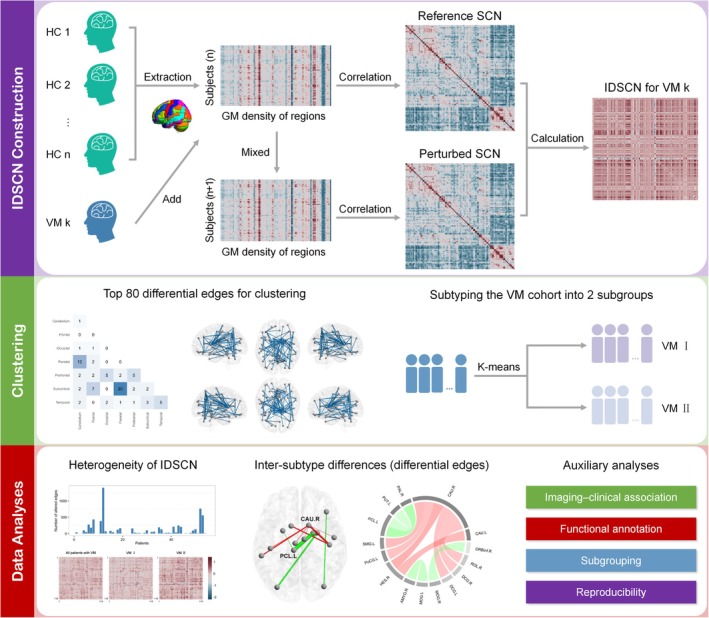
Methods: Structural T1-weighted MRI scans were performed on 55 patients with VM and 65 healthy controls, and an IDSCN was constructed for each patient. We studied the extent of heterogeneity in the IDSCNs, summarized the distribution of differential edges, and clustered the patients into subtypes with the shared differential edges. Imaging-clinical association analyses were conducted on both the subtype classification and the differential edges exhibiting significant inter-subtype differences.
Results: Patients with VM demonstrated notable heterogeneity in the number of significantly altered IDSCN edges, while sharing several common differential connections that were mainly distributed among the parietal, subcortical, and cerebellar regions. Two robust and distinct neuroanatomical subtypes of VM were identified, which were associated with headache frequency. The differential edge between the left paracentral lobule and right pallidum was associated with both headache frequency and occurrence.
Conclusions: These findings indicate the importance of considering individual differences in VM research and may offer insights for precise diagnosis and individualized treatment of the disease.
Keywords: gray matter; heterogeneity; individualized analysis; magnetic resonance imaging; structural covariance network; vestibular migraine.
© 2025 The Author(s). CNS Neuroscience & Therapeutics published by John Wiley & Sons Ltd.
Conflict of interest statement
The authors declare no conflicts of interest.
Figures


References
-
- Teggi R., Colombo B., Cugnata F., et al., “Phenotypes and Clinical Subgroups in Vestibular Migraine: A Cross‐Sectional Study With Cluster Analysis,” Neurological Sciences 45, no. 3 (2024): 1209–1216. - PubMed
-
- Formeister E. J., Rizk H. G., Kohn M. A., and Sharon J. D., “The Epidemiology of Vestibular Migraine: A Population‐Based Survey Study,” Otology & Neurotology 39, no. 8 (2018): 1037–1044. - PubMed
-
- Neuhauser H. K., Radtke A., von Brevern M., et al., “Migrainous Vertigo: Prevalence and Impact on Quality of Life,” Neurology 67, no. 6 (2006): 1028–1033. - PubMed
-
- Byun Y. J., Levy D. A., Nguyen S. A., Brennan E., and Rizk H. G., “Treatment of Vestibular Migraine: A Systematic Review and Meta‐Analysis,” Laryngoscope 131, no. 1 (2021): 186–194. - PubMed
MeSH terms
Grants and funding
LinkOut - more resources
Full Text Sources
Medical
