Review
. 2025 Sep 5;15(39):32155-32171.
doi: 10.1039/d5ra04410c.

Exploring 4D printing of smart materials for regenerative medicine applications

Affiliations
Review

Exploring 4D printing of smart materials for regenerative medicine applications

Budur N Alanazi et al. RSC Adv. .

Abstract

The field of biomaterials has evolved rapidly with the introduction of time as a transformative factor, giving rise to four-dimensional (4D) materials that can dynamically change their structure or function in response to external stimuli. This review presents a comprehensive comparison between traditional three-dimensional (3D) and emerging 4D biomaterials, highlighting the key distinctions in design, adaptability, and functionality. We explore the development of smart biomaterials at the core of 4D systems, including stimuli-responsive polymers, shape-memory materials, and programmable hydrogels. The ability of these materials to undergo controlled transformations under physiological or engineered stimuli offers promising avenues in tissue engineering, drug delivery, regenerative medicine, and soft robotics. By integrating responsiveness and temporal control, 4D biomaterials represent a paradigm shift in biomedical engineering, with the potential to revolutionize patient-specific therapies and next-generation implants. Future challenges and opportunities for clinical translation are also discussed.


Conflict of interest statement

The authors declare that they have no financial or personal conflicts of interest that could influence the integrity or outcomes of this study.

Figures

Fig. 1
Fig. 1. 4D printing of smart biomaterials enables stimulus-driven shape and function changes for applications in regenerative medicine.
Fig. 2
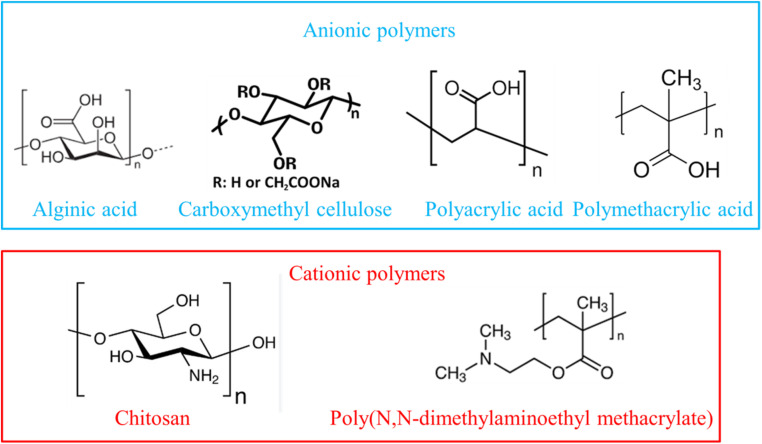
Fig. 2. Examples of pH-responsive polymers frequently utilized in 4D printing for biomedical applications.
Fig. 3
Fig. 3. Representative light sensitive polymers commonly employed in 4D printing applications.
Fig. 4
Fig. 4. Representative thermo-sensitive polymers commonly employed in 4D printing applications.
Fig. 5
Fig. 5. Morphological evaluation of acellular constructs. (A) Simulated printing path via G-code. (B) Field-emission scanning electron microscopy image showing sinusoidal morphology. (C and D) Optical images of 4D-bioprinted constructs: (C) without MNPs and (D) with 5 mg mL−1 MNPs. (Reproduced under Creative Commons license, B. Liu et al., 2024 (ref. 80).)
Fig. 6
Fig. 6. (A) Time-dependent self-folding of scaffolds (10 × 5 mm) with bioprinted lines aligned longitudinally; food dyes added for visual contrast. (B) Line orientation governs the folding behavior of the 4D-printed scaffold. (C) Force analysis during self-folding: folding occurs under loads up to 70 mg, while 80 mg prevents actuation. (Reproduced under Creative Commons license CC BY-NC 4.0 Carmelo De Maria, et al., 2024 (ref. 82).)
Fig. 7
Fig. 7. Schematic of a 4D-printed cardiac patch and its fabrication. (a) A cell-laden construct transforms from a flat to a curved configuration, enabling implantation onto the infarcted myocardium to aid tissue repair. In contrast, precurved scaffolds lead to uneven cell distribution due to gravitational settling. (b) Diagram of the DLP-based printing setup featuring a digital micromirror device (DMD), lens system, and motion controller. (c) Illustration of the printing process using a PEGDA mold for 4D extrusion. The curved structure flattens upon heating above the SMP's glass transition temperature (Tg), with reversible shape change triggered by heat or NIR light (this figure has been adapted/reproduced from ref. with permission from American Chemical Society, copyright 2021).
Fig. 8
Fig. 8. Fabrication and 4D bioprinting strategy for vascular grafts. (a) EPCs and HUVECs are incorporated into collagen peptide-modified sodium alginate (SA–COP) to prepare the bio-ink. (b) Instant crosslinking of SA–COP is initiated by CaCl2. (c) Extrusion is performed using a custom co-axial, dual-chamber nozzle. (d) Printing occurs within a CaCl2-based support medium using a six-axis robotic system for structural fidelity. (e) Post-printing, grafts are transferred to a bioreactor. (f) Final grafts exhibit a lumen diameter of 3–3.5 mm and (g) a total length of 30–40 cm. (Reproduced under Creative Commons license CC BY-NC 4.0, Rouven Berndt et al., 2024 (ref. 89).)
Fig. 9
Fig. 9. Overview of 4D skin bioprinting: patient-derived skin cells are cultured and combined with smart biomaterials and growth factors to create bioinks. CAD-integrated bioprinting systems use wound imaging to design customized skin constructs, which are then printed and transplanted back onto the patient. (Reproduced under Creative Commons license CC BY-NC 4.0, Damiati et al., 2025 (ref. 96).)
Fig. 10
Fig. 10. Shape memory behavior of PCLDMA–UPyMA samples: after being cut (a), the specimen was thermally healed at 80 °C for 1 h (b). Upon deformation (c), heating at 70 °C initiated and completed shape recovery (d–f) (this figure has been adapted/reproduced from ref. with permission from Elsevier, copyright 2018).

References

    1. V Murphy S. Atala A. 3D bioprinting of tissues and organs. Nat. Biotechnol. 2014;32(8):773–785. doi: 10.1038/nbt.2958. - DOI - PubMed
    1. Ramezani M. Mohd Ripin Z. 4D Printing in Biomedical Engineering: Advancements, Challenges, and Future Directions. J. Funct. Biomater. 2023;14(7):347. doi: 10.3390/jfb14070347. - DOI - PMC - PubMed
    1. Kim J. D A G. Debnath P. Saha P. Smart Multi-Responsive Biomaterials and Their Applications for 4D Bioprinting. Biomimetics. 2024;9(8) doi: 10.3390/biomimetics9080484. - DOI - PMC - PubMed
    1. Tran T. S. Balu R. Mettu S. Roy Choudhury N. Dutta N. K. 4D Printing of Hydrogels: Innovation in Material Design and Emerging Smart Systems for Drug Delivery. Pharmaceuticals. 2022;15(10) doi: 10.3390/ph15101282. - DOI - PMC - PubMed
    1. Ebrahim N. A. A. Soliman S. M. A. Innovations in Functional Materials and Advanced Imaging Techniques for Targeting Extramural Venous Invasion (EMVI) in Colorectal Cancer: A Comprehensive Review. Biomed. Mater. & Devices. 2025 doi: 10.1007/s44174-025-00284-7. - DOI

LinkOut - more resources