. 2025 Sep 10;20(9):e0331462.
doi: 10.1371/journal.pone.0331462. eCollection 2025.

Identification of potential inflammation markers for outgrowth of cow's milk allergy

Affiliations

Identification of potential inflammation markers for outgrowth of cow's milk allergy

Diana M Hendrickx et al. PLoS One. .

Abstract

Immunoglobulin E (IgE)-mediated cow's milk allergy (CMA) is an immune-mediated reaction to cow's milk (CM). Non-IgE-mediated CMA resolves in most children in the first years of life, whereas IgE-mediated CMA outgrowth is often later or not at all. The exact mechanisms underlying resolution of IgE-mediated CMA are not fully understood. We aim to gain insight in the immunological mechanisms underlying resolution of IgE-mediated CMA by analyzing unique saliva samples of allergic infants using the Olink® Target 96 Inflammation panel. Twenty-four children who outgrew their CMA after 12 months were compared to 15 with persistent CMA. Persistent CMA was accompanied by an increase in interleukin-15 receptor subunit alpha in the first 6 months, followed by a decrease, hinting towards an initial increased T cell response. At the same time caspase-8 was increased and interleukin-7 was decreased in persistent CMA. For CMA resolution, we found elevated levels of delta and notch-like epidermal growth factor-related receptor. Furthermore, adenosine deaminase (ADA) increased significantly between 0 and 12 months in resolved CMA, but not in persistent CMA. KEGG pathway analysis suggests mainly the TNF signaling pathway to be important in the resolution of CM allergy. Our findings show that Olink® Target 96 Inflammation panel analysis of saliva samples can reveal potential immunological markers and mechanisms involved in CMA resolution.


Conflict of interest statement

The authors of this manuscript have the following competing interests: H.W. is an employee of Danone-Nutricia Research. This study was part of the EARLYFIT project, which is part of a partnership programme between NWO-TTW and Danone-Nutricia Research. The research of DMH, CB and RGvdM was funded by the Dutch Research Council (NWO) and Danone Nutricia Research . This does not alter our adherence to PLOS ONE policies on sharing data and materials.

Figures

Fig 1
Fig 1. Development of immune factors over visits in the persistent and resolved CMA group as (A) scores and (B) loadings.
A positive loading means that the NPX value of the immune factor increases when the scores increase. A negative loading means that the NPX value of the immune factor decreases when the scores increase.
Fig 2
Fig 2. Development of immune factors over visits in the persistent and resolved CMA group as (A) scores and (B) loadings when using the persistent CMA group as a reference.
A positive loading means that the NPX value of the immune factor increases when the scores increase. A negative loading means that the NPX value of the immune factor decreases when the scores increase.
Fig 3
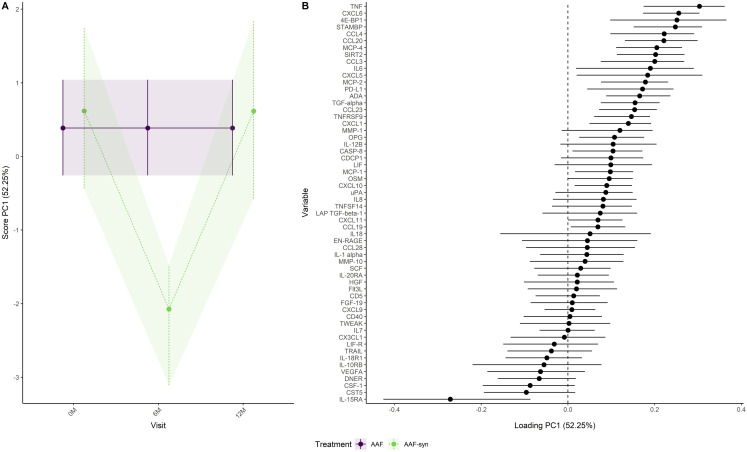
Fig 3. Development of immune factors over visits in the AAF and AAF-syn treatment group as (A) scores and (B) loadings.
A positive loading means that the NPX value of the immune factor increases when the scores increase. A negative loading means that the NPX value of the immune factor decreases when the scores increase.
Fig 4
Fig 4. Development of immune factors over visits in the AAF-syn treatment group as (A) scores and (B) loadings when using the AAF treatment group as a reference.
A positive loading means that the NPX value of the immune factor increases when the scores increase. A negative loading means that the NPX value of the immune factor decreases when the scores increase.
Fig 5
Fig 5. Potential mechanisms for persistent CMA (left) and resolution of CMA (right) revealed by our study.
In infants with persistent CMA an increase of IL-15RA, which binds IL-15, possibly results in increased T cell activity. An increase of CASP-8 and a decrease of IL-7 could reduce the number of regulatory T cells (Tregs), and enhance the Th2 immune response, leading to the production of IgE antibodies which bind to mast cells. This could result in increased mast cell degranulation and release of inflammatory mediators after re-exposure to CM antigens. In resolved CMA, the Th2 response is possibly disrupted by an increase in DNER, which facilitates the IFN-γ production by T cells. Tregs generate adenosine which can further inhibit T cell activity and allergic response. Created with BioRender.com. Hendrickx, D. (2024) https://biorender.com/n96p662.

References

    1. NIAID-Sponsored Expert Panel, Boyce JA, Assa’ad A, Burks AW, Jones SM, Sampson HA, et al. Guidelines for the diagnosis and management of food allergy in the United States: report of the NIAID-sponsored expert panel. J Allergy Clin Immunol. 2010;126(6 Suppl):S1-58. doi: 10.1016/j.jaci.2010.10.007 - DOI - PMC - PubMed
    1. Schoemaker AA, Sprikkelman AB, Grimshaw KE, Roberts G, Grabenhenrich L, Rosenfeld L, et al. Incidence and natural history of challenge-proven cow’s milk allergy in European children--EuroPrevall birth cohort. Allergy. 2015;70(8):963–72. doi: 10.1111/all.12630 - DOI - PubMed
    1. Pratelli G, Tamburini B, Badami GD, Lo Pizzo M, De Blasio A, Carlisi D, et al. Cow’s Milk: A Benefit for Human Health? Omics Tools and Precision Nutrition for Lactose Intolerance Management. Nutrients. 2024;16(2):320. doi: 10.3390/nu16020320 - DOI - PMC - PubMed
    1. Høst A, Halken S. A prospective study of cow milk allergy in Danish infants during the first 3 years of life. Clinical course in relation to clinical and immunological type of hypersensitivity reaction. Allergy. 1990;45(8):587–96. doi: 10.1111/j.1398-9995.1990.tb00944.x - DOI - PubMed
    1. Martorell-Aragonés A, Echeverría-Zudaire L, Alonso-Lebrero E, Boné-Calvo J, Martín-Muñoz MF, Nevot-Falcó S, et al. Position document: IgE-mediated cow’s milk allergy. Allergol Immunopathol (Madr). 2015;43(5):507–26. doi: 10.1016/j.aller.2015.01.003 - DOI - PubMed

LinkOut - more resources