


Optical Coherence Tomography to Better Assess Chronic Total Occlusion Percutaneous Intervention Results: The PERFECTO Study
- PMID: 40930013
- PMCID: PMC12455136
- DOI: 10.1016/j.jacadv.2025.102125
Optical Coherence Tomography to Better Assess Chronic Total Occlusion Percutaneous Intervention Results: The PERFECTO Study
Abstract
Background: Angioplasty of coronary chronic total occlusions (CTOs) was a breakthrough, but there is a lack of data concerning stent healing after these complex procedures.
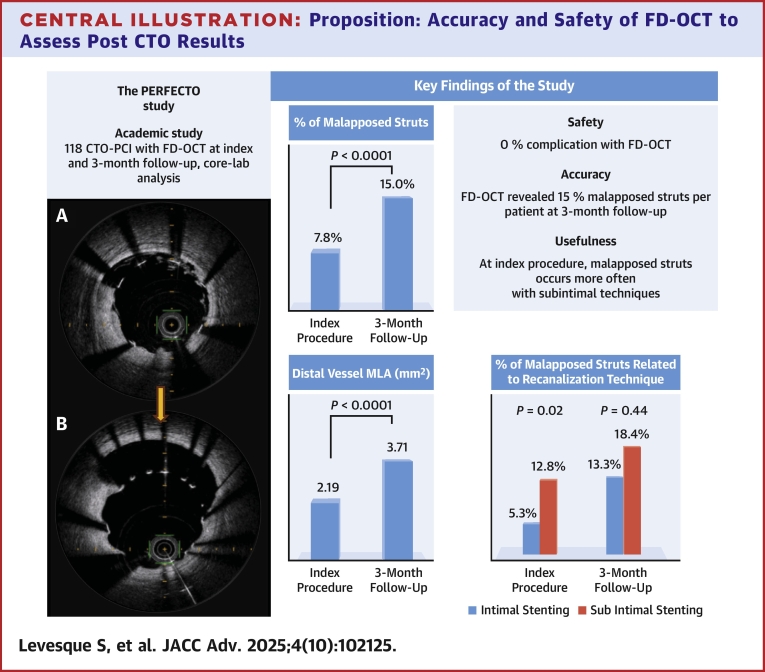
Objectives: The main aim of the PERFECTO (Post-stEnting assessment of Reendothelialization with optical Frequency domain imaging aftEr CTO procedure) study is to assess, for the first time, stent strut apposition at the index CTO procedure and at 3-month follow-up using frequency-domain optical coherence tomography (FD-OCT).
Methods: From March 2018 to January 2020, 114 consecutive patients who underwent successful CTO recanalization >20 mm in length were prospectively included in 7 centers. FD-OCT was performed for ad hoc guidance during the index procedure and at 3-month follow-up. All patients received the same last-generation drug-eluting stent.
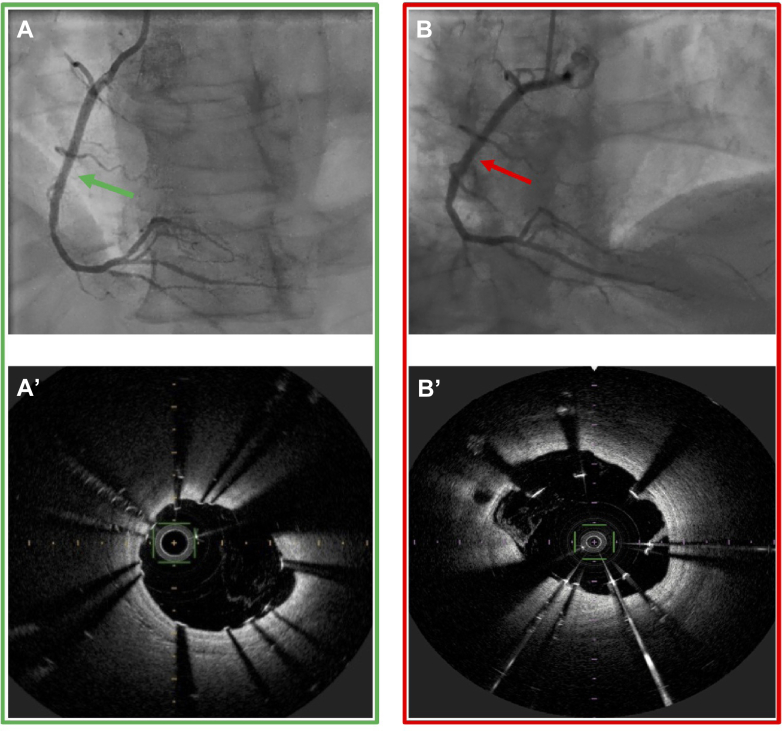
Results: Mean age was 63.2 years, and 87% were male. The rate of malapposed struts per patient was 7.84% at the end of the index procedure and 15.03% at 3-month follow-up (P < 0.0001), highlighting the phenomenon of acquired malapposition. Malapposed struts occurred more often with dissection and re-entry techniques and subintimal stenting compared to intimal techniques (12.8% vs 5.3%, P = 0.02). At 3-month follow-up, distal vessel minimal lumen area increased from 69% (index 2.19 mm2 vs 3.71 mm2 at 3 months, P < 0.0001). No complication occurred with FD-OCT.
Conclusions: CTO-percutaneous coronary intervention could affect stent healing with a high incidence of immediate and late-acquired malapposition. These results support the interest of using FD-OCT during follow-up to better assess CTO recanalization results. (Post-stenting Assessment of Reendothelialization With OFDI After CTO Procedure [PERFECTO]; NCT03209843).
Keywords: chronic total occlusion; late-acquired malapposition; optical coherence tomography.
Copyright © 2025 The Authors. Published by Elsevier Inc. All rights reserved.
Conflict of interest statement
Funding support and author disclosures The main funding source is the Alienor Fundation of the University Hospital of Poitiers (https://www.fonds-alienor.fr/interview-du-dr-sebastien-levesque/). Dr Lattuca has received research grants from Biotronik, Boston Scientific, and the Institute of CardioMetabolism and Nutrition and lecture fees from Abbott, AstraZeneca, Bayer, Medtronic, Novartis, Sanofi, and Terumo. Dr Levesque is a consultant for Asahi and Boston Scientific and has received lecture fees from Shockwave Medical. Dr Motreff is a consultant for Terumo and Abbott. Dr Faurie is consultant for Asahi, Boston, and Teleflex. All other authors have reported that they have no relationships relevant to the contents of this paper to disclose.
Figures


References
-
- Werner G.S., Martin-Yuste V., Hildick-Smith D., et al. A randomized multicentre trial to compare revascularization with optimal medical therapy for the treatment of chronic total coronary occlusions. Eur Heart J. 2018;39:2484–2493. - PubMed
-
- Strauss B.H., Knudtson M.L., Cheema A.N., et al. Canadian multicenter chronic total occlusion registry: ten-year follow-up results of chronic total occlusion revascularization. Circ Cardiovasc Interv. 2021;14 - PubMed
-
- Maeremans J., Walsh S., Knaapen P., et al. The hybrid algorithm for treating chronic total occlusions in Europe: the RECHARGE registry. J Am Coll Cardiol. 2016;68:1958–1970. - PubMed
-
- Raber L., Mintz G.S., Koskinas K.C., et al. Clinical use of intracoronary imaging. Part 1: guidance and optimization of coronary interventions. An expert consensus document of the European Association of Percutaneous Cardiovascular Interventions. Eur Heart J. 2018;39:3281–3300. - PubMed
-
- Ali Z.A., Landmesser U., Maehara A., et al. Optical coherence tomography-guided versus angiography-guided PCI. N Engl J Med. 2023;389:1466–1476. - PubMed
Associated data
LinkOut - more resources
Full Text Sources
Medical
