. 2025 Aug 20:102707.
doi: 10.1016/j.chempr.2025.102707. Online ahead of print.

Organosilicon Precursors for Efficient Aromatic Copper-Mediated Radiocyanation

Affiliations

Organosilicon Precursors for Efficient Aromatic Copper-Mediated Radiocyanation

Jay S Wright et al. Chem. .

Abstract

Copper-mediated radiolabelling has transformed how (hetero)aromatic imaging agents are prepared for positron emission tomography (PET). However, current methods maintain critical stability, reactivity, and toxicity concerns paramount for safely and reproducibly generating radiomedicines. To overcome these limitations, a copper-mediated 11C-cyanation reaction is presented that leverages heptamethyltrisiloxanes as (hetero)aryl nucleophiles. Rapid ipso-radiocyanation occurs in conversions surpassing related precursors, while offering stability and safety advantages. Multiple bioactive scaffolds relevant to (pre)clinical PET were labelled to showcase the broader significance of this protocol. Most notably, an automated radiosynthesis of a κ-opioid receptor antagonist currently used in clinical PET studies is reported using this method. Overall, adopting aryl silane precursors will improve radiochemical space and support the production of PET nuclear medicines.

Keywords: Carbon-11; Copper-Mediated Radiolabelling; Nuclear Medicine; Organosilane; Positron Emission Tomography; Radiochemistry; Radiocyanation.


Conflict of interest statement

DECLARATION OF INTERESTS The authors declare no competing interests.

Figures

Figure 1.
Figure 1.. Aromatic Copper-Mediated (Radio)Cyanation Reactions
(A) Radiocyanation of Organometallic, Halide, and Cationic Substrates (B) Non-Radioactive Oxidative Cyanation of C–B and C–H Bonds via Aryl Iodides (C) Non-Radioactive Oxidative Cyanation of Trialkoxysilanes via Aryl Iodides (D) Radiocyanation of Aryl Heptamethyltrisiloxanes (This Work)
Scheme 1.
Scheme 1.. Evaluation of Silicon Motifs for Copper-Mediated Radiocyanation
(A) Inactive Silicon Motifs with Trace or No Radiochemical Incorporation (B) Active Silicon Motifs, Including 1-Si(OTMS)2Me Selected for Further Study RCC = Radiochemical Conversion, Measured via radio-Thin-Layer Chromatography (rTLC). Values Represent the Percentage of Organic Products (Rf>0) vs. Radiocyanide (Rf=0). RCP = Radiochemical Purity. Values Represent the Percentage of Labelled Product vs. Other Organic Labelled Side Products, Measured via radio-High Performance Liquid Chromatography (rHPLC).
Scheme 2.
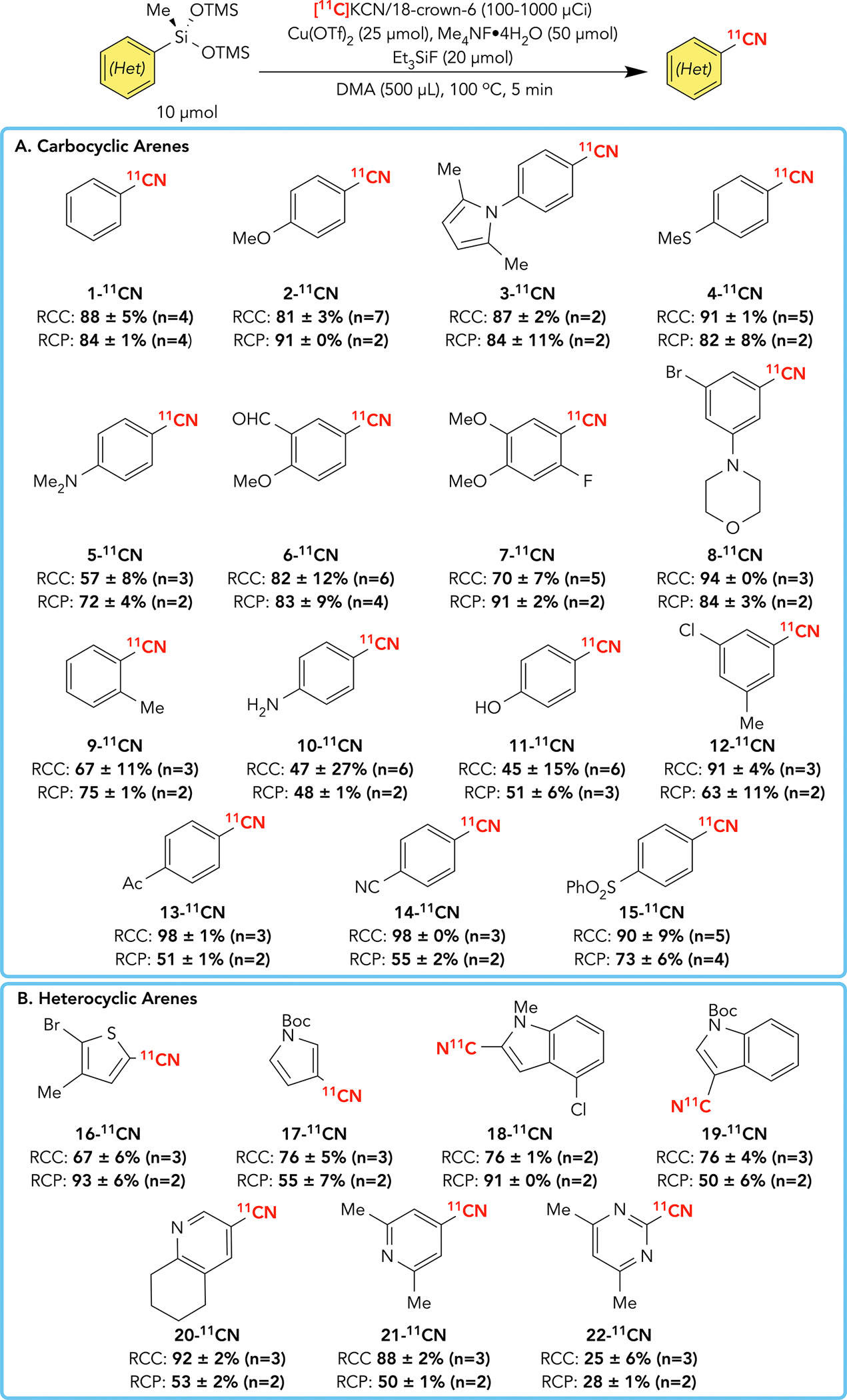
Scheme 2.. Scope of Copper-Mediated Aryl Silane Radiocyanation
(A) Carbocyclic Aryl Heptamethyltrisiloxane Radiocyanation Scope (B) Heterocyclic Aryl Heptamethyltrisiloxane Radiocyanation Scope See SI for complete details of aryl silane manual radiocyanation. Radiochemical conversions (RCCs) represent the conversion of radiocyanide (Rf = 0) to organic products measured via radio-thin-layer chromatography. Radiochemical purities (RCPs) verify product identity and represent purities of organic radiolabelled products measured via radio-high-performance liquid chromatography.
Scheme 3.
Scheme 3.. Radiolabelling of 2-Pyridyl Derivatives
(A) Successful Radiolabelling of 2-Silylpyridine 23-(OTMS)2Me (B) Attempted Radiolabelling of 2-Borylpyridine 23-BPin Reactions conducted under the optimised radiolabelling conditions shown in Scheme 2. Radiochemical conversions (RCCs) represent the conversion of radiocyanide (Rf = 0) to organic products measured via radio-thin-layer chromatography. Radiochemical purities (RCPs) verify product identity and represent purities of organic radiolabelled products measured via radio-high-performance liquid chromatography.
Scheme 4.
Scheme 4.. Bioactive PET Imaging Scaffold Scope of Copper-Mediated Aryl Silane Radiocyanation
All carbon-11 labelled nitrile compounds depicted were radiolabelled under manual conditions depicted in Scheme 2. See SI for complete details, including the automated one-pot radiosynthesis of 27-CONH2 from 27-(OTMS)2Me with manual reformulation. Radiochemical conversions (RCCs) represent the conversion of radiocyanide (Rf = 0) to organic products measured via radio-thin-layer chromatography. Radiochemical purities (RCPs) verify product identity and represent purities of organic radiolabelled products measured via radio-high-performance liquid chromatography. [1] Isolated decay corrected radiochemical yield (RCY) and radiochemical purity (RCP) with EtOH/saline reformulation. [2] Isolated decay corrected RCY and RCP without reformulation.
Scheme 5.
Scheme 5.. Experiments to Probe Aryl Silane Intermediates
(A) Reaction of 1-(OTMS)2Me with fluoride at 80 °C , followed via NMR. (B) Reaction of 1-(OTMS)2Me with fluoride at room temperature, followed via NMR. (C) Prior report of difluoro(methyl)(aryl)silane preparation. (D) Comparison of radiolabelling efficiency with different substituents at PhSiR2Me See SI for complete details of mechanistic experiments. NMR shifts are in ppm.
Scheme 6.
Scheme 6.. Putative Mechanism of Aryl Silane Cu-Mediated Radiocyanation

References

    1. Deng X, Rong J, Wang L, Vasdev N, Zhang L, Josephson L, and Liang SH (2019). Chemistry for Positron Emission Tomography: Recent Advances in 11C-, 18F-, 13N-, and 15O-Labeling Reactions. Angew. Chem. Int. Ed. 58, 2580–2605. 10.1002/anie.201805501. - DOI
    1. Serdons K, Verbruggen A, and Bormans GM (2009). Developing new molecular imaging probes for PET. Methods 48, 104–111. 10.1016/j.ymeth.2009.03.010. - DOI - PubMed
    1. Aboagye EO, Barwick TD, and Haberkorn U (2023). Radiotheranostics in oncology: Making precision medicine possible. CA. Cancer J. Clin. 73, 255–274. 10.3322/caac.21768. - DOI - PubMed
    1. Mark A. Mintun, Albert C. Lo, Cynthia Duggan Evans, Alette M. Wessels, Paul A. Ardayfio, Scott W. Andersen, Sergey Shcherbinin, JonDavid Sparks, John R. Sims, Miroslaw Brys, et al. (2021). Donanemab in Early Alzheimer’s Disease. N. Engl. J. Med. 384, 1691–1704. 10.1056/NEJMoa2100708. - DOI - PubMed
    1. Zanotti-Fregonara P, Lammertsma AA, and Innis RB (2021). 11C Dosimetry Scans Should Be Abandoned. J. Nucl. Med. 62, 158–159. 10.2967/jnumed.120.257402. - DOI - PMC - PubMed

LinkOut - more resources