


Can octopus embryos and juveniles contend with heatwaves?
- PMID: 40934224
- PMCID: PMC12425330
- DOI: 10.1371/journal.pone.0330680
Can octopus embryos and juveniles contend with heatwaves?
Abstract
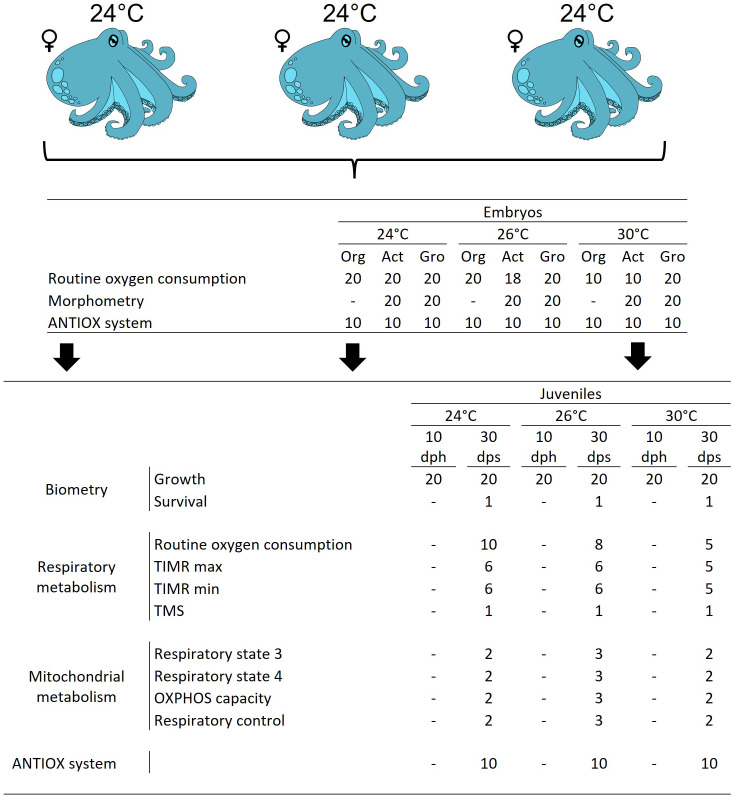
Heatwaves are emerging climatological threats intensifying by climate change, that pose unprecedented challenges to thermally sensitive marine species. This study investigated the physiological and metabolic responses of O. maya offspring to heatwave conditions, focusing on oxidative stress, mitochondrial function, and survival. We simulated a critical scenario where females with an optimal thermal history (24°C) laid eggs at the onset of a heatwave, exposing the offspring to optimal (24°C), intermediate (26°C), or high (30°C) temperatures for the entire embryonic development (~45 days) and 30 days post-hatching. Embryos incubated at 30°C showed altered morphometry (reduced mantle and arm lengths) and suppressed routine metabolic rates by the end of embryonic development. Among antioxidants analyzed, total glutathione (GSH) emerged as a key factor in mitigating oxidative stress, supporting previous observations suggesting a key role in reactive oxygen species (ROS) protection. We hypothesized that energy reallocation to stress defense mechanisms compromised developmental processes, resulting in smaller hatchlings with reduced survival and diminished factorial metabolic scope. High-resolution respirometry revealed mitochondrial dysfunction, including increased proton leak and reduced respiratory efficiency, exacerbating oxidative damage and impairing oxygen transport. While some juveniles exhibited metabolic plasticity and elevated ATP production, these responses were insufficient to counteract the long-term costs of thermal stress. These findings suggest that although optimal thermal history, as seen in upwelling zones, may offer temporary protection, prolonged exposure to elevated temperatures could severely compromise reproductive success and population sustainability.
Copyright: © 2025 Vargas-Abúndez et al. This is an open access article distributed under the terms of the Creative Commons Attribution License, which permits unrestricted use, distribution, and reproduction in any medium, provided the original author and source are credited.
Conflict of interest statement
The authors have declared that no competing interests exist.
Figures



References
-
- Perkins SE, Alexander LV. On the Measurement of Heat Waves. Journal of Climate. 2013;26(13):4500–17. doi: 10.1175/jcli-d-12-00383.1 - DOI
-
- Smale DA, Wernberg T, Oliver ECJ, Thomsen M, Harvey BP, Straub SC, et al. Marine heatwaves threaten global biodiversity and the provision of ecosystem services. Nat Clim Chang. 2019;9(4):306–12. doi: 10.1038/s41558-019-0412-1 - DOI
-
- Brodeur RD, Auth TD, Phillips AJ. Major shifts in pelagic micronekton and macrozooplankton community structure in an upwelling ecosystem related to an unprecedented marine heatwave. Frontiers in Marine Science. 2019;6.
-
- Lonhart SI, Jeppesen R, Beas-Luna R, Crooks JA, Lorda J. Shifts in the distribution and abundance of coastal marine species along the eastern Pacific Ocean during marine heatwaves from 2013 to 2018. Mar Biodivers Rec. 2019;12(1). doi: 10.1186/s41200-019-0171-8 - DOI
MeSH terms
Substances
LinkOut - more resources
Full Text Sources
