. 2025 Apr 29:53:101301.
doi: 10.1016/j.lanepe.2025.101301. eCollection 2025 Jun.

Adolescent mental health before, during, and after the COVID-19 pandemic in Iceland: a repeated, cross-sectional, population-based study

Affiliations

Adolescent mental health before, during, and after the COVID-19 pandemic in Iceland: a repeated, cross-sectional, population-based study

Erin Haskell et al. Lancet Reg Health Eur. .

Abstract

Background: Adolescents' mental health declined during the COVID-19 pandemic, yet little is known about the long-term outcomes after the pandemic's declassification as a global health emergency (5 May 2023). This study examined changes in adolescent mental health in Iceland from 2016 to 2023, using a bioecological framework to identify risk and protective factors.

Methods: Youth in Iceland surveys were administered nationwide to 13-15-year-olds in 2016, 2018, 2020, 2021, 2022 and 2023, with an average 75% response rate across the years. The surveys included measures on depressive symptoms, anxiety and hostility (Symptom Checklist-90), parental social support (Perceived Parental Support Scale), screen time, and stress/trauma exposure (Negative Life Events Scale). Stepwise-reduced mixed-effects models assessed the association of age, gender, time and risk/protective factors and their effect on mental health. Multiple imputation addressed missing data, and Bonferroni corrections adjusted for multiple testing.

Findings: 62,011 adolescents participated: 48.2% female (n = 29,890), 50.0% male (n = 31,002), 1.8% non-binary (n = 1119). Depressive symptoms showed signs of improvement post-pandemic (2023) compared to 2021 (β 0.19, 95% CI 0.13-0.24), yet remained higher than pre-pandemic levels (2016: β -0.38, 95% CI -0.44 to -0.33; 2018: β -0.26, 95% CI -0.31 to -0.20). Anxiety and hostility also increased and remained higher than pre-pandemic levels in 2023 (anxiety: 2016 β -0.29, 95% CI -0.35 to -0.24, 2018 β -0.20, 95% CI -0.26 to -0.15; hostility: 2016 β -0.26, 95% CI -0.31 to -0.20, 2018 β -0.12, 95% CI -0.18 to -0.07). Across all the models examining the predictors from diverse bioecological spheres, low parental social support, high social media use, and bad grades were consistently associated with poor mental health, regardless of mental health outcome and gender.

Interpretation: The COVID-19 pandemic has had a serious and continuing negative effect on adolescents' mental health. Targeted interventions are needed to address the increase in mental health problems during the COVID-19 pandemic, with a focus on enhancing parental support and managing screen use.

Funding: Icelandic Research Fund (217612-051); NordForsk (147386).

Keywords: Adolescents; Bioecological model; COVID-19; Gender differences; Mental health; Screen use.


Conflict of interest statement

IET is a staff member at Planet Youth, a youth substance use prevention service organisation that is distributed globally through sale of the Planet Youth Guidance Program, which is based on the Icelandic Prevention Model, from which she receives a salary. All other authors declare no competing interests.

Figures

Fig. 1
Fig. 1
Conceptual image of the bioecological model in the context of COVID-19, and depicting the variables utilised within this paper at each of the levels pertinent to an adolescent: individual, home and school/peer environments. The central (purple) circle represents the ‘individual’ and includes variables of age, gender, and incidence of serious illness and accidents. The next (green) circle represents the immediate ‘home’ environment and includes variables relating to the parent/carer, activities in the home and home-related stresses and traumas. The next (light blue) circle includes variables relating to the ‘school/peer’ environment and includes academic- and peer-related stresses, traumas and activities. The elements of each environment can interact with each other, adjacent positioning does not indicate a direct interaction. The ‘macro’ scale of the bioecological model is represented by the light turquoise external circle, whereby all other bioecological spheres were affected by the COVID-19 pandemic and related restrictions, this is represented with the ‘year’ variable in our analysis. Created in BioRender. Haskell, E. (2025) licence details available at https://BioRender.com/f21j794.
Fig. 2
Fig. 2
Combined plot of mean mental health cumulative survey scores over the course of the survey period (20162023). Participant age (13-, 14-, or 15-years-old) is represented by different colours. Graphs are segregated based on gender (Mixed gender, Girl, Boy). Depressive symptom scores range from 10 to 40 and are represented in graphs a–c, anxiety symptom scores range from 5 to 20 and are represented by graphs d–f, and hostility scores range from 5 to 20 and are represented by graphs g–i. Y-axis scales have been truncated to enable age group differences to be visualised. Error bars represent standard error. Y-axes scale origins are not set to 0, they have been truncated (as indicated by the .. symbol) to be adapted to the cumulative score range and enable age group differences to be visualised. Error bars represent standard error.
Fig. 3
Fig. 3
Proportion of participants with high mental health symptom scores for 13-, 14- and 15-year-old adolescents across the study period (2016–2023). Figure shows the proportion of individuals with high depressive (plots a–b), anxiety (plots c–d) symptom and hostility (e–f) scores equal to or above those of the 5th centile determined separately for boys and girls for each age group in 2016 as a pre-pandemic baseline.
Fig. 4
Fig. 4
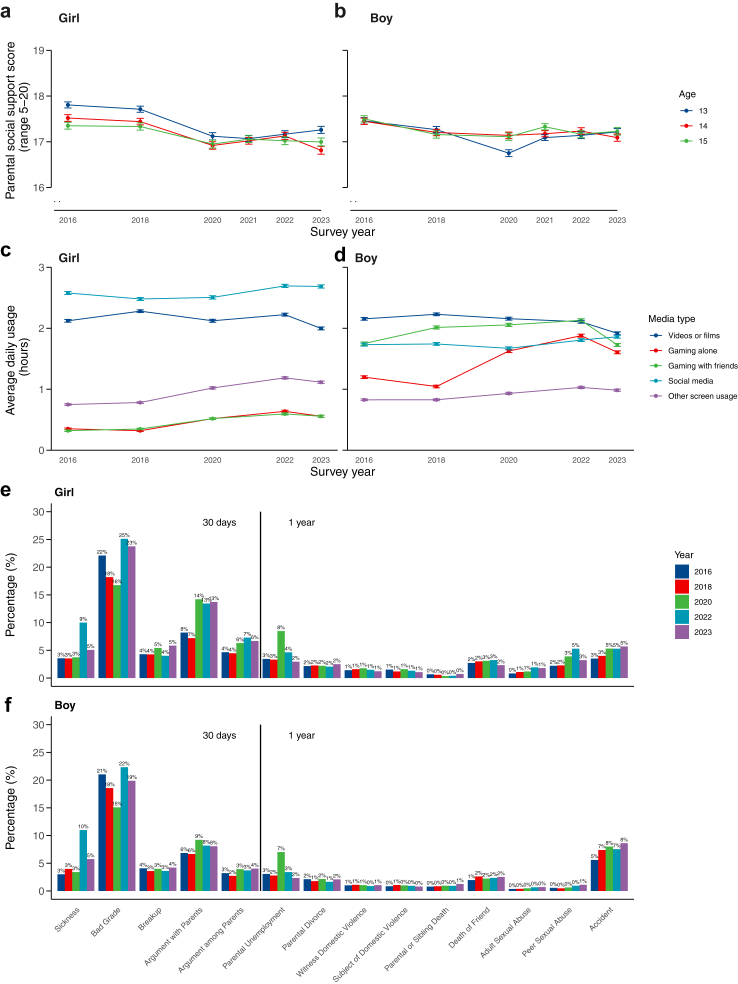
Combined plot showing the changes in survey responses on parental social support, screen use and stress and trauma across the study period. Plots a–b show mean cumulative survey scores (range 5–20) for parental social support for girls and boys respectively, higher scores indicate better perceived levels of support, note that Y-axes scale origins are not set to 0, they have been truncated (as indicated by the . symbol). Plots c–d show screen usage (mean hours per day, range 0 h–6+ hours), segregated by media type: watching videos, playing video games alone or with friends, social media use and offline/other screen use, for girls and boys respectively. Plots e–f show the proportion of survey participants reporting an experience of specific stressors and traumas across the study period (response options were binary), for girls and boys respectively. Responses are split by reports within the last 30 days for stressful experiences, and in the last year for traumatic experiences. Screen usage and stress and trauma related questions were not asked in 2021. Error bars represent standard error.

References

    1. Kiviruusu O., Ranta K., Lindgren M., et al. Mental health after the COVID-19 pandemic among Finnish youth: a repeated, cross-sectional, population-based study. Lancet Psychiatry. 2024;11:451–460. - PubMed
    1. Samji H., Wu J., Ladak A., et al. Review: mental health impacts of the COVID-19 pandemic on children and youth – a systematic review. Child Adolesc Ment Health. 2022;27:173–189. - PMC - PubMed
    1. McGorry P.D., Mei C., Dalal N., et al. The Lancet psychiatry commission on youth mental health - the Lancet psychiatry. Lancet Psychiatry Comm. 2024;11:731–774. - PubMed
    1. Hakulinen C., Komulainen K. Perspectives on adolescent mental health after the COVID-19 pandemic. Lancet Psychiatry. 2024;11:402–403. - PubMed
    1. Orben A., Tomova L., Blakemore S.-J. The effects of social deprivation on adolescent development and mental health. Lancet Child Adolesc Health. 2020;4:634–640. - PMC - PubMed

LinkOut - more resources