


Analysis of the trends and predictions of tuberculosis burden in China from 1990 to 2021 based on the GBD database
- PMID: 40959629
- PMCID: PMC12434080
- DOI: 10.3389/fpubh.2025.1626232
Analysis of the trends and predictions of tuberculosis burden in China from 1990 to 2021 based on the GBD database
Abstract
Background: Tuberculosis (TB) is a major public health concern in China, exhibiting unique epidemiological traits and changing patterns. This study aims to assess the burden of TB in China from 1990 to 2021 and forecast the future.
Methods: Data on TB burden indicators in China from 1990 to 2021 were collected from the Global Burden of Disease (GBD) database. The Joinpoint Regression (JPR) model was employed to assess trends in disease burden, with calculations of the annual percentage change (APC) and average annual percentage change (AAPC). The Auto-Regressive Integrated Moving Average (ARIMA) model and the Bayesian Age-Period-Cohort (BAPC) model were utilized to forecast trends in the age-standardized incidence rate (ASIR) and age-standardized mortality rate (ASMR) over the next 15 years.
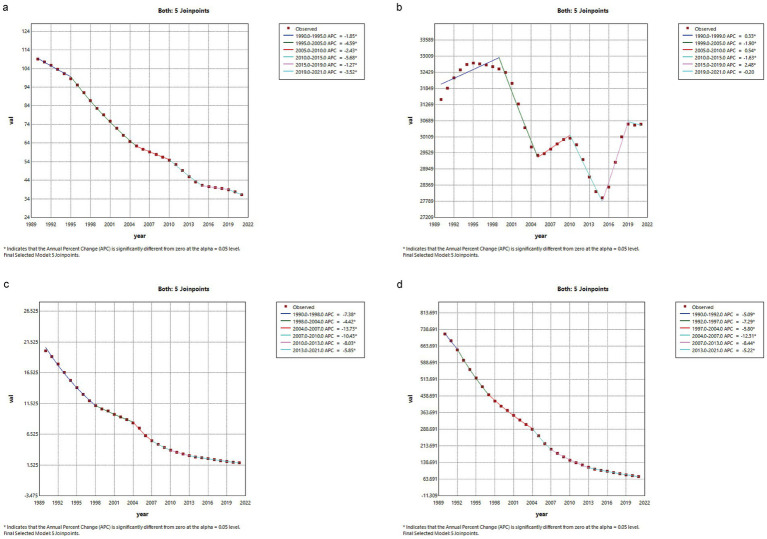
Results: From 1990 to 2021, the incidence, mortality, and disability-adjusted life years (DALYs) of TB in China showed a declining trend, decreasing by 47.17, 78.14, and 81.25%, respectively, while the absolute number of TB cases increased by 32.96%. In 2021, the ASIR, age-standardized prevalence rate (ASPR), ASMR, and age-standardized DALY rate (ASDR) of TB in China were 36.28 per 100,000 (95% CI: 32.63-40.47), 30,557.45 per 100,000 (95% CI: 27,692.69-33,531.31), 1.91 per 100,000 (95% CI: 1.51-2.51), and 76.22 per 100,000 (95% CI: 62.59-94.45), respectively, reflecting reductions of 66.60, 2.83, 90.72, and 89.53% from 1990 levels. The burden of TB exhibited disparities across gender and age groups, with older males experiencing a higher burden than older females, and children under 5 years old demonstrating the highest incidence rate among all age groups. The JPR regression model indicated a significant decline in ASIR (AAPC = -3.49; 95% CI: -3.49 to -3.37; p < 0.001), ASMR (AAPC = -7.42; 95% CI: -7.78 to -7.07; p < 0.001), and ASDR (AAPC = -7.01; 95% CI: -7.22 to -6.80; p < 0.001) from 1990 to 2021, whereas ASPR remained relatively stable (AAPC = -0.15; 95% CI: -0.37 to -0.006; p = 0.17). Predictions from both the ARIMA and BAPC models were consistent, suggesting a continued decline in ASIR and ASMR through 2036, with the burden remaining higher among males than females.
Conclusion: From 1990 to 2021, TB incidence, mortality, and DALYs in China demonstrated an overall downward trend, with similar declines observed in both male and female populations. Projections indicate that ASIR and ASMR will continue to decline from 2022 to 2036. These findings provide valuable insights for the development of public health strategies aimed at reducing the TB burden in China.
Keywords: BAPC model; GBD database; disease burden; predictive analysis; tuberculosis.
Copyright © 2025 Lu, Feng, Feng and Shen.
Conflict of interest statement
The authors declare that the research was conducted in the absence of any commercial or financial relationships that could be construed as a potential conflict of interest.
Figures




References
MeSH terms
LinkOut - more resources
Full Text Sources
Medical
