


Stopover departure decisions in spring: pre-Saharan migrants stay longer and are more selective for favourable wind than trans-Saharan migrants
- PMID: 40983936
- PMCID: PMC12455787
- DOI: 10.1186/s40462-025-00575-0
Stopover departure decisions in spring: pre-Saharan migrants stay longer and are more selective for favourable wind than trans-Saharan migrants
Abstract
Background: Birds that breed in Europe and winter south of the Sahara, so-called trans-Saharan migrants, generally migrate longer distances than pre-Saharan migrants. The latter are expected to be less time constrained during autumn migration than the former. As such, pre-Saharan migrants are assumed to be more selective for favourable weather conditions and are more likely to minimise energy cost of migration than trans-Saharan migrants. While this pattern is supported for autumn migration, it is less well understood for spring migration. Since the optimal arrival timing at the breeding areas is generally under selection pressure to arrive ‘early’, i.e. before ‘competitors’, and since this advantage is likely to hold across migration strategies, we predict that the general differences in decision making between pre- and trans-Saharan migrants will also be manifested during spring migration.
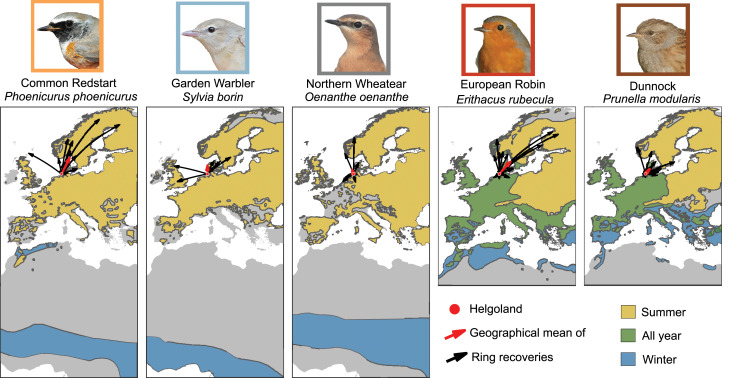
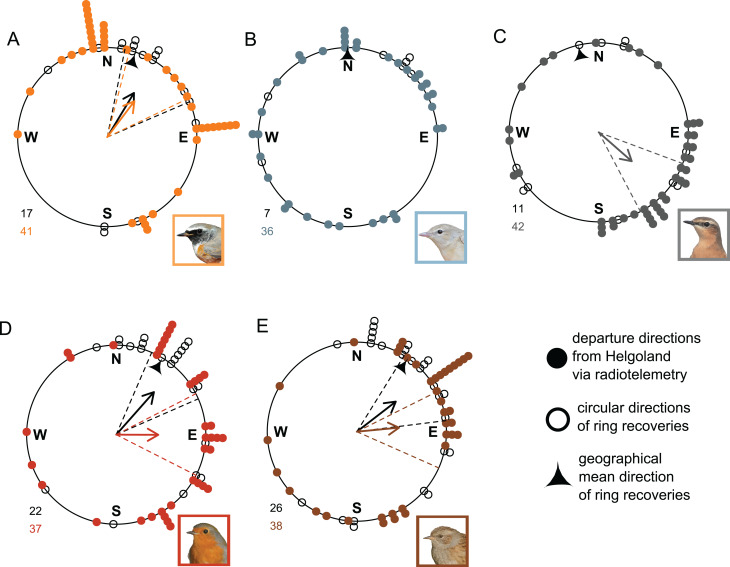
Methods: We radio-tracked three trans-Saharan (Common Redstart Phoenicurus phoenicurus, Garden Warbler Sylvia borin and Northern Wheatear Oenanthe oenanthe) and two pre-Saharan (European Robin Erithacus rubecula and Dunnock Prunella modularis) migrants during stopover using a regional network of Motus receiving stations. We analysed the night-to-night and within-night departure decisions in relation to weather and energy stores, and compared species’ departure direction with the location of their ring recoveries.
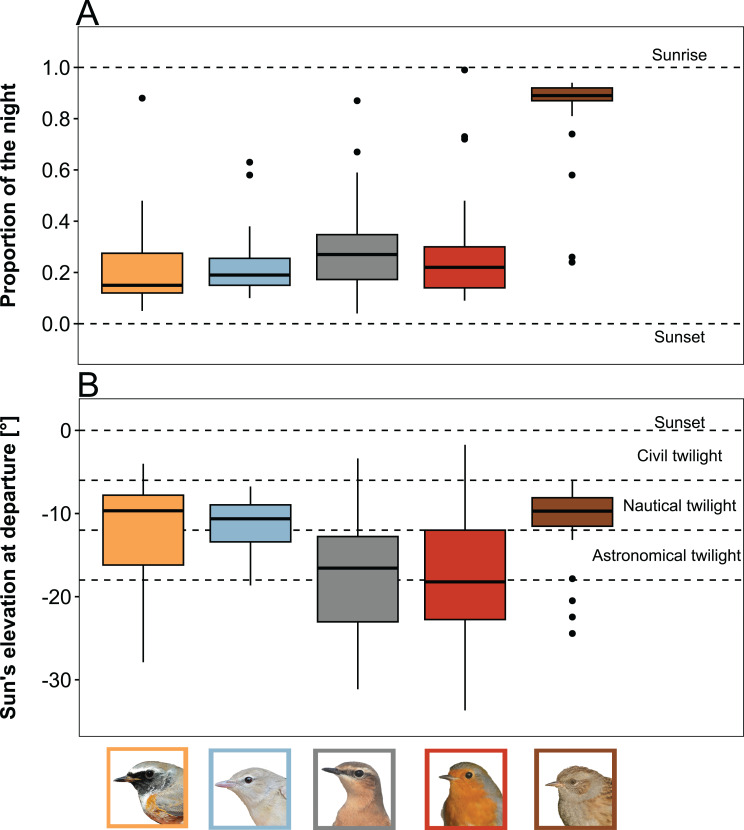
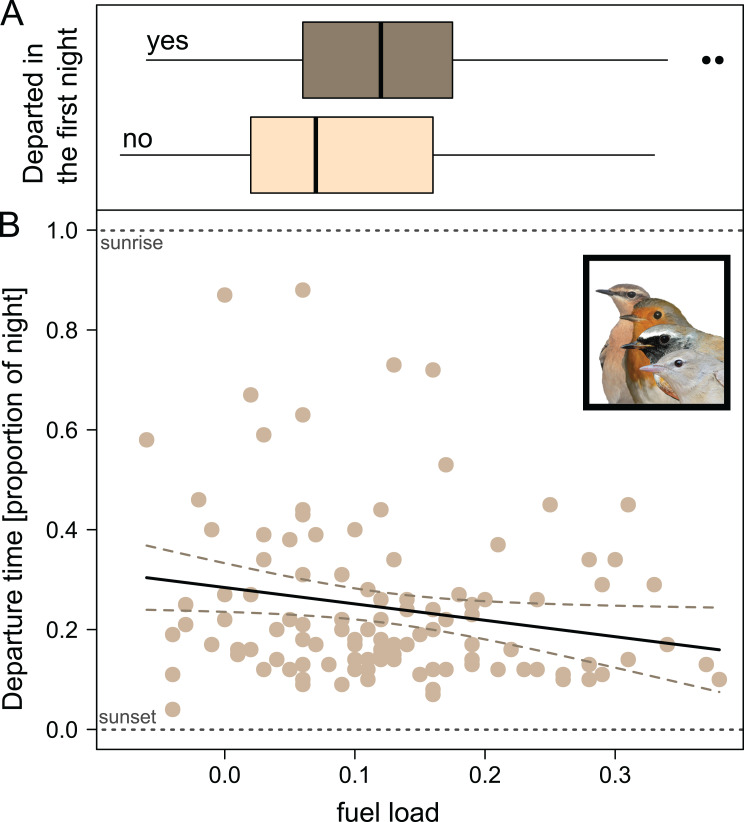
Results: Trans-Saharan migrants stopped-over shorter and were less selective for favourable wind conditions than pre-Saharan migrants. The positive effect of high energy stores and low cloud cover on departure probability was a consistent pattern. Within-night departure times did not differ between migration strategies. Departure directions were in line with geographical mean location of ring recoveries for Common Redstart, European Robin and Dunnock.
Conclusions: Our results suggest that pre-Saharan migrants are less time-constrained and follow an energy-saving strategy more strongly than trans-Saharan migrants that seem to have a stronger urge to migrate fast in spring. Since a similar pattern exists for autumn migration, we suggest that how the species-specific migration strategies and associated time constraints affect stopover decision making in both migration seasons is a general mechanism in migratory songbirds.
Supplementary Information: The online version contains supplementary material available at 10.1186/s40462-025-00575-0.
Keywords: Departure decision; Departure direction; Energy stores; Radio-tracking; Songbird; Weather conditions; pre-Saharan migrants; trans-Saharan migrants.
Conflict of interest statement
Declarations. Ethics approval and consent to participate: All procedures were approved by the Ministry for Agriculture, the Environment and Rural Areas, Schleswig-Holstein, Germany (permission numbers: V 244–4829/2017 (33 − 3/17)). Consent for publication: Not applicable. Competing interests: The authors declare no competing interests.
Figures



References
-
- Newton I. The migration ecology of birds. Academic; 2007.
-
- Newton I. Obligate and facultative migration in birds: ecological aspects. J Ornithol. 2017;153:171–80. - DOI
-
- Böhning-Gaese K, Halbe B, Lemoine N, Oberrath R. Factors influencing the clutch size, number of broods and annual fecundity of North American and European land birds. Evol Ecol Res. 2000;2:823–39.
LinkOut - more resources
Full Text Sources
Research Materials
