


Fixed-dose vs loose-dose combination antidiabetic therapy and cardiorenal outcomes in type 2 diabetes: a nationwide comparative effectiveness study
- PMID: 40988019
- PMCID: PMC12455815
- DOI: 10.1186/s12933-025-02936-w
Fixed-dose vs loose-dose combination antidiabetic therapy and cardiorenal outcomes in type 2 diabetes: a nationwide comparative effectiveness study
Abstract
Background: Combination therapy is gaining attention in type 2 diabetes management due to its potential to reach glycaemic goals within a shorter period. However, the long-term comparative cardiorenal effectiveness of fixed- versus loose-dose combinations remains unclear. This study aimed to assess whether oral antidiabetic fixed-dose combination (FDC) therapy is associated with improved cardiorenal outcomes in adults with type 2 diabetes compared with loose-dose combination (LDC) therapy. A secondary objective was to evaluate the mediating role of medication adherence in these associations.
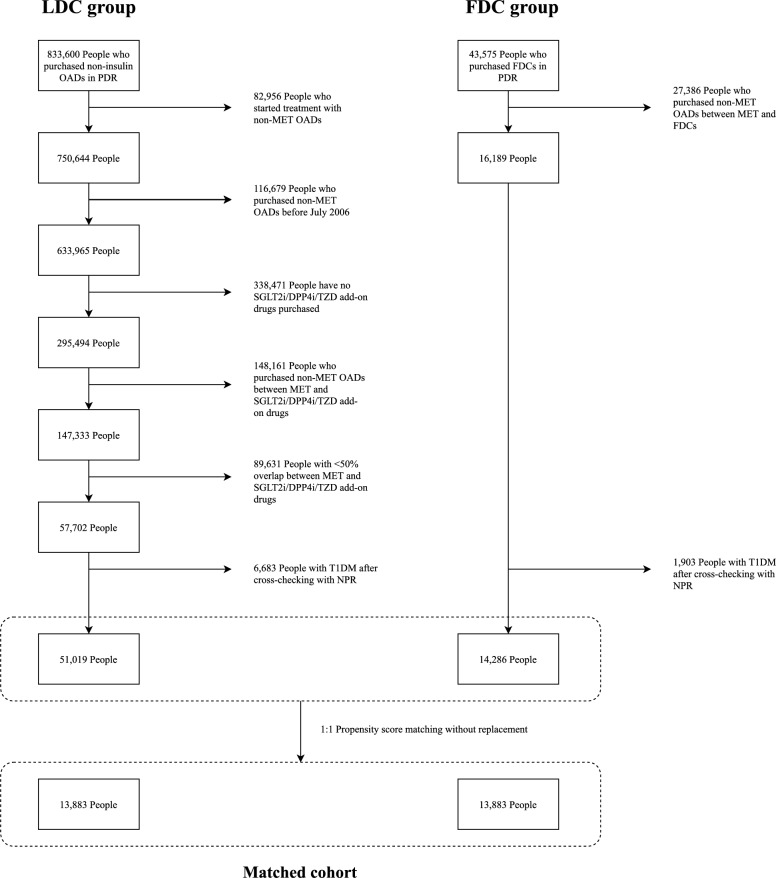
Methods: This population-based, new-user, active-comparator cohort study used Swedish national registers. Propensity score matching without replacement was applied. Study outcomes included acute myocardial infarction, atrial fibrillation, unstable angina, heart failure, ischaemic stroke, and eGFR < 30 ml/min/1.73m2. Associations with cardiorenal outcomes were assessed using Cox regression. Adherence was defined as the proportion of days covered > 80% during the first year.
Results: The median follow-up time was 4.0 years for cardiovascular outcomes and 3.8 years for kidney outcomes. In the matched cohort (mean age 62 years; 67% male), FDC users had higher treatment adherence (68.6 vs. 46.5%). FDC was associated with a lower rate of heart failure (HR = 0.88; 95% CI 0.79, 0.99), with adherence mediating 47% of this association. In people aged ≥ 65 years, FDC was associated with a lower rate of heart failure (HR = 0.79; 95% CI 0.69, 0.91). The observed association was attenuated with further matching for diabetes duration or when drugs were matched at the ATC code level. No associations between FDC use and other outcomes were identified.
Conclusions: FDC therapy in people with type 2 diabetes was associated with a lower rate of heart failure, particularly in older adults. Higher medication adherence appeared to mediate nearly half of this association.
Keywords: Antidiabetic agent; Comparative effectiveness; Fixed-dose combination; Heart failure; Type 2 diabetes.
© 2025. The Author(s).
Conflict of interest statement
Declarations. Ethics approval and consent to participate: The study was approved by the Swedish Ethical Review Authority (dnr 2021–03957, 2023–03824–02) and fully complies with the principles of the Declaration of Helsinki as revised in 2008. Informed consent to be included in national registers is not required. This study is reported in accordance with the Strengthening the Reporting of Observational Studies in Epidemiology (STROBE) guidelines for cohort studies. Data were analysed using STATA 18 SE (StataCorp, USA) and R 4.3.2 (R Foundation for Statistical Computing, Austria). Consent for publication: Not applicable. Competing interests: JSL is personally funded by a Wellcome Trust Early Career Award (301005/Z/23/Z). JSL also reports speaker fees from AstraZeneca and consultancy fees from Boehringer Ingelheim, outside the submitted work. PBM reports grants from AstraZeneca and Boehringer Ingelheim outside the submitted work and speaker fees from AstraZeneca, Bayer, Pharmacosmos, Astellas, GSK, and Vifor. PW reports grant income from Roche Diagnostics, AstraZeneca, Boehringer Ingelheim, and Novartis, outside the submitted work and speaker fees from Novo Nordisk and Raisio. All other authors declare no conflict.
Figures

References
Publication types
MeSH terms
Substances
LinkOut - more resources
Full Text Sources
Medical
Research Materials
Miscellaneous
