Review
. 2025 Sep 25;16(1):8398.
doi: 10.1038/s41467-025-63259-8.

Neurodevelopmental commonalities in cognitive control networks for mathematics and reading in meta-analysis of 3308 participants

Affiliations
Review

Neurodevelopmental commonalities in cognitive control networks for mathematics and reading in meta-analysis of 3308 participants

Zehra E Ünal et al. Nat Commun. .

Abstract

Mathematics and reading abilities are foundational academic skills that are robustly correlated across development, suggesting shared cognitive mechanisms. To identify their common neural architecture, we conducted the largest cross-domain meta-analysis to date (179 experiments, 3308 participants). By analyzing activation patterns across simple and complex tasks in both children and adults, we uncovered three key insights into how the brain supports academic performance and learning. First, while mathematical processing recruits frontal-parietal regions and reading frontal-temporal regions, both domains rely on shared cognitive control networks. The salience network in particular, anchored by the bilateral insula and dorsomedial prefrontal cortex, supports both mathematical and reading processes, particularly during complex tasks. Second, children show broader engagement of these cognitive control networks than adults across both domains. Third, adults demonstrate more specialized posterior network engagement for domain-specific processing while maintaining prefrontal recruitment for challenging tasks, suggesting a developmental shift toward efficient, specialized processing. These findings suggest the ability to engage and coordinate cognitive control networks might represent a fundamental mechanism in academic performance and learning.


Conflict of interest statement

Competing interests: The authors declare no competing interests.

Figures

Fig. 1
Fig. 1. Key convergent regions for number-arithmetic and reading revealed by meta-analyses.
a Thresholded ALE maps revealed significant convergence across number-arithmetic studies in both adults [left panel] and children [right panel], primarily within the left frontal-parietal cortices for both lower- and higher-level contrasts. Conjunction analyses revealed significant overlaps between contrasts in the frontal-parietal network, as well as in the dorsomedial prefrontal cortex (dmPFC) and anterior insula (AI) in both age groups (see Tables S9 and S10 for details). b Thresholded ALE maps revealed significant convergence across reading studies in both adults [left panel] and children [right panel], primarily within the left frontal-temporal cortices for both lower- and higher-level contrasts. Conjunction analyses revealed that significant overlaps between contrasts in the frontal-temporal reading network, as well as in the dmPFC/dorsal anterior cingulate cortex (dACC) and AI in both age groups (see Tables S11 and S12 for details). Note, the color scales indicate the estimated ALE values. FG fusiform gyrus, IFG inferior frontal gyrus, IPL inferior parietal lobule, IPS intraparietal sulcus, ITG inferior temporal gyrus, MFG middle frontal gyrus, MTG middle temporal gyrus, PCu precuneus, SFG superior frontal gyrus, SMG supramarginal gyrus, SPL superior parietal lobule, STG superior temporal gyrus, L left, R right.
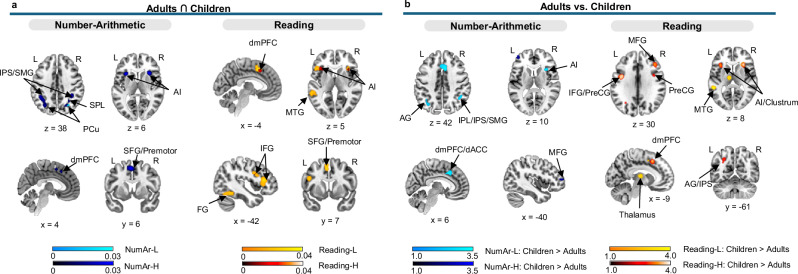
Fig. 2
Fig. 2. Similarities and differences in key convergent regions between adults and children for number-arithmetic and reading.
a Conjunction analyses revealed significant overlap between adults and children for both lower- and higher-level contrasts. For number-arithmetic, lower-level contrasts showed overlap in the parietal cortex, while higher-level contrasts showed overlap in the dorsomedial prefrontal cortex (dmPFC) and anterior insula (AI) across both age groups (Left panel; See Tables S13). For reading, lower-level contrasts showed overlap within the frontal-temporal reading network, while higher-level contrasts showed overlap in the dmPFC and AI between adults and children (Right panel; See Tables S14). b Contrast analyses revealed greater activations in children compared to adults for both contrast levels. For number-arithmetic, children showed greater activation in the parietal cortex, including the intraparietal sulcus (IPS), as well as the dmPFC/dorsal anterior cingulate cortex (dACC) and AI for lower-level contrasts. For higher-level contrasts, greater activation in children was observed within a small cluster in the middle frontal gyrus (MFG) (Left panel; See Tables S15). For reading, children showed greater activation in the frontal-temporal cortices and AI for lower-level contrasts. Higher-level contrasts revealed additional differences between adults and children in frontal-parietal regions, including the left dmPFC, AI and angular gyrus (AG) (Right panel; see Tables S16). Note, the color scales indicate the estimated ALE values and the IPS was identified by the Juelich atlas in FSL. FG fusiform gyrus, IFG inferior frontal gyrus, IPL inferior parietal lobe, IPS intraparietal sulcus, MTG middle temporal gyrus, PCu precuneus, preCG precentral gyrus, SFG superior frontal gyrus, SMG supramarginal gyrus, SPL superior parietal lobule, L left, R right.
Fig. 3
Fig. 3. Similarities in key activated regions across number-arithmetic and reading for adults and children.
Conjunction analyses revealed significant overlaps between number-arithmetic and reading for both lower- and higher-level contrasts. a For adults, processes with lower-level contrasts showed overlaps within the inferior frontal gyrus (IFG), while processes with higher-level contrasts additionally engaged the dorsomedial prefrontal cortex and dorsal anterior cingulate cortex (dmPFC/dACC), as well as the anterior insula (AI), across domains (see Tables S17). b For children, both lower-level and higher-level processes showed significant overlaps in the dmPFC and AI across domains, similar to adults. Additionally, lower-level and higher-level processes engaged the superior parietal lobule (SPL) and the precuneus (PCu), respectively. (see Tables S18). Note, the color scales indicate the estimated ALE values: SFG superior frontal gyrus. L left, R right.
Fig. 4
Fig. 4. Meta-analytic coactivation profiles of cognitive control regions and associated behavioral domains.
a Meta-analytic connectivity modeling (MACM) results using the anterior insula (AI) as the seed region. b MACM results using the dorsomedial prefrontal cortex and dorsal anterior cingulate cortex (dmPFC/dACC) as the seed region. All seed coordinates were defined based on the peak activations from the conjunction analyses between the ALE maps for Arithmetic-Number and Reading, with a focus on higher-level contrasts. The left panels show coactivation patterns and associated behavioral domains based on coordinates from adult studies, while the right panels shows the results based on coordinates from child studies. Coactivation patterns and associated behavioral domains were identified using studies retrieved from the BrainMap database via Sleuth (details for coordinates in Tables S17–S18). Introspection-related experiments (e.g., thirst, sleep; n = 1–7) were excluded from all AI behavioral profile histograms, as introspection was not the primary focus of the study. Red, green, blue, and yellow colors in histograms indicate action, cognition, emotion, and perception domains, respectively. L left, R right.
Fig. 5
Fig. 5. Overview of commonalities and differences in number-arithmetic and reading processes across adults and children.
Several regions were identified from thresholded ALE maps, each associated with domain of interests (top: number-arithmetic; bottom: reading), age group (left: adults; right: children), and target contrast (color bar: lower-level; striped color bar: higher-level). A circular graph represents the hemispheric locations of the brain regions, with colors indicating the corresponding lobes of the brain. Convergent activations on number-arithmetic processes were predominantly observed in the bilateral frontal-parietal cortices (see Fig. 1a), whereas convergent activations on reading processes were primarily observed in the bilateral frontal and left temporal cortices (see Fig. 1b). Follow-up conjunction analyses revealed that the bilateral insula (AI) and dorsomedial prefrontal cortex (dmPFC), key regions within the salience network, are common across number-arithmetic and reading processes in both adults and children, particularly during higher-level processing (Fig. 3). AG angular gyrus, dACC dorsal anterior cingulate cortex, FG fusiform gyrus, IFG inferior frontal gyrus, IPL inferior parietal lobule, IPS intraparietal sulcus, MFG middle frontal gyrus, MTG middle temporal gyrus, PCu precuneus, SMG supramarginal gyrus, SPL superior parietal lobule, STG superior temporal gyrus, L left, R right. For more detailed results, see Fig. S2.

References

    1. Ritchie, S. J. and T. C. Bates, enduring links from childhood mathematics and reading achievement to adult socioeconomic status. Psychol. Sci. 24, 1301−8 (2013). - PubMed
    1. Stoet, G. & Geary, D. C. Gender differences in the pathways to higher education. Proc. Natl Acad. Sci. USA117, 14073–14076 (2020). - PMC - PubMed
    1. Duncan, G. J. et al. School readiness and later achievement. Dev. Psychol.43, 1428–1446 (2007). - PubMed
    1. Korpipää, H. et al. Early cognitive profiles predicting reading and arithmetic skills in grades 1 and 7. Contemp. Educ. Psychol.60, 101830 (2020).
    1. Ünal, Z. E. et al. What is the source of the correlation between reading and mathematics achievement? two meta-analytic studies. Educ. Psychol. Rev.35, 4 (2023).

LinkOut - more resources