


Mental health outcomes at intensive care unit discharge: prevalence, mediators and risk factors
- PMID: 40999288
- PMCID: PMC12463781
- DOI: 10.1186/s13613-025-01545-w
Mental health outcomes at intensive care unit discharge: prevalence, mediators and risk factors
Abstract
Background: Intensive Care Unit (ICU) patients often experience significant discomfort and distress due to both the medical environment and the nature of their stay. While long-term sequelae such as depression, anxiety, and post-traumatic stress are well-documented, few studies have examined psychological disorders present at the time of ICU discharge. Based on the model of Post-Intensive Care Syndrome, specifically the mental component (PICS-M), we defined DICS-M (Discharge Intensive Care Syndrome - Mental component). This study aimed to estimate the prevalence of psychological disorders at ICU discharge and to identify potential mediators and risk factors.
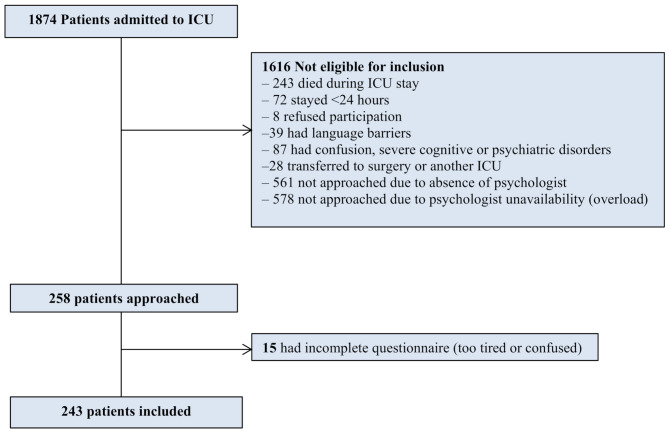
Methods: We conducted a prospective observational study involving 243 patients admitted between January 2023 and April 2024.
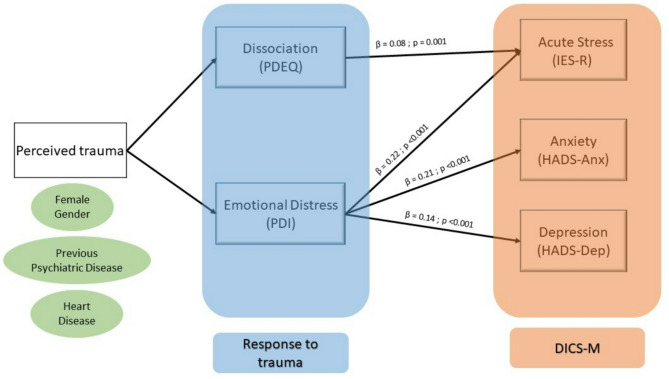
Results: The prevalence of DICS-M was 53% [95% CI: 46-59], with acute stress, anxiety, and depression observed in 37%, 36%, and 23% of patients, respectively. The analyses revealed an overlap among these psychological components. Peritraumatic distress acted as the main mediator of DICS-M. Univariate and multivariable analyses identified female gender and a history of psychiatric and cardiac conditions as risk factors of DICS-M.
Conclusion: Psychological disorders are common at ICU discharge, mediated by peritraumatic distress, and associated with identifiable risk factors. These findings may help guide interventions to prevent long-term sequelae of ICU stays.
Keywords: Acute stress disorder; Early psychological assessment; Post intensive care syndrome; Psychological disorders; Trauma.
© 2025. The Author(s).
Conflict of interest statement
Declarations. Consent for publication: Not applicable. Competing interests: None.
Figures

References
-
- Novaes MA, Aronovich A, Ferraz MB, Knobel E. Stressors in ICU: patients’ evaluation. Intensive Care Med. 1997;23:1282–5. - PubMed
-
- Rotondi AJ, Chelluri L, Sirio C, Mendelsohn A, Schulz R, Belle S, et al. Patients’ recollections of stressful experiences while receiving prolonged mechanical ventilation in an intensive care unit. Crit Care Med. 2002;30:746–52. - PubMed
-
- Simini B. Patients’ perceptions of intensive care. Lancet. 1999;354:571–2. - PubMed
-
- American Psychiatric Association. Diagnostic and statistical manual of mental disorders (DSM-5®). American Psychiatric Pub; 2013.
LinkOut - more resources
Full Text Sources
Miscellaneous
