Review
. 2025 Sep 12;25(18):5708.
doi: 10.3390/s25185708.

Methodologies for Remote Bridge Inspection-Review

Affiliations
Review

Methodologies for Remote Bridge Inspection-Review

Diogo Ribeiro et al. Sensors (Basel). .

Abstract

This article addresses the state of the art of methodologies for bridge inspection with potential for inclusion in Bridge Management Systems (BMS) and within the scope of the IABSE Task Group 5.9 on Remote Inspection of Bridges. The document covers computer vision approaches, including 3D geometric reconstitution (photogrammetry, LiDAR, and hybrid fusion strategies), damage and component identification (based on heuristics and Artificial Intelligence), and non-contact measurement of key structural parameters (displacements, strains, and modal parameters). Additionally, it addresses techniques for handling the large volumes of data generated by bridge inspections (Big Data), the use of Digital Twins for asset maintenance, and dedicated applications of Augmented Reality based on immersive environments for bridge inspection. These methodologies will contribute to safe, automated, and intelligent assessment and maintenance of bridges, enhancing resilience and lifespan of transportation infrastructure under changing climate.

Keywords: Augmented Reality; Big Data; Digital Twins; computer vision; methodologies; remote bridge inspection.


Conflict of interest statement

Author Ali Mirzazade was employed by the company Invator AB. The remaining authors declare that the research was conducted in the absence of any commercial or financial relationships that could be construed as a potential conflict of interest.

Figures

Figure 1
Figure 1
Computer vision approaches.
Figure 2
Figure 2
Generated 3D model of the bridge: (a) merge of four-point cloud data, (b) photo modeler 3D model, (c) Revit 3D model (adapted from [2]).
Figure 3
Figure 3
Reality capture of access viaduct of Pirâmides railway bridge: (a) TLS model, (b) SfM-based model based on UAV data, and (c) hybrid model (adapted from [28]).
Figure 4
Figure 4
3D point cloud model: (a) photogrammetry, (b) LiDAR, and (c) fusion strategy [29].
Figure 5
Figure 5
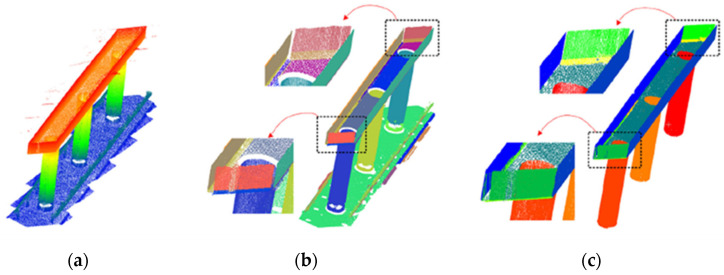
Comparison between surface extraction results: (a) sub-dataset of a pier, (b) surface extracted by RANSAC, and (c) surface extracted by the method proposed by Hong et al. [25].
Figure 6
Figure 6
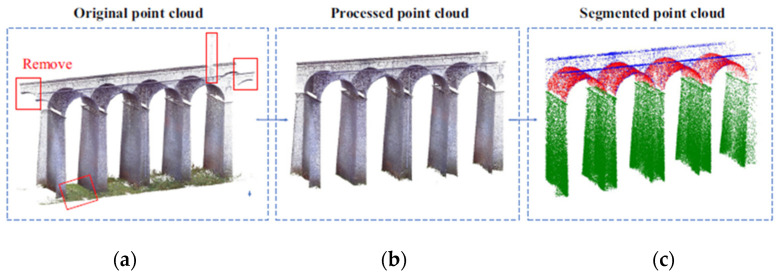
Point cloud processing: (a) original point cloud, (b) background removal, and (c) semantic segmentation [36].
Figure 7
Figure 7
Application of heuristic filters to the case of a steel railway bridge: (a) original image, (b) defect detection (adapted from [49]).
Figure 8
Figure 8
Example of visual recognition results presented by Narazaki et al. [21]: (a) structural components and (b) structural damage.
Figure 9
Figure 9
Steps to create photo-realistic synthetic environments [21].
Figure 10
Figure 10
Virtual LiDAR-based synthetic bridge point clouds generation processes and automated annotation for DL-based 3D instance segmentation of highway bridges [64].
Figure 11
Figure 11
Streamlined bridge inspection system [60].
Figure 12
Figure 12
Integrating damage into BrIM: (a) damage area with crop representation (red lines), (b) full 3D model using SfM, (c) detection results with cropped images, and (d) BrIM model with damage labels [67].
Figure 13
Figure 13
Horizontal and vertical displacements measurementusing a DIC-based method (adapted from [89]). White arrows indicate the displacement direction.
Figure 14
Figure 14
Computer vision-based dense 3D structural displacement measurement framework [8].
Figure 15
Figure 15
Normalized operational deflection shapes of the cantilever beam from (a) displacements extracted from camera video and (b) accelerometer data [9] (with permission from ASCE).
Figure 16
Figure 16
Remote modal identification of a suspended pedestrian bridge: (a) image of UAV Phantom 4 recording video and (b) mode shapes [100].
Figure 17
Figure 17
Monitored surface strain and displacement on a reinforced concrete sample [102].
Figure 18
Figure 18
Characteristics of the 5Vs of Big Data.
Figure 19
Figure 19
Knowledge Discovery in Databases (KDD) process [110].
Figure 20
Figure 20
(a) BrIM model, and (b) Digital Twin of the bridge with BrIM model, FEM model, and load test [129].
Figure 21
Figure 21
Developed bridge DT prototype for drone-enabled bridge inspection [130].
Figure 22
Figure 22
DT platform: timeline of the interactions regarding measurements, simulation, standards, and BIM [132].
Figure 23
Figure 23
(a) AR application: app development in UNITY 3D and its linkage with the IoT platform, and (b) visualization of SHM data in HoloLens [150].

References

    1. Cheng H., Chai W., Hu J., Ruan W., Shi M., Kim H., Cao Y., Narazaki Y. Random bridge generator as a platform for developing computer vision-based structural inspection algorithms. J. Infrastruct. Intell. Resil. 2024;3:100098. doi: 10.1016/j.iintel.2024.100098. - DOI
    1. Dabous S.A., Al-Ruzouq R., Llort D. Three-dimensional modeling and defect quantification of existing concrete bridges based on photogrammetry and computer aided design. Ain Shams Eng. J. 2023;14:102231. doi: 10.1016/j.asej.2023.102231. - DOI
    1. Pepe M., Costantino D., Crocetto N., Garofalo A.R. 3D Modeling of Roman Bridge by the Integration of Terrestrial and UAV Photogrammetric Survey for Structural Analysis Purpose. International Archives of the Photogrammetry, Remote Sensing and Spatial Information Sciences—ISPRS Archives; Hannover, Germany: 2019. - DOI
    1. Yu L.C., He S.H., Liu X.S., Ma M., Xiang S.Y. Engineering-oriented bridge multiple-damage detection with damage integrity using modified faster region-based convolutional neural network. Multimed. Tools Appl. 2022;81:18279–18304. doi: 10.1007/s11042-022-12703-8. - DOI
    1. Kao S.P., Chang Y.C., Wang F.L. Combining the YOLOv4 Deep Learning Model with UAV Imagery Processing Technology in the Extraction and Quantization of Cracks in Bridges. Sensors. 2023;23:2572. doi: 10.3390/s23052572. - DOI - PMC - PubMed

LinkOut - more resources