


Food addiction and its associations with mental and physical health comorbidities and with quality of life in the general population
- PMID: 41013620
- PMCID: PMC12465856
- DOI: 10.1186/s40337-025-01400-0
Food addiction and its associations with mental and physical health comorbidities and with quality of life in the general population
Abstract
Background and aims: There is limited information on the prevalence and characteristics of Food Addiction (FA) in representative samples of the general population, and particularly in low- and middle-income countries. This study aimed to estimate the prevalence of FA and its associations with mental and physical health comorbidities, and with quality of life in Brazil.
Methods: A population-based household survey of 2297 individuals aged 18 to 60 years with 3-staged sampling was conducted in the city of Rio de Janeiro, Brazil from 2019 to 2020. FA was assessed with the modified Yale Food Addiction Scale 2.0 (mYFAS 2.0). Psychiatric comorbidity was evaluated with validated instruments and physical health conditions with close-ended questions. The prevalence of FA and all analyses were adjusted with sample weights. Multivariate logistic regression was used to assess associations between psychiatric and physical comorbidities and FA.
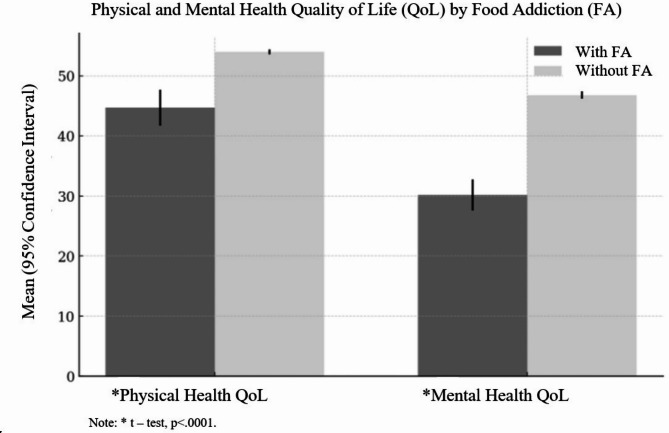
Results: The prevalence of FA was 2.78% (95% CI: 1.40 to 4.17) and was significantly higher in women than men [4.08% vs. 1.39% respectively, p < .001] and in younger compared to older individuals. Individuals with FA were significantly more likely to have depression (75.4%), anxiety (77.0%), attention deficit hyperactivity disorder (32.7%) and alcohol use disorder (19.7.%) symptoms compared to those without FA. Eating disorders (binge eating disorder and bulimia nervosa) were more than 10 more likely to occur in individuals with FA compared to those without FA. Furthermore, FA was significantly associated with all eating disorder, mental and physical health comorbidities, such as diabetes, stroke, asthma, chronic asthma, headaches, muscle problems, and gastroesophageal reflux, adjusting for Body Mass Index (BMI), sex and race, and poorer quality of life.
Conclusions: The prevalence of FA in the general population of a metropolitan city of Brazil lower than reported in other populations. However, FA was associated with notable mental and physical health comorbidity and a lower quality of life.
Keywords: Eating disorder; Food addiction modified yale food addiction scale 2.0; Physical comorbidity; Psychiatric disorders; Survey.
Plain language summary
There is limited information on the prevalence and characteristics of Food Addiction (FA) in representative samples of the general population, especially in low- and middle-income countries. Therefore, this study aimed to assess the occurrence of FA and its associations with mental and physical health conditions, and quality of life in a representative sample of the city of Rio de Janeiro/ Brazil. From 2297 respondents the rate of occurrence of food addiction was 2.78%. The associations between FA and various mental/physical comorbidities and higher body weight denote the importance of studying this topic and evaluating the impact on quality of life. The results provide valuable public health information regarding the prevalence and associations of FA with eating and general mental and physical health problems providing new insights into this phenomenon in a major urban center in a developing country.
© 2025. The Author(s).
Conflict of interest statement
Declarations. Ethical approval and consent to participate: To carry out the research, approval was obtained from the Ethics Committee of the Federal University of Rio de Janeiro (protocol number CAAE: 03814818.7.0000). The study was conducted by the principles of the Declaration of Helsinki. All participants were informed about the study, and consent was provided written informed consent before enrolling in the study. Also, the chance to withdraw from study at any point was given for the participants. Competing interests: Jose C. Appolinario has received research grants, consultancy fees, and advisory board fees from Takeda Pharmaceuticals. He receives/has received royalties/honoraria from Artmed Panamericana Editora. He also received a research grant from the Brazilian National Research Council (CNPq). Phillipa Hay has received sessional fees and lecture fees from the Australian Medical Council, Therapeutic Guidelines publication, and New South Wales Institute of Psychiatry and royalties from Hogrefe and Huber, McGraw Hill Education, and Blackwell Scientific Publications, and she has received research support from CAPES, NHMRC, and ARC. She is Chair of the National Eating Disorders Collaboration in Australia (2019-). She is a consultant for Tryptamine Therapeutics Pharmaceuticals.
Figures
References
-
- Randolph TG. The descriptive features of food addiction. Addictive eating and drinking. Q J Stud Alcohol. 1956;17(2):198–224. - PubMed
-
- APA. American Psychiatric Association. Diagnostic and statistical manual of mental disorders 5th ed., text rev. ed 2022.
-
- WHO. World Health Organization. ICD-11: International classification of diseases. updated 2022. 11th revision. https://icd.who.int/.
Grants and funding
LinkOut - more resources
Full Text Sources
