Review
. 2025 Sep 26;18(1):85.
doi: 10.1186/s13045-025-01739-6.

Combination immunotherapy in hepatocellular carcinoma: synergies among immune checkpoints, TKIs, and chemotherapy

Affiliations
Review

Combination immunotherapy in hepatocellular carcinoma: synergies among immune checkpoints, TKIs, and chemotherapy

Suoyi Dai et al. J Hematol Oncol. .

Abstract

Combination therapy is rapidly becoming the cornerstone of hepatocellular carcinoma (HCC) treatment. Immune checkpoint inhibitors (ICIs) have emerged as a central strategy in systemic therapy, yet their efficacy as monotherapies remains limited. Consequently, combinatorial approaches, such as ICIs-Tyrosine kinase inhibitors (TKIs), ICIs-chemotherapy, and dual ICI regimens, are gaining momentum. While clinical trials have established efficacy benchmarks, mechanistic insights remain scarce, partly due to the limitations of current preclinical models in mimicking the complex tumor microenvironment (TME). Given the substantial heterogeneity of HCC, spanning genetic, transcriptomic, and immunologic dimensions, treatment outcomes vary widely. Additional factors such as gut microbiota and epigenetic modifications further influence therapeutic response and resistance. Although PD-1, PD-L1, and CTLA-4 inhibitors are widely used, unresponsiveness is common. Novel targets such as LAG-3, TIM-3, TIGIT, and VISTA, as well as strategies to reprogram fibrotic and immunosuppressive TME, are under active investigation. Ultimately, translating basic insights into personalized therapy will depend on predictive biomarkers and integrated analyses that account for the complex interactions among tumor cells, the immune system, and the TME. This review synthesizes current knowledge and cellular mechanisms underpinning combination therapies, highlights therapeutic synergies, and discusses emerging directions for stratified treatment in HCC.

Keywords: Chemotherapy; Combination immunotherapy; Hepatocellular carcinoma (HCC); Immune checkpoint inhibitors (ICIs); Tyrosine kinase inhibitors (TKIs).


Conflict of interest statement

Declarations. Ethics approval and consent to participate: Not applicable. Consent for publication: Not applicable. Competing interests: The authors declare no competing interests.

Figures
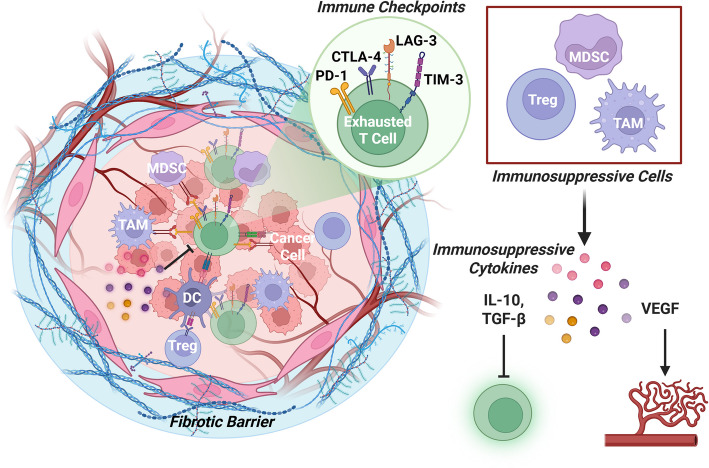
Fig. 1
Fig. 1
The immunosuppressive TME in HCC. In HCC, cytotoxic CD8⁺ T cells exhibit an exhausted phenotype characterized by upregulation of immune checkpoints including PD-1, CTLA-4, LAG-3, and TIM-3. The TME is populated by immunosuppressive cells, including Tregs, MDSCs, and TAMs, which engage immune checkpoints and secrete IL-10, TGF-β, and VEGF to suppress T cell function and promote tumor progression. A dense fibrotic stroma further impairs immune infiltration, contributing to an immune-excluded phenotype
Fig. 2
Fig. 2
Mechanisms of action of ICIs in HCC. ICIs restore antitumor immunity by blocking key inhibitory pathways that suppress T cell function. PD-1, expressed on exhausted T cells, binds PD-L1 on tumor and immune cells such as MDSCs and TAMs, leading to T cell inhibition. Anti-PD-1/PD-L1 therapies (e.g., nivolumab, pembrolizumab) disrupt this interaction, thereby reinvigorating T cell cytotoxicity. CTLA-4, primarily found on Tregs and activated T cells, competes with CD28 for binding to B7 molecules on antigen-presenting cells, thereby limiting T cell priming. CTLA-4 inhibitors (e.g., ipilimumab, tremelimumab) block this suppression and enhance T cell activation in lymphoid tissues. Together, these ICIs enhance effector T cell activity and shift the TME toward an immune-responsive state
Fig. 3
Fig. 3
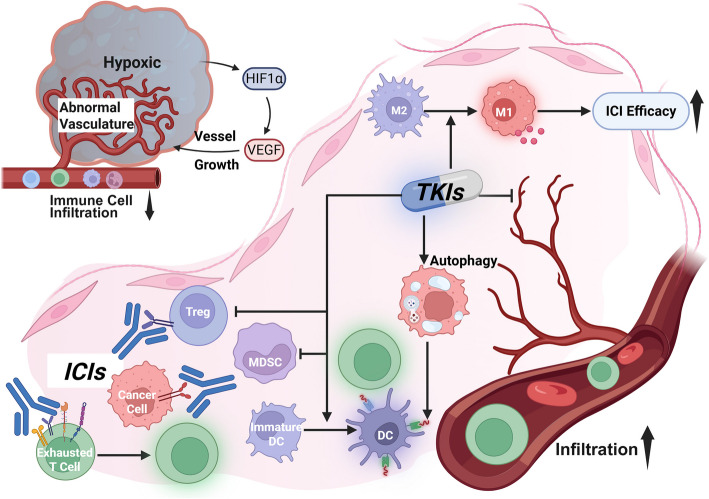
Synergistic mechanisms of ICI–TKI therapy. Hypoxia-induced VEGF overexpression leads to the development of abnormal vasculature, immune exclusion, and the recruitment of immunosuppressive cells, including MDSCs, Tregs, and M2-like TAMs. TKIs normalize tumor vasculature, alleviate hypoxia, and reduce these immunosuppressive populations, improving immune infiltration. They also enhance DC maturation and promote antigen availability through autophagy induction. When combined with ICIs, these changes reinvigorate CD8⁺ T cell responses, leading to more effective tumor control
Fig. 4
Fig. 4
ICD and ICI-chemotherapy synergy. Chemotherapy induces tumor cell death and releases antigens, aiding DC activation and T cell priming. It depletes suppressive populations, such as Tregs and MDSCs, remodels stromal barriers to facilitate immune infiltration, and alters cytokine balance to favor immune stimulation. Some agents also increase PD-L1 expression or shift gut microbiota composition, further enhancing ICI sensitivity
Fig. 5
Fig. 5
Mechanistic synergies of dual immune checkpoint blockade in HCC. Dual inhibition of PD-1 and CTLA-4 enhances antitumor immunity through complementary mechanisms. CTLA-4 blockade promotes early T cell priming in lymphoid tissues by enhancing CD28 co-stimulation, while PD-1 blockade reinvigorates exhausted effector T cells within the tumor. This combination enhances cytokine production (e.g., IFN-γ, TNF-α), expands the function of cytotoxic T and NK cells, and facilitates epitope spreading. Additionally, dual blockade supports the formation of long-lived memory CD8⁺ T cells, contributing to durable tumor control
Fig. 6
Fig. 6
Immune phenotypes of HCC tumors and their implications for ICI response. HCC tumors can be classified into three major immune phenotypes: immune-inflamed, immune-excluded, and immune-desert. Immune-inflamed tumors are characterized by dense infiltration of CD8⁺ T cells in the tumor parenchyma and are typically more responsive to ICIs. Immune-excluded tumors exhibit abundant immune cells in the surrounding stroma but limited infiltration into tumor nests, often due to fibrotic barriers or β-catenin–mediated suppression of DC recruitment. Immune-desert tumors lack meaningful T cell infiltration altogether, reflecting impaired immune priming or antigen presentation. These phenotypic distinctions are associated with differential responses to immunotherapy, highlighting the need for stratified combination strategies in HCC

References

    1. Vogel A, Meyer T, Sapisochin G, Salem R, Saborowski A. Hepatocellular carcinoma. Lancet. 2022;400:1345–62. - PubMed
    1. Luo X, He X, Zhang X, Zhao X, Zhang Y, Shi Y, et al. Hepatocellular carcinoma: signaling pathways, targeted therapy, and immunotherapy. MedComm. 2020;2024(5):e474. - PMC - PubMed
    1. Llovet JM, Ricci S, Mazzaferro V, Hilgard P, Gane E, Blanc JF, et al. Sorafenib in advanced hepatocellular carcinoma. N Engl J Med. 2008;359:378–90. - PubMed
    1. El-Khoueiry AB, Sangro B, Yau T, Crocenzi TS, Kudo M, Hsu C, et al. Nivolumab in patients with advanced hepatocellular carcinoma (CheckMate 040): an open-label, non-comparative, phase 1/2 dose escalation and expansion trial. Lancet. 2017;389:2492–502. - PMC - PubMed
    1. Zhu AX, Finn RS, Edeline J, Cattan S, Ogasawara S, Palmer D, et al. Pembrolizumab in patients with advanced hepatocellular carcinoma previously treated with sorafenib (KEYNOTE-224): a non-randomised, open-label phase 2 trial. Lancet Oncol. 2018;19:940–52. - PubMed

MeSH terms

Substances