


Cognitive stimulation in Parkinson's disease with mild cognitive impairment
- PMID: 41015632
- PMCID: PMC12476383
- DOI: 10.1007/s00415-025-13374-9
Cognitive stimulation in Parkinson's disease with mild cognitive impairment
Abstract
Background: Cognitive impairment is among the most frequent and disabling non-motor symptoms of Parkinson's disease (PD), often emerging early and substantially impacting autonomy and quality of life. While cognitive stimulation (CS) is supported in other neurodegenerative conditions, its role in PD is less explored. This study aimed to compare the efficacy of a therapist-guided, home-based CS program, delivered via a virtual reality rehabilitation system, with a conventional in-person CS intervention.
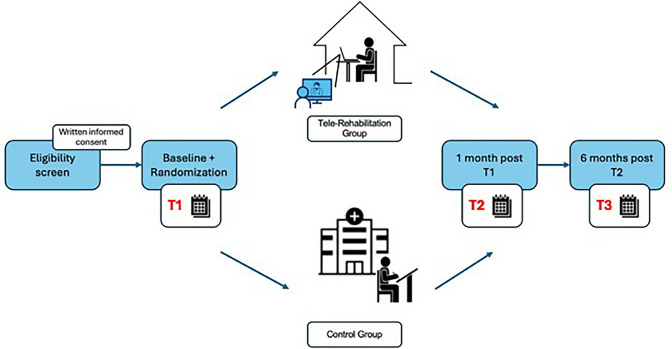
Methods: Of 123 individuals screened, 45 patients with PD and mild cognitive impairment (PD-MCI) were randomized to either the tele-rehabilitation group (TRG; n = 25) or the control group (CG; n = 20). Both groups received the same standardized 4-week CS program (20 multi-domain sessions, 5 days/week), targeting memory, attention, executive functions, language, and visuospatial skills. The TRG trained at home via the VRRS platform under remote supervision, while the CG attended outpatient sessions. Neuropsychological and clinical outcomes were assessed at baseline (T1), post-intervention (T2), and 6-month follow-up (T3). Analyses included repeated-measures ANOVA, multivariate linear regression, and categorical comparisons based on predefined clinical cut-offs.
Results: All participants completed the intervention with adherence exceeding 90% in both groups. At T2, the TRG showed greater improvements than the CG in global cognition, working memory, and delayed recall. These effects remained significant after adjusting for age, sex, baseline performance, and cognitive reserve index, and were robust to false discovery rate correction. Regression models confirmed these improvements. Categorical analyses also showed a marked reduction in pathological scores in the TRG in the same domains.
Conclusion: A short-term, therapist-guided CS program delivered via tele-rehabilitation effectively improved cognitive functioning in PD-MCI, with partial benefits maintained at 6 months, especially in memory and executive domains. The intervention was particularly beneficial for memory and executive functions, highlighting telemedicine as a promising and accessible option for cognitive care in PD.
Keywords: Cognitive stimulation; Digital health; Mild cognitive impairment; Non-pharmacological treatment; Parkinson’s disease; Tele-rehabilitation.
© 2025. The Author(s).
Conflict of interest statement
Declarations. Conflict of interest: The authors declare no financial or other conflicts of interest. Ethical statement: The procedures outlined in the study adhere to the ethical principles outlined in the Declaration of Helsinki and its subsequent revisions. The study complies with regulatory requirements and legal obligations as specified in Legislative Decree no. 211 dated 24/06/2003 and Ministerial Decree dated 17/12/2004 of the Italian government, about non-profit studies. Informed consent: Written informed consent was obtained from each participant included in the study. The patient informed consent file is attached in the supplementary material. Consent for publication: All authors have approved the manuscript before submission, including the names and order of authors; all gave explicit consent to submit and obtained consent from the responsible authorities at the institute/organization where the work has been carried out.
Figures
References
-
- Kouli A, Torsney KM, Kuan WL (2018) Parkinson’s disease: etiology, neuropathology, and pathogenesis (chapter 1). In: Stoker TB, Greenland JC (eds) Parkinson’s Disease: Pathogenesis and Clinical Aspects. Codon Publications, Brisbane. 10.15586/codonpublications.parkinsonsdisease.2018.ch1
Publication types
MeSH terms
Grants and funding
LinkOut - more resources
Full Text Sources
Medical
