


A computational study of light-induced superimposed mechanical and dipolar effects
- PMID: 41041483
- PMCID: PMC12484087
- DOI: 10.1140/epjp/s13360-025-06866-0
A computational study of light-induced superimposed mechanical and dipolar effects
Abstract
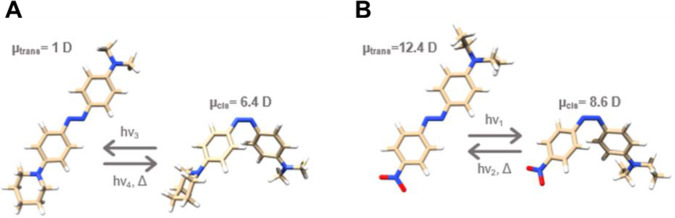
Light-sensitive molecules provide a powerful means to control cellular excitability without genetic modification. Among them, the amphiphilic membrane targeting azobenzene Ziapin2 has emerged as a versatile photo-switch able to modulate membrane potential. Previous studies have attributed its action mainly to an opto-mechanical effect. However, azobenzenes are known to undergo significant light-induced dipole changes, raising the possibility of additional electrical contributions. Here, we combine experimental data and numerical modeling to investigate this dual mechanism in Ziapin2. Our analysis shows that beyond capacitance modulation, a substantial increase in molecular dipole moment (> 6D) can shift membrane surface potential, partially counteracting the hyperpolarizing effect. A model with time-varying surface potential captures key features of published responses and shows that polarity is governed by the membrane interface at which the photo-dipole is expressed, not by the dipole change alone. This combined framework provides a more complete description of Ziapin2 action and enables prospective design of next-generation molecules with tailored selective depolarizing or hyperpolarizing response.
© The Author(s) 2025.
Figures


References
-
- A. Beharry, G. Andrew Woolley, Azobenzene photoswitches for biomolecules. Chem. Soc. Rev. 40, 4422–4437 (2011) - PubMed
-
- C. Florindi, G. Simoncini, G. Lanzani, F. Lodola, Shining light in a heartbeat: controlling cardiac bioelectricity with membrane-targeted photoswitches. Appl. Phys. Lett. 126, 230501 (2025)
-
- V. Marturano et al., Modeling of azobenzene-based compounds. Phys. Sci. Rev. 2, 20170138 (2017)
LinkOut - more resources
Full Text Sources