


doi: 10.1021/acs.jpca.5c03721.
Epub 2025 Oct 3.
Pyrolysis Reactions of (2-Chloroethyl)benzene
Affiliations
- PMID: 41042686
- PMCID: PMC12536402
- DOI: 10.1021/acs.jpca.5c03721
Item in Clipboard
Pyrolysis Reactions of (2-Chloroethyl)benzene
J Phys Chem A.
.
Abstract
Pyrolysis of polyvinyl chloride (PVC) is considered an alternative to traditional, mechanical methods of recycling. However, there is insufficient research conducted on the thermal decomposition pathways of PVC, particularly the fate of chlorinated hydrocarbons generated during the chemical recycling process. One significant product from the pyrolysis of PVC is (2-chloroethyl)benzene. Using a hyperthermal tubular reactor and matrix-isolation FTIR techniques, the pyrolysis products of gas-phase (2-chloroethyl)benzene were identified. Following pyrolysis at 1400 K, the FTIR spectra indicated the formation of HCl, styrene, phenylacetylene, benzene, vinylacetylene, acetylene, propyne, ethylene, and propargyl radical.
Figures

(2-Chloroethyl)benzene.

A temperature study of
(2-chloroethyl)benzene, comparing the argon-matrix
FTIR spectrum of an unheated sample to those collected following pyrolysis
at temperatures ranging from 900 to 1400 K. All samples were 0.07%
mixtures in argon.

Argon-matrix FTIR spectrum of 0.07% (2-chloroethyl)benzene
(bottom
trace) and a spectrum collected following pyrolysis of the sample
at 1400 K.

Argon-matrix FTIR spectrum of pyrolyzed
0.07% (2-chloroethyl)benzene
and a benchmark spectrum of 0.1% styrene in argon.

Argon-matrix FTIR spectrum of pyrolyzed 0.07%
(2-chloroethyl)benzene
and a benchmark spectrum of 0.1% phenylacetylene in argon.

Argon-matrix
FTIR spectrum of 0.07% (2-chloroethyl)benzene (bottom
trace) and a spectrum collected following pyrolysis of the sample
at 1400 K. The band marked with an asterisk could belong to either
vinylacetylene or styrene. Small oscillations in the baseline are
due to an etalon effect of a relatively thin argon matrix.

Argon-matrix FTIR spectrum of 0.07% (2-chloroethyl)benzene
(bottom
trace) and a spectrum collected following pyrolysis of the sample
at 1400 K.

Argon-matrix FTIR spectrum of 0.07% (2-chloroethyl)benzene
(bottom
trace) and a spectrum collected following pyrolysis of the sample
at 1400 K. The bands marked with an asterisk are CO or CO-cluster
contaminants derived from reactions of the hot SiC tube with trace
amounts of oxygen. These were also observed in control experiments
with heated argon.

Argon-matrix
FTIR spectrum of 0.07% (2-chloroethyl)benzene (bottom
trace) and a spectrum collected following pyrolysis of the sample
at 1400 K. The band labeled with an asterisk could belong to both
styrene and phenylacetylene.
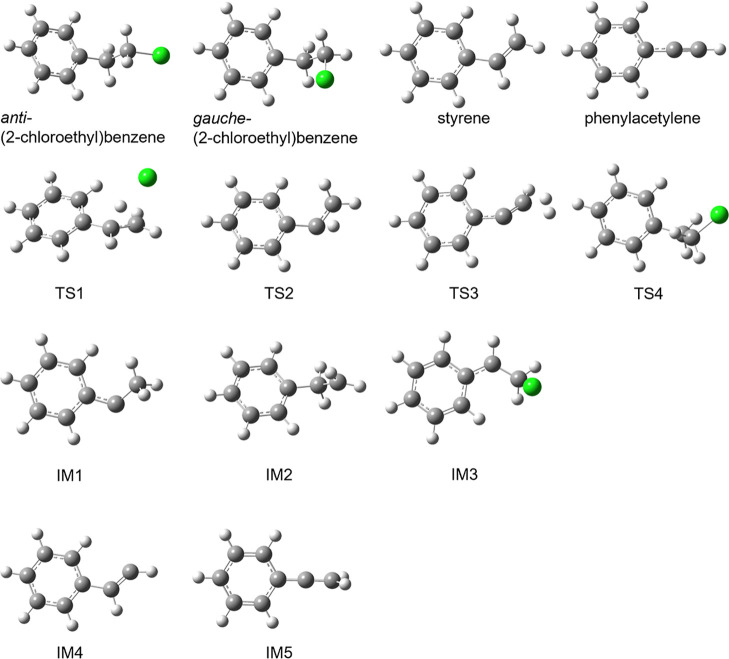
Structures
of species, referenced in Figures
and , involved
in the reactions of (2-chloroethyl)benzene forming styrene and phenylacetylene,
optimized at the B3LYP/6-311++G(d,p) level of theory.

Pathway of (2-chloroethyl)benzene (2CEB) forming phenylacetylene
via molecular elimination mechanisms with zero-point corrected energies
in kJ/mol, relative to the energy of anti-(2-chloroethyl)benzene.
The anti- to gauche-isomerization
is shown as well.

Pathway of (2-chloroethyl)benzene (2CEB) forming phenylacetylene
via single-bond scission mechanisms with zero-point corrected energies
in kJ/mol, relative to the energy of anti-(2-chloroethyl)benzene.
References
-
- Plastics Europe Plastics – The Fast Facts 2023, https://plasticseurope.org/knowledge-hub/plastics-the-fast-facts-2023/(accessed March 7, 2025).
-
- Edo G. I., Ndudi W., Ali A. B. M., Yousif E., Zainulabdeen K., Onyibe P. N., Ekokotu H. A., Isoje E. F., Igbuku U. A., Essaghah A. E. A.. et al. Poly(vinyl chloride) (PVC): an updated review of its properties, polymerization, modification, recycling, and applications. J. Mater. Sci. 2024;59(47):21605–21648. doi: 10.1007/s10853-024-10471-4. - DOI
-
- Tian Y., Han M., Gu D., Bi Z., Gu N., Hu T., Li G., Zhang N., Lu J.. PVC Dechlorination for Facilitating Plastic Chemical Recycling: A Systematic Literature Review of Technical Advances, Modeling and Assessment. Sustainability. 2024;16(19):8331. doi: 10.3390/su16198331. - DOI
-
- Mnyango J. I., Hlangothi S. P.. Polyvinyl chloride applications along with methods for managing its end-of-life items: A review. Prog. Rubber, Plast. Recycl. Technol. 2024:14777606241308652. doi: 10.1177/14777606241308652. - DOI
LinkOut - more resources
Full Text Sources
