


Hexagonal Zn1-xMgxS sheds light on the lattice dynamics of atomic alloys
- PMID: 41044097
- PMCID: PMC12495001
- DOI: 10.1038/s41598-025-17723-6
Hexagonal Zn1-xMgxS sheds light on the lattice dynamics of atomic alloys
Abstract
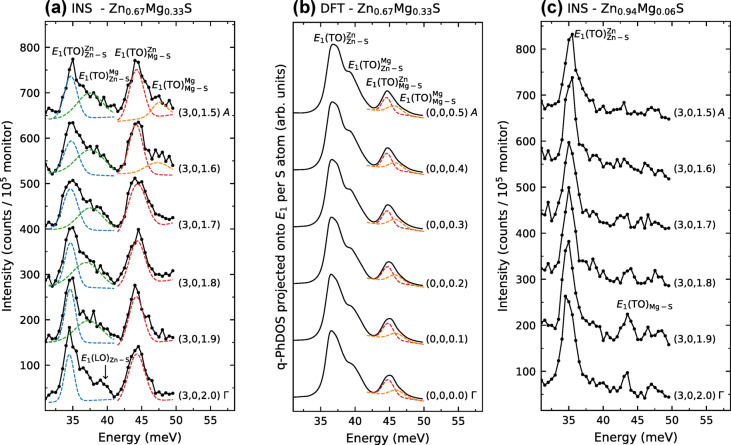
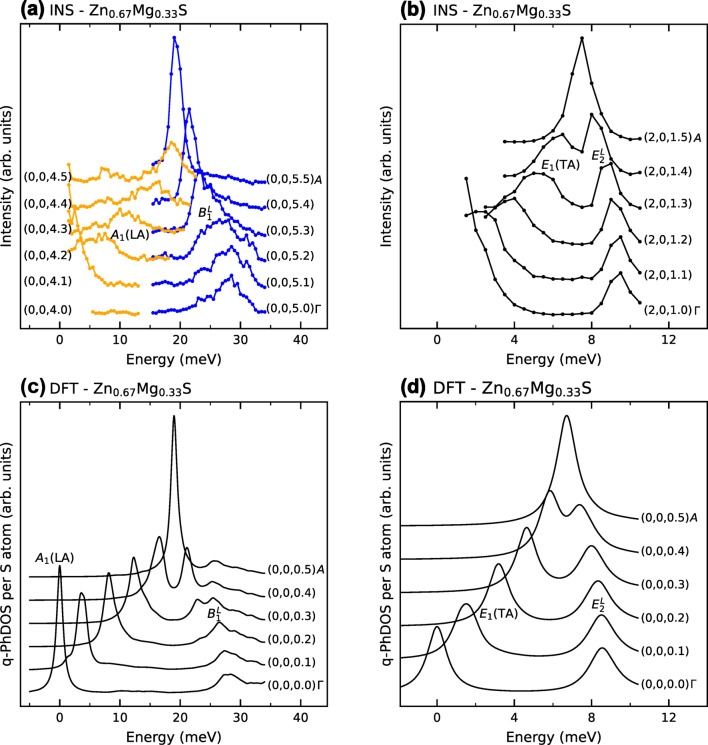
Cubic pseudo-unary A1-xBx high-entropy metallic alloys and pseudo-binary A1-xBxC disordered semiconductor alloys set a benchmark to explore how physical properties are impacted by disorder. Through its diversity, the lattice dynamics offers a unique playground to assign the relevant length scales at which operate various kinds of disorders induced by alloying. (i) In high-entropy metallic alloys, the overdamping of the bond-collective (multi-bond→1-mode) acoustic modes at short wavelength originates from force-constant fluctuations. (ii) In semiconductor alloys, the lattice mismatch splits, at any wavelength, the bond-specific (1-bond→1-mode) optical modes in duos distinguishing "same" from "alien" environments, as explained by the percolation model. Zn1-xMgxS is ideal to test both univocal assignments. Its force-constant disorder is small, reducing the cause for overdamping of the acoustic modes. Its local strain is inverted, the lighter substituent being the larger one and forming the longer bond. This forecasts a dramatic inversion of the mode-duos. Further, its wurtzite structure enables (iii) to test whether/how the percolation model for the mode-duos transfers under lowering the crystal symmetry from cubic to hexagonal. The triple acoustic-(i)/optical-(ii-iii) test on Zn1-xMgxS, combining inelastic neutron scattering with first-principles simulations, is positive. This highlights a few key points behind the lattice dynamics of atomic alloys.
© 2025. The Author(s).
Conflict of interest statement
Declarations. Competing interests: The authors declare no competing interests.
Figures



References
-
- George, E. P., Raabe, D. & Ritchie, R. O. High-entropy alloys. Nat. Rev. Mater.4, 515–534 (2019).
-
- Adachi, S. Properties of Semiconductor Alloys – Group-IV, III-V and II-VI Semiconductors (John Wiley & Sons, Inc., 2009).
-
- Mascarenhas, A., Cheong, H. M., Seong, M. J. & Alsina, F. Spontaneous Ordering in Semiconductor Alloys, edited by Mascarenhas, A. (Kluwer Academic/Plenum Publishers, New York, (2002).
-
- Stauffer, D. & Aharony, A. Introduction To Percolation Theory (Taylor and Francis, 1994).
-
- Körman, F., Ikeda, Y., Grabowski, B. & Sluiter, M. H. F. Phonon broadening in high entropy alloys. Npj Comput. Mater.3, 36 (2017).
Grants and funding
- ANR-15-IDEX-04-LUE/ViSA-IRP
- ANR-15-IDEX-04-LUE/ViSA-IRP
- ANR-15-IDEX-04-LUE/ViSA-IRP
- ANR-15-IDEX-04-LUE/ViSA-IRP
- ANR-15-IDEX-04-LUE/ViSA-IRP
- ANR-15-IDEX-04-LUE/ViSA-IRP
- ANR-15-IDEX-04-LUE/ViSA-IRP
- ANR-15-IDEX-04-LUE/ViSA-IRP
- ANR-15-IDEX-04-LUE/ViSA-IRP
- ANR-15-IDEX-04-LUE/ViSA-IRP
- Proposal 7-01-598/Institut Laue-Langevin
- Proposal 7-01-598/Institut Laue-Langevin
- Proposal 7-01-598/Institut Laue-Langevin
- Proposal 7-01-598/Institut Laue-Langevin
- Proposal 7-01-598/Institut Laue-Langevin
- Proposal 7-01-598/Institut Laue-Langevin
- Proposal 7-01-598/Institut Laue-Langevin
- Proposal 7-01-598/Institut Laue-Langevin
- Project No. 2019CPMXX0918/Université de Lorraine
- Project No. 2019CPMXX0918/Université de Lorraine
- Project No. 2019CPMXX0918/Université de Lorraine
LinkOut - more resources
Full Text Sources
