. 2025 Oct 7;3(1):145.
doi: 10.1038/s44271-025-00324-4.

Everyday norms have become more permissive over time and vary across cultures

Kimmo Eriksson  1   2 Pontus Strimling  3   4   5 Irina Vartanova  3   4 Brent Simpson  6 Minna Persson  3 Khalid Ahmed Abdi  7 Neta Ad  8 Alisher Aldashev  9 Habib Mohammad Ali  10 Maurizio Alì  11 Khatai Aliyev  12   13 Yasser M H A Alrefaee  14 Alberth Estuardo Alvarado Ortiz  15 Per A Andersson  16 Giulia Andrighetto  3   5   17 Gizem Arikan  18 John Jamir Benzon R Aruta  19 Christian Lutete Ayikwa  20 Jonatan Baños-Chaparro  21 Davide Barrera  22   23 Justina Barsyte  24   25 Birzhan Batkeyev  9 Azma Batool  26 Elizaveta Berezina  27 Stéphanie Ngandu Bimina  28 Marie Björnstjerna  29 Sheyla Blumen  30 Paweł Boski  31 Eva Boštjančič  32 Yap Boum 2nd  33 Marie Briguglio  34 Kagonbe Bruno  35 Huyen Thi Thu Bui  36 Tomás Caycho-Rodríguez  37 Yanyan Chen  38   39 Manase Kudzai Chiweshe  40 Hoon-Seok Choi  41 Carlos C Contreras-Ibáñez  42 Dinka Čorkalo  43 Christian E Cruz-Torres  44 Andrea Czakó  45   46 Piyanjali de Zoysa  47 Zsolt Demetrovics  45   46   48 Bojana M Dinić  49 Saša Drače  50 Rita W El-Haddad  51 Jan B Engelmann  52 Ignacio Escudero Pérez  53 Hyun Euh  54 Xia Fang  55 Celine Frank  56   57 Esteban Freidin  58 Marta Fulop  59   60 Vladimer Gamsakhurdia  61 Mauro Alberto García Jiménez  62 Ragna B Gardarsdottir  63 Alin Gavreliuc  64 Colin Mathew Hugues D Gill  65 Biljana Gjoneska  66 Andreas Glöckner  56   67 Sylvie Graf  68 Ani Grigoryan  69 Katarzyna Growiec  31 Brian W Haas  70 Geoffrey Haddock  71 Stavros P Hadjisolomou  51 Nina Hadžiahmetović  50 Mohammad Hosein Haji Mohammad Ali  72 Eemeli Hakoköngäs  73 Peter Halama  74 Given Hapunda  75 Andree Hartanto  76 Mahsa Hazrati  72 Boris Christian Herbas-Torrico  77 Szilárd Holka  58   78 Martina Hřebíčková  68 John A Hunter  79 Moudachirou Ibikounle  80 Dzintra Ilisko  81 Harpa Lind Hjördísar Jónsdóttir  63 Zivile Kaminskiene  24   25 Hansika Kapoor  82 Iva Kapović  43 Gassemi Karim  83 Kerry Kawakami  84 Narine Khachatryan  69 Julian B Kirschner  52 Jonah Kiruja  7 Toko Kiyonari  85 Michal Kohút  86 Shazia Kousar  87 Besnik Krasniqi  88 Ludovic Lado  35 Miguel Landa-Blanco  89 Barbara Landon  90 Žan Lep  32   91 Lisa M Leslie  92 Yang Li  93 Kadi Liik  94 Ming-Jen Lin  95 Marlon Elías Lobos Rivera  96 Wilson López-López  97 Edona Maloku  98 Mohona Mandal  6 Bernardo Ananias Manhique  99 Nathan Mpeti Mbende  20 Imed Medhioub  100 Maria Luisa Mendes Teixeira  101 J Paola Merchán Tamayo  6 Linda Lila Mohammed  102 Schontal N Moore  103 Bahar Moraligil  104 Nijat Muradzada  12   105 Herwin Nanda  33 Ekaterina Nastina  106 Pegah Nejat  72 Daniel Nettle  107   108 Orlando Julio Andre Nipassa  99 Martin Noe-Grijalva  109 Pie Ntampaka  110 Rodrigue Ntone  33 Ravit Nussinson  8 Milan Oljača  49 Nneoma G Onyedire  111 Ike E Onyishi  111 Penny Panagiotopoulou  112 Daybel Pañellas Alvarez  113 Md Shahin Parvez  114 Gian Luca Pasin  17 Ivana Pedović  115 Pablo Pérez de León  53 Lorena R Perez Floriano  116 Nada Pop-Jordanova  66 Jose Roberto Portillo  15 Angela Potang  117 Adolfo Quesada-Román  118 Jana L Raver  119 Ricardo B Rodrigues  120 Juan Diego Rodríguez-Romero  97 Sara Romanò  22 Robert M Ross  121 Nachita Rosun  122 Selka Sadiković  49 Alvaro San Martin  123 Snežana Smederevac  49 Sarah Jane Smith  71 Natalia Soboleva  106 Daniel Erena Sonessa  124 Samantha K Stanley  125 Kristina Stoyanova  126 Drozdstoy Stoyanov  126 Kosuke Takemura  127 John Thøgersen  128 Habib Tiliouine  129 Hans Tung  130 Tungalag Ulambayar  131 Elze Marija Uzdavinyte  24   25 Randall Waechter  132 Yi-Ting Wang  133 Junhui Wu  38   39 Brice Martial Yambio  134   135 Eric Yankson  136 Kuang-Hui Yeh  137 Paul A M Van Lange  138
Affiliations

Everyday norms have become more permissive over time and vary across cultures

Kimmo Eriksson et al. Commun Psychol. .

Abstract

Every social situation that people encounter in their daily lives comes with a set of unwritten rules about what behavior is considered appropriate or inappropriate. These everyday norms can vary across societies: some societies may have more permissive norms in general or for certain behaviors, or for certain behaviors in specific situations. In a preregistered survey of 25,422 participants across 90 societies, we map societal differences in 150 everyday norms and show that they can be explained by how societies prioritize individualizing moral foundations such as care and liberty versus binding moral foundations such as purity. Specifically, societies with more individualistic morality tend to have more permissive norms in general (greater liberty) and especially for behaviors deemed vulgar (less purity), but they exhibit less permissive norms for behaviors perceived to have negative consequences in specific situations (greater care). By comparing our data with available data collected twenty years ago, we find a global pattern of change toward more permissive norms overall but less permissive norms for the most vulgar and inconsiderate behaviors. This study explains how social norms vary across behaviors, situations, societies, and time.


Conflict of interest statement

Competing interests: The authors declare no competing interests.

Figures

Fig. 1
Fig. 1. The geographical scope of the study.
A Societal variation in norms is studied across 90 societies colored red. B Norm change is studied in 26 societies, colored blue, for which data are available from two studies, 20 years apart.
Fig. 2
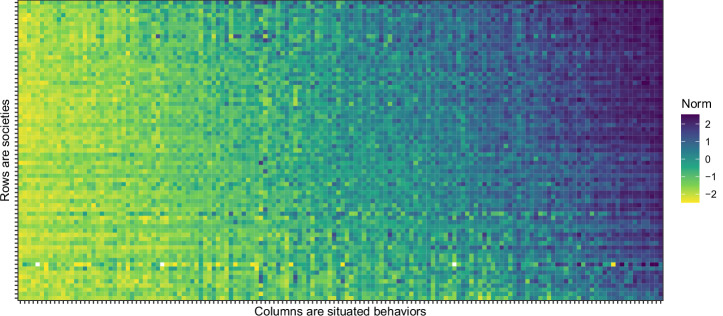
Fig. 2. Measures of everyday norms.
The norm for a given situated behavior in a given society was measured by ratings on a six-step scale from extremely inappropriate, coded −2.5, to extremely appropriate, coded 2.5, and averaged across participants (n = 54.3 on average, ranging from 1 to 217 across cells). A lighter color means a higher inappropriateness rating. White cells represent missing data due to some countries not allowing some questions.
Fig. 3
Fig. 3. Behavior-specific and situation-specific global everyday norms.
A A color-coded matrix illustrating the global appropriateness ratings (averaged over 71 societies) of fifteen behaviors in each of ten situations. B Scatter plot illustrating appropriateness ratings of fifteen specific behaviors aggregated across various situations (centered on the mean across behaviors) and their strong negative association with the sum of behavior-specific concerns about vulgarity and inconsiderateness. The index ‘b’ indicates that measures refer to behaviors. C Scatter plot illustrating appropriateness ratings of 15 behaviors in ten specific situations (n = 150 situated behaviors, centered on the mean across situations for each behavior) and their strong negative association with the sum of situation-specific concerns about inconsiderateness and lacking sense. The index ‘xb’ indicates that measures refer to situated behaviors. Gray shading indicates 95% confidence intervals.
Fig. 4
Fig. 4. Results on societal variation in everyday norms from a mixed-level model of appropriateness ratings.
A The graph shows the estimated coefficients for societies’ scores on individualistic morality (IM) and their interactions with situation-general concerns about vulgarity (Vulgarb) and inconsiderateness (Inconsiderateb), and situation-specific concerns about inconsiderateness (Inconsideratexb) and lacking sense (Lacks sensexb). Error bars represent 95% confidence intervals. Results are presented for data collected up to the preregistered deadline (red, n = 547,170 appropriateness ratings from 71 societies), all data (yellow, n = 833,930 ratings from 90 societies)), and only including participants who passed the attention check (blue, n–515,162 ratings from 80 societies). The confidence intervals for the interaction effects become somewhat wider if random slopes are included (see Supplementary Fig. 3A). B Scatter plot illustrating the positive relation between a society’s individualistic morality and its overall (context- and behavior-general) appropriateness rating across 71 societies. Labels are ISO codes. Gray shading indicates 95% confidence intervals.
Fig. 5
Fig. 5. The global average change in everyday norms.
Every panel shows appropriateness ratings of a specific behavior in ten different situations at two times: 2000–2003 (dashed lines) and 2023–2024 (solid lines). Ratings are aggregated across 22 societies (but only 21 for laughing, because Israel missed 2000–2003 data for laughing at a party).
Fig. 6
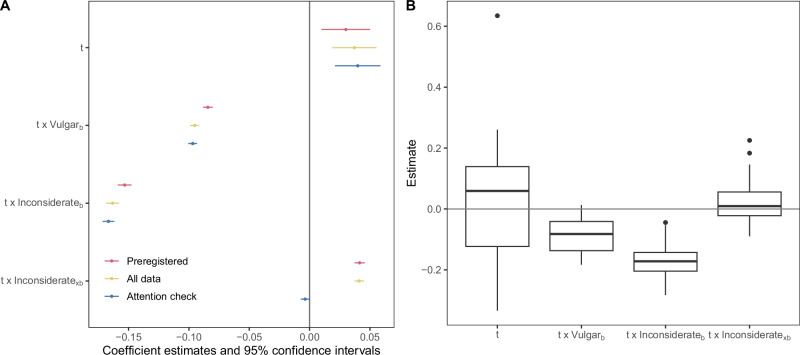
Fig. 6. Results on global change in everyday norms from a mixed-level model of appropriateness ratings.
A The graph shows the estimated coefficients for time and its interactions with situation-general concerns about vulgarity and inconsiderateness, and situation-specific concerns about inconsiderateness. Error bars represent 95% confidence intervals. Results are presented for data collected up to the preregistered deadline (red, n = 869,180 appropriateness ratings from 22 societies), all data (yellow, n = 929,143 appropriateness ratings from 26 societies), and only including participants who passed the attention check (blue, n = 856,692 appropriateness ratings from 26 societies). The confidence intervals for the interaction effects become somewhat wider if random slopes are included (see Supplementary Fig. 3B). B Boxplots of the coefficients for time and its interactions with concerns estimated separately in each of the 22 societes. Dots represent societies, boxes indicate the first and third quartiles, and the bold lines indicate medians.

References

    1. Horne, C. & Mollborn, S. Norms: an integrated framework. Annu. Rev. Sociol.46, 467–487 (2020).
    1. Elster, J. Social norms and economic theory. J. Econ. Perspect.3, 99–117 (1989).
    1. Cialdini, R. B., Reno, R. R. & Kallgren, C. A. A focus theory of normative conduct: a theoretical refinement and reevaluation of the role of norms in human behavior. Adv. Exp. Soc. Psychol.23, 201–234 (1990).
    1. Inglehart, R. Cultural Evolution: People’s Motivations Are Changing, and Reshaping the World (Cambridge University Press, 2018).
    1. Inglehart, R. F., Ponarin, E. & Inglehart, R. C. Cultural change, slow and fast: the distinctive trajectory of norms governing gender equality and sexual orientation. Soc. Forces95, 1313–1340 (2017).

LinkOut - more resources