. 2025 Oct 8;15(1):34466.
doi: 10.1038/s41598-025-19911-w.

Pulsed thermographic analysis of Herculaneum papyri

Affiliations

Pulsed thermographic analysis of Herculaneum papyri

Sofia Ceccarelli et al. Sci Rep. .

Abstract

The Herculaneum papyri represent an exceptional cultural treasure, providing invaluable insights into the philosophical, literary and historical landscape of the Greco-Roman world. However, their carbonization due to the eruption of Mount Vesuvius in 79 AD poses significant challenges for both textual legibility and structural analysis. This study illustrates the first application of Pulsed Thermography to the non-destructive analysis of these unique manuscripts. By employing an experimental setup comprising a couple of flashes providing the excitation and a thermal camera for recording the infrared emission from the sample, the technique proves to be an important tool for textual recovery, revealing writing almost not discernible to the naked eye. Furthermore, Pulsed Thermography provides structural information useful for restorers, such as the papyrus texture and adhesion points to paperboard, offering a valuable advantage over other imaging techniques. The results show the potential of the adopted method not only as a powerful tool for textual recovery but also for guiding conservation strategies ensuring a deeper understanding of Herculaneum papyri.


Conflict of interest statement

Declarations. Competing interests: The authors declare no competing interests.

Figures

Fig. 1
Fig. 1
P. Herc. 1018, ‘cornice’ 1: (a) NIR image at 1000 nm acquired through technical photography. By permission of Ministero della Cultura (photocredit: Biblioteca Nazionale “Vittorio Emanuele III,” Napoli–Consiglio Nazionale delle Ricerche, Istituto di Scienze del Patrimonio Culturale); (b) thermographic mosaic showing the enhancement of the Greek text. By permission of Ministero della Cultura (photocredit: Biblioteca Nazionale “Vittorio Emanuele III,” Napoli–Consiglio Nazionale delle Ricerche, Istituto di Scienze del Patrimonio Culturale).
Fig. 2
Fig. 2
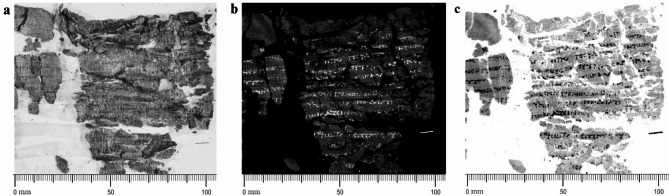
P. Herc. 1021, ‘cornice’ 2: (a) NIR image at 1000 nm acquired through technical photography, in which the Greek text is hardly visible; (b, c) thermographic mosaic displaying the enhanced text through standard and inverted palette, respectively. By permission of Ministero della Cultura (photocredit: Biblioteca Nazionale “Vittorio Emanuele III,” Napoli–Consiglio Nazionale delle Ricerche, Istituto di Scienze del Patrimonio Culturale).
Fig. 3
Fig. 3
P.Herc 1780, ‘cornice’ 7, detail: (a) NIR image acquired at 1000 nm, in which the text is hardly visible. By permission of Ministero della Cultura (photocredit: Biblioteca Nazionale “Vittorio Emanuele III,” Napoli–Consiglio Nazionale delle Ricerche, Istituto di Scienze del Patrimonio Culturale); (b, c) thermographic images showing optimal textual enhancement through standard and inverted palette, respectively. By permission of Ministero della Cultura (photocredit: Biblioteca Nazionale “Vittorio Emanuele III,” Napoli–Consiglio Nazionale delle Ricerche, Istituto di Scienze del Patrimonio Culturale).
Fig. 4
Fig. 4
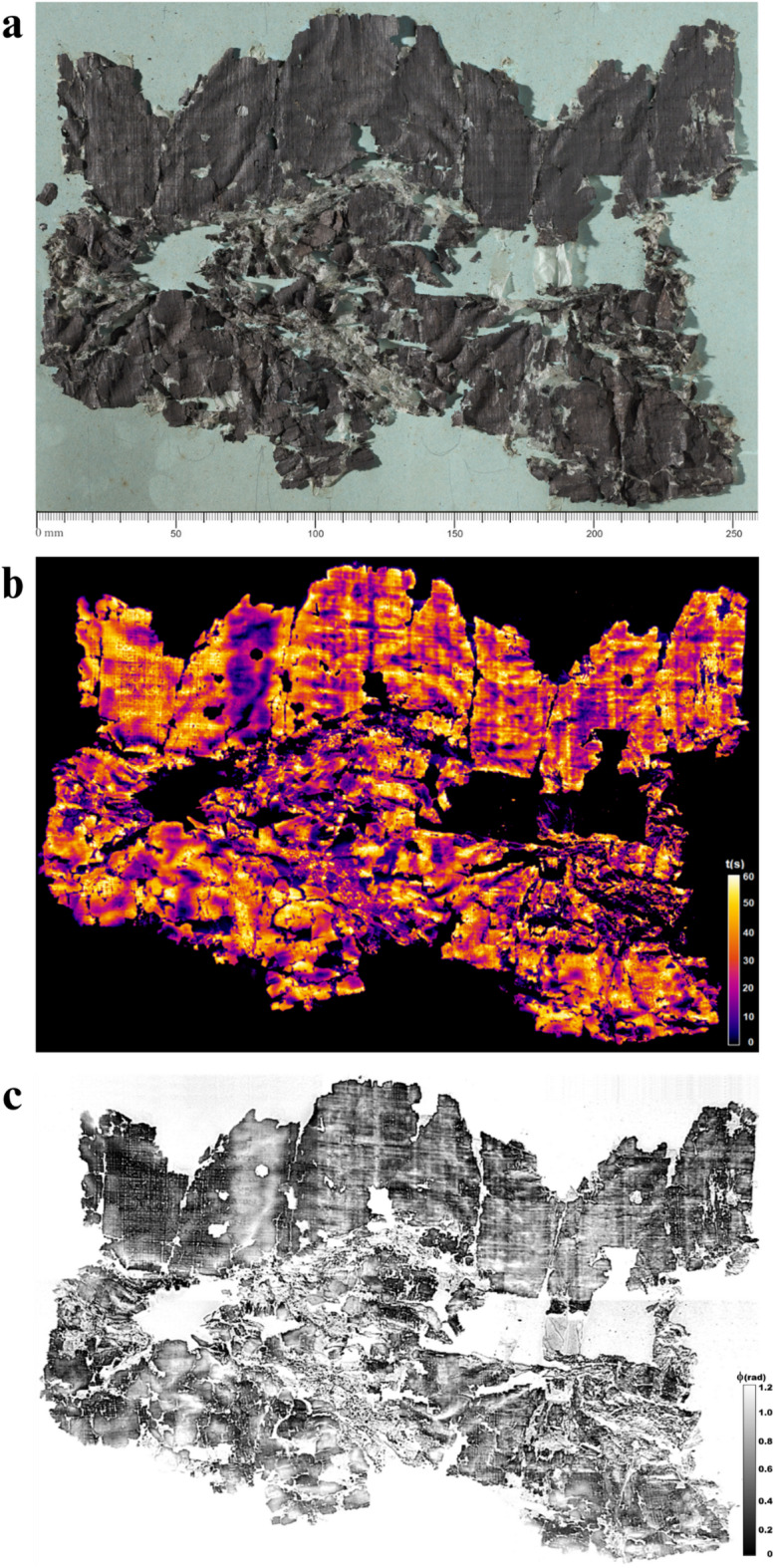
P. Herc 1018, ‘cornice’ 1: (a) visible image acquired with raking light; (b) TR map showing regions with different recovery times probably due to variations in height of the papyrus with respect to the paperboard; (c) phase image obtained by PPT at 0.2 Hz, where both fiber pattern and whitish ‘clouds’ are displayed. By permission of Ministero della Cultura (photocredit: Biblioteca Nazionale “Vittorio Emanuele III,” Napoli–Consiglio Nazionale delle Ricerche, Istituto di Scienze Applicate e Sistemi Intelligenti).
Fig. 5
Fig. 5
P.Herc 1018, ‘cornice’ 1: (ac) raking-visible light, TR mapping, and phase image obtained by PPT of selected regions of the papyrus fragment; P.Herc 1018, ‘cornice’ 2: (df) raking-visible light, TR mapping, and phase image obtained by PPT of selected regions of the papyrus fragment, where the fibers pattern is clearly visible (squared-marked areas in (f)). By permission of Ministero della Cultura (photocredit: Biblioteca Nazionale “Vittorio Emanuele III,” Napoli–Consiglio Nazionale delle Ricerche, Istituto di Scienze Applicate e Sistemi Intelligenti).

References

    1. Gigante, M. La biblioteca di Filodemo. Cronache Ercolanesi. 15, 5–30 (1985).
    1. Capasso, M. Manuale di papirologia ercolanese (Galatina, 1991).
    1. Giordano, G. et al. Thermal interactions of the AD 79 Vesuvius pyroclastic density currents and their deposits at Villa dei Papiri (Herculaneum archaeological site, Italy). Earth Planet. Sci. Lett.490, 180–192. 10.1016/j.epsl.2018.03.023 (2018).
    1. Zanella, E. et al. Influences of urban fabric on pyroclastic density currents at pompeii (Italy): 2. Temperature of the deposits and hazard implications. Journal Geophys. Research: Solid Earth.112 (2007).
    1. Comparetti, D. & De Petra, G. La Villa Ercolanese dei Pisoni. I suoi monumenti e la sua biblioteca (Napoli, 1883).

LinkOut - more resources