. 2025;173(2):469-489.
doi: 10.1007/s10658-025-03073-6. Epub 2025 May 26.

Disease-suppressive mechanisms in contrasting potato-based strip-cropping systems

Affiliations

Disease-suppressive mechanisms in contrasting potato-based strip-cropping systems

Zohralyn Homulle et al. Eur J Plant Pathol. 2025.

Abstract

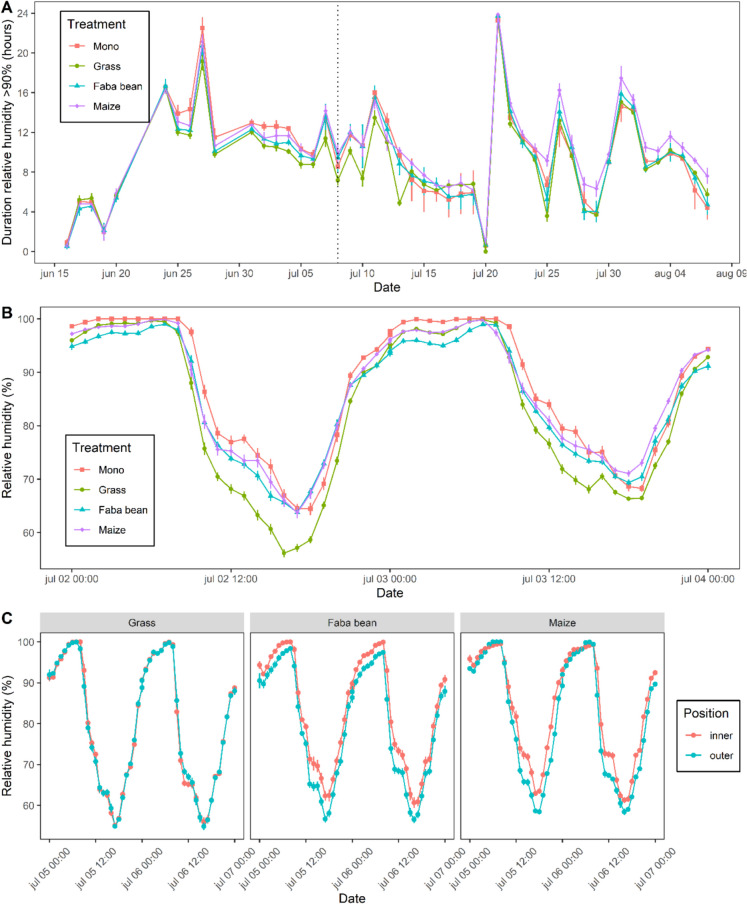
Intercropping has been shown to suppress diseases in many crop-pathogen combinations and could be a component of more sustainable integrated crop protection. While various disease-suppressive mechanisms have been proposed, it remains unclear how different companion species influence these mechanisms, and whether trade-offs or synergies exist between them. Field experiments were conducted in the Netherlands to study various disease-suppressive mechanisms affecting late blight epidemics in potato strip-cropped with contrasting companion crops (grass, faba bean, or maize). Strip cropping significantly altered the microclimate in the potato strip; relative humidity was lower in potato-grass than in the potato monoculture, whereas the humidity was increased in potato-maize, especially later in the season. Strip cropping with faba bean did not significantly change the microclimate. Furthermore, potato-maize intercropping received the lowest number of particles over the growing season (a proxy for incoming spores). Strip cropping had little to no effect on potato plant morphology or canopy structure. Grass as a companion created drier conditions in the neighbouring potato canopy making it less conducive for disease development, while maize formed a barrier for spore dispersal though it increased humidity later in the season. But the barrier strategy appears a less certain approach across growing seasons, as it relies on the companion crop reaching sufficient height before the epidemic begins, but the timing of the epidemic is unpredictable and may be very early. This study offers insights into how companion species with specific traits can assist disease control in strip cropping.

Supplementary information: The online version contains supplementary material available at 10.1007/s10658-025-03073-6.

Keywords: Disease suppression; Disease-suppressive mechanisms; Intercropping; Potato late blight; Strip cropping.


Figures

Fig. 1
Fig. 1
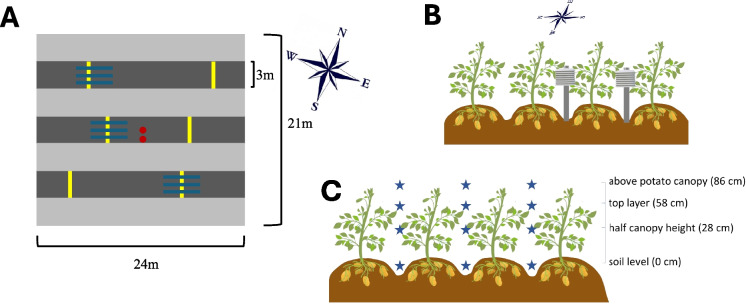
A Schematic arrangement of one experimental strip-cropping plot. Strips of each crop species were 3 m wide, and all strips were oriented from east to west. The plots had a size of 21 m × 24 m. The dark grey strips in the schematic arrangement represent potato, and the light grey strips either maize, grass or faba bean grown as a companion species. The yellow lines perpendicular to the strips represent transects for making disease assessments and measurements of crop height. Each transect consists of four plants, one per row. Transects were placed at random locations in each strip. Red dots indicate the position of the microclimate sensors. Blue lines parallel to the strip indicate where measurements of light interception were made with the SunScan (a 1-m long probe). B Side view of the placement of the microclimate sensors. Sensors were placed in the furrow between the potato rows. They were positioned roughly at the midpoint of the height of the canopy and the position was adjusted upwards throughout the growing season as the potato canopy grew in height. C Cross sectional view of the positions of the light interception measurements (the SunScan probe was directed parallel to the rows). Measurements with the Sunscan were made in three strips in each plot and per strip in three furrows and in each of these locations at four heights. The heights were: above the potato canopy (86 cm from the top of the soil), within the top layer of the potato canopy (58 cm), at half the potato canopy height (28 cm), and at soil level (0 cm)
Fig. 2
Fig. 2
Overview of the treatments, the investigated disease-suppressive mechanisms, their related measurements and the hypothesised effects of the strip-cropping treatments compared to potato monoculture. The symbol ↑ indicates that the variable was hypothesized to be higher than in the monoculture, while ↓ signifies that it was expected to be lower. The symbol = is used when the variable was not anticipated to deviate significantly from the monoculture, and ? indicates uncertainty in forming a hypothesis. The canopy illustrations are for illustration only and do not accurately represent the actual height-to-width ratios
Fig. 3
Fig. 3
Disease progress curves for potato late blight on potato during the 2022 growing season at site A (A) and site B (B), modified from Homulle et al. (2024). The points (symbols) represent the mean disease severity per plot based on visual observations on 24 plants per plot. The lines are drawn between the midpoints of the two plots for each treatment
Fig. 4
Fig. 4
Relative humidity in the potato canopy for potatoes either grown in monoculture (Mono), or strip-cropped with grass, faba bean, or maize. A Daily hours with relative humidity equal to or exceeding 90% for each treatment across a part of the growing season. Vertical dotted line marks the first detection of late blight. B Hourly relative humidity for each treatment between 2 and 4 July; the time around which the first infections took place. C Hourly relative humidity of the inner and outer rows of potato strips in the strip-cropping treatments between 5 and 7 July
Fig. 5
Fig. 5
Particle counts in the potato canopy in potato mono (Mono), potato-grass, potato-faba, or potato-maize over the growing season, as an index for the barrier effect of the companion crop. Particles were sampled using Vaseline covered glass slides in passive spore traps placed in each plot. The vertical dotted line in A marks the first detection of late blight. A Particle counts on measurement days over the growing season. Stars indicate a significant difference between the strip-crop and the monoculture on a given day; top asterisk (green) for potato-grass, middle asterisk (blue) for potato-faba, and bottom asterisk (purple) for potato-maize. B Cumulative counts of measurement days across the season and their standard error. C Particle count in the potato canopy in relation to the height of the companion crop. Dots represent average particle counts per spore trap per day. The line represents the estimated regression: exp2.86-0.0013x, where the slope is not significant (p = 0.063)
Fig. 6
Fig. 6
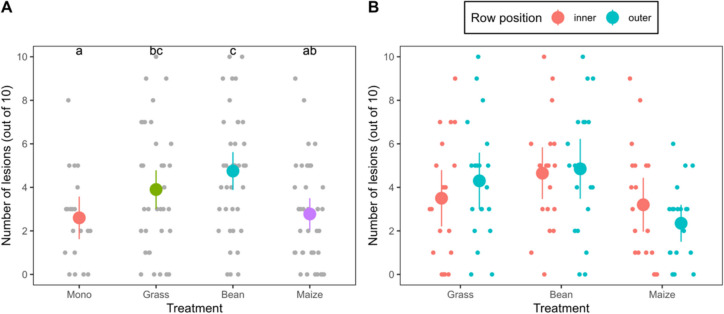
A Number of lesions out of 10 inoculations in detached leaf assays with leaflets from field-grown potato plants grown in monoculture (mono) or strip-cropped with grass, faba bean, or maize. Large circles represent the means and error bars indicate the confidence interval. The smaller points represent measurements on individual leaflets. Letters indicate significant differences between treatments at P < 0.05. B Number of lesions separately for inner and outer rows of potato strips in the strip-cropping treatments
Fig. 7
Fig. 7
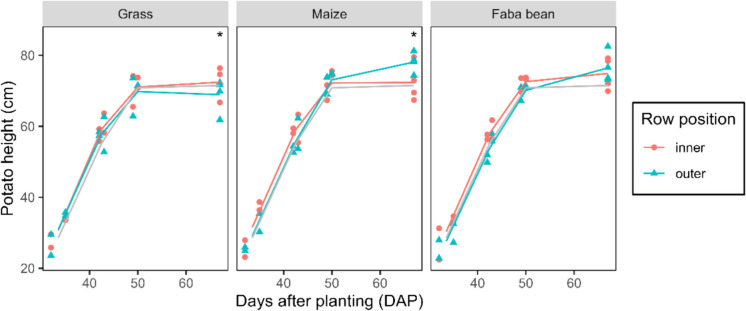
Height of potato plants in the inner and outer rows of potato-grass, potato-faba bean, and potato-maize across the growing season. Points represent the mean height of the potato plants in a plot, and lines represent the mean heights per row position. The grey line represent the average potato height in the monoculture for reference. Asterisks indicate significant difference between inner and outer rows (p < 0.05)
Fig. 8
Fig. 8
A Specific leaf area (cm2/g) from potato plants grown in monoculture (mono) or from potatoes strip-cropped with grass, faba bean, or maize. Large circles represent the means and error bars the confidence interval. The smaller points represent the average SLA per plant. Letters indicate significant differences between treatments at P < 0.05. B Specific leaf area of potatoes from inner and outer rows of the potato strips in the strip-cropping treatments. Asterisks indicate significant differences between inner and outer rows within a treatment at P < 0.05

References

    1. Ahn, E., Odvody, G., Prom, L. K., & Magill, C. (2020). Leaf angle distribution in Johnsongrass, leaf thickness in sorghum and Johnsongrass, and association with response to Colletotrichum sublineola. Scientific Reports,10(1), 1. 10.1038/s41598-020-79473-x - PMC - PubMed
    1. Alonso-Villaverde, V., Boso, S., Santiago, J.-L., Gago, P., Rodríguez-García, M. I., & del Martínez, M. C. (2011). Leaf thickness and structure of Vitis vinifera L cv Albariño clones and its possible relation with susceptibility to downy mildew (Plasmopara viticola) infection. OENO One,45(3), 3. 10.20870/oeno-one.2011.45.3.1492
    1. Anten, N. P. R., Alcalá-Herrera, R., Schieving, F., & Onoda, Y. (2010). Wind and mechanical stimuli differentially affect leaf traits in Plantago major. New Phytologist,188(2), 554–564. 10.1111/j.1469-8137.2010.03379.x - PubMed
    1. Atkinson, C. T., Roy, K., & Granthon, C. (2019). Economical environmental sampler designs for detecting airborn spread of fungi responsible for rapid `Ōhi` death. In Economical environmental sampler designs for detecting airborn spread of fungi responsible for rapid `Ōhi` death: Vol. HCSU-TR087 (Other Report HCSU-TR087; Hawai`i Cooperative Studies Unit Technical Report). University of Hawaii at Hilo. http://pubs.er.usgs.gov/publication/70202226
    1. Aylor, D. E., Fry, W. E., Mayton, H., & Andrade-Piedra, J. L. (2001). Quantifying the rate of release and escape of Phytophthora infestans sporangia from a potato canopy. Phytopathology,91(12), 1189–1196. 10.1094/PHYTO.2001.91.12.1189 - PubMed

LinkOut - more resources